



About Guild Articles
Find practical, solution-oriented information—on design, development, management, technology, and executive matters—that you can use to make well-informed business decisions to ensure your organization’s success with learning.
-

The Impact of Learner Data on Adaptive AI-Driven Learning Systems
Adaptive AI-driven learning systems are transforming higher education by offering personalized learning experiences. Central to their effectiveness is the integration and analysis of learner data. This article examines how various types of learner data contribute to the performance and efficacy of adaptive learning systems. We explore data sources, methodologies for data analysis, implications for instructional design, and ethical considerations, offering a comprehensive view of how data-driven AI enhances learning outcomes. Further, we analyze the current landscape, implementation case studies, and future prospects for data-enhanced adaptive learning in academic institutions. Introduction The evolution of artificial intelligence (AI) has led to the…
-

Beyond Click-Next: How Test Automation Can Revolutionize Learning Technology & Improve User Engagement
Introduction: The hidden quality problem in learning technology Learning platforms have evolved at a significant pace by integrating adaptive learning, AI-driven recommendations, and immersive experiences to engage learners. However, there is one critical issue that goes unnoticed often: quality assurance (QA) and reliability testing in learning technology. When L&D (learning and development) systems exhibit broken interactions, slow content or failures in accessibility, user engagement plummets. Research has shown that adoption of digital learning drops by up to 60% when platforms exhibit usability issues. Despite this study, a lot of organizations still tend to focus more on the content creation aspect…
-

Understanding the Scope of Learning Technology
Learning technology is constantly changing, and keeping up with all the changes is almost a full-time job. We spoke with attendees at DevLearn 2024 about their takeaways from the event, and they were amazed at the amount of technology on the market today and what it can do. Embrace technology at your organization Attendees were wowed by the scope of technology that exists today and how much of it they were unaware of before the event. One attendee even said, “There’s a lot that I don’t know and a lot that I can know.” Another attendee encouraged organizations to…
-
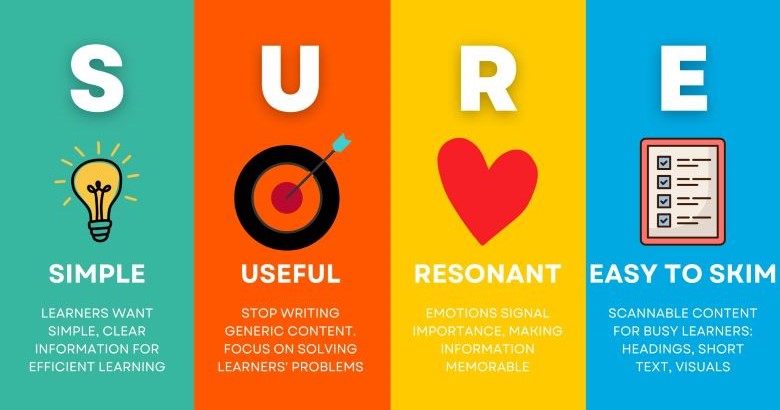
The Magic Formula for Learning Content That Actually Changes Behavior
We’ve all been victims of bad training. But what if there were a formula to create learning experiences that would not only keep people awake but actually transform how they work?Good news! That formula exists, and it’s as easy as remembering one word: SURE.
-

How Your Peers are Using AI
There’s no question that the use of artificial intelligence (AI) in learning and development is a topic being explored by just about every L&D professional right now. But have you ever wondered how your peers are really using AI every day? At the 2024 DevLearn Conference & Expo, we asked attendees about their AI use and discovered that it’s being used in a variety of ways: Writing scripts & code Some attendees found AI to be a time-saver in writing code for projects that they are working on. Also, they mentioned using AI to write scripts that they’re using to…
-

If Leadership Training Isn’t Applied, It Hasn’t Happened
L&D leadership training sessions often “feel” successful. A program is designed, a workshop is delivered, and employees leave feeling informed and engaged. But if that training isn’t applied in the workplace, did it actually happen? If we focus entirely on the “learning” but not the “development,” we’re wasting huge amounts of time and money. So let’s take a look at the current situation first. The reality is stark; according to Harvard Business Review: That first stat is astonishing. Only 12% applying their learning? We wouldn’t accept that return for many things in life. These numbers together expose a harsh truth—that…
-

Boost Workflow Learning with In-Product Tours
Have you ever invested months building comprehensive training content, only to discover that almost nobody was using it? At Pigment, a business planning platform, we faced this exact challenge. Despite our robust Pigment Academy featuring video tutorials, eLearning courses, and practice activities, the majority of our users—particularly the business users representing most of our user base—simply weren’t engaging with the training. The problem wasn’t with the quality of our content. It was that users weren’t going to the Academy in the first place. This realization prompted us to fundamentally reimagine our approach to training—shifting from traditional, segregated courses to in-product…
-

Skilling Up for AI Transformation
By Megan Torrance and Lauren Milstid Back in the summer of 2023, the AI buzz was loud and growing louder by the day. In nearly every conversation, learning leaders were asking versions of the same question: How do we get our people ready for this? Not just ready to click through a webinar or try out a chatbot, but really ready—to use it, adapt with it, and lead with it. Spoiler: It’s not just about training. It’s about transformation. And not the kind that happens overnight. In fact, it’s ongoing. Lately, I’ve been in a lot of conversations—some casual, some…
-

Microlearning Secrets from Marketers: How to Make Learning Stick
The attention economy has changed everything. People are bombarded with content, distractions are endless, and companies are fighting harder than ever to keep audiences engaged. Marketers have mastered the art of grabbing attention and making messages memorable—something many Learning & Development (L&D) teams struggle with. One solution? Apply marketing principles to microlearning. Marketers know how to craft concise, compelling messages that resonate with audiences in seconds. When learning professionals adopt these same tactics, they can create short, high-impact learning experiences that stick. The most effective marketing campaigns follow clear, proven strategies—something I’ve observed firsthand in senior marketing roles at companies…
-

From AI to Accessibility: Interview with Guild Master Diane Elkins
DevLearn 2024 celebrated Diane Elkins as Guild Master for her L&D impact. From resume writing to co-founding Artisan Learning, she finds purpose in helping people work better. Elkins has mixed feelings on AI’s role, excited by accessibility potential but cautious about writing quality. She sees a future prioritizing accessibility in L&D.