


Instructional Design
Applying learning theory and design strategies to meet specific performance goals through the creation of instructional materials and formal learning experiences.
-
Inaugural Learning & Performance Tech Week to bring together learning professionals across a wide variety of industries
Learning Leadership and DevLearn will run consecutively in Las Vegas from November 2 – 6, connecting professionals across strategy, design, technology, and practical application New York, NY – October 22, 2026 – The inaugural Learning & Performance Tech Week will bring together professionals from across the learning field, including learning and talent development leaders, instructional designers, customer education professionals, higher education teams, and those working across performance, skills, data, measurement, and learning technology. The week will combine two events at MGM Grand in Las Vegas. Learning Leadership will take place from November 2 – 3, followed immediately by DevLearn Conference…
-

As AI Reshapes Work, Are We Developing the Judgment It Demands?
If organizations increasingly need people to contribute judgment and critical thinking, those capabilities cannot remain aspirations attached to the AI productivity story. L&D can help ensure that as AI changes the work, people are still developing the judgment to do what matters most.
-

Beyond the FAQ: How Customer Education Creates Lasting Value
Mark Oehlert, Director of Customer Education at Qualtrics, has worked across internal L&D, government training, and customer-facing education. In this interview, he discusses what changes, and what remains the same, when your learners are customers, why customer education metrics can provide a sharper view of impact, and how organizations can move beyond quick answers to create learning experiences that drive deeper engagement and value. He also previews his DevLearn 2026 session on what internal L&D teams can learn from customer education, and vice versa. Q: How did you get your start in learning and development? A: Yeah, you know, pretty…
-

Using Targeted Universalism to Find Hidden Barriers in eLearning
One goal can have more than one path. Sometimes better learning design begins by noticing who the path was built for.
-
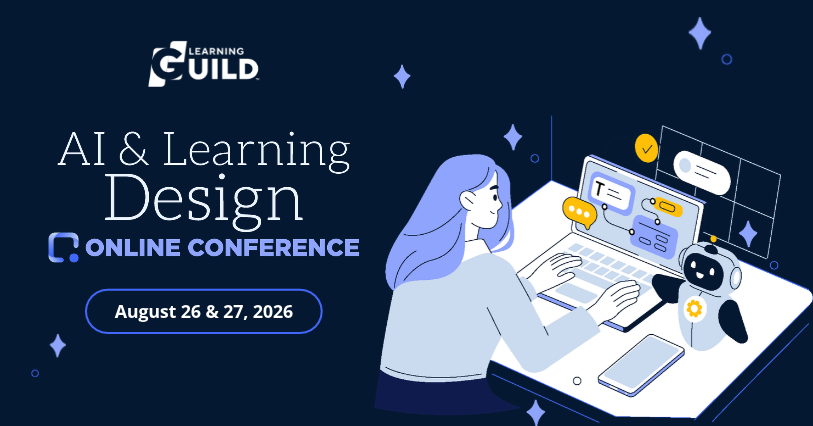
Use AI Effectively & Safely in High-Risk Environments
This session explores the practical boundaries between human decision-making and AI-supported work in instructional design. It introduces a clear distinction between traditional automation and generative AI and examines how each can be used effectively without compromising accuracy, compliance, or defensibility. Grounded in experience across military, education, and DOE-aligned training environments, this session focuses on the realities of designing training in high-consequence, regulated contexts where decisions must be auditable and outcomes must be defensible. Through real-world examples and contrasting use cases, we will explore where AI can act as a true force multiplier, where it introduces hidden risks, and how to…
-
Getting Real About AI in Professional Coaching: What to Do & What to Avoid
We will examine what worked really well and what didn’t. I will share outcomes that surprised us as I walk through our design decisions and show where we saw genuine value, where AI fell short, and what we would do differently. You’ll map your own programs against an AI-readiness framework and receive a downloadable AI Coaching Integration Checklist, a practical one-page tool that walks through key questions to ask. You will leave with:
-
Tame SME Chaos with an Efficient AI‑Powered Workflow
This practical session introduces an AI-powered workflow for transforming unstructured SME input into a clear, usable learning blueprint while keeping instructional judgment firmly in human hands. Using real-world case examples, the session demonstrates how AI can be applied at three key points: We will examine examples of AI outputs that worked well and those that missed the mark to highlight common pitfalls, lessons learned, and best practices. You will practice identifying gaps, challenging assumptions, and using instructional design principles to refine AI?generated analysis. We will emphasize transferable prompts, review strategies, and safeguards that you can apply across tools and organizations.…
-
Diagnose, Then Design: Using AI to Close the Gaps Training Alone Can’t Fix
This session draws from real-world application in a financial services environment to explore how to use AI as a reasoning partner in performance diagnosis. Throughout the session, you will work through a four-part framework, apply it to a real challenge from your own organization, and leave with a clearer picture of what’s actually blocking performance and what kind of intervention will actually help. You will learn to:
-
Cognitive Design for AI-Powered Learning
Through structured scenario analysis, live decision mapping, and guided redesign exercises, you will apply the model to decisions affecting AI-assisted content drafting, assessment generation, feedback automation, learner use of AI for synthesis, and performance support design. You will redesign one AI-enabled learning flow to strengthen independent reasoning rather than unintentionally weaken it.This session is not about resisting AI. It is about designing AI-powered learning that builds durable expertise. You will learn how to:
-

Strategic Pauses: 4 Event Boundaries That Protect What Learners Just Learned
Without event boundaries, nothing tells working memory to consolidate what it just processed