This article is a continuation of my interview with Nick Floro;the first part of the interview appeared in Learning Solutions Magazine on October6, 2016. In case you missed that part, Nick is the president of Sealworks Interactive Studios. The eLearning Guild recognized him as a Guild Master atFocusOn Learning 2016 Conference & Expo.
In this part of theinterview, I asked Nick to give his thoughts about what new eLearning designersand developers should focus on and the value of iterative design anddevelopment. The interview has been edited for clarity.
Pamela S. Hogle: Many of our members and readers arerelative newcomers to eLearning—new eLearning designers or developers or evenpeople with little experience in either of those areas. What suggestions oradvice can you offer them for launching an eLearning initiative in theircompanies or organizations and for creating engaging content, often on a tightbudget?
Nick Floro: Welcome to an amazing worldof learning! I believe one of the biggest hurdles to overcome and understand isthat there are so many amazing ways to create learning today that you need tofocus on what is best for your audience, what’s possible in your timeline, andwhat tools you have. I would highly recommend adopting a model that is flexibleand lets you test, gather feedback, launch, gather feedback—and that allows youto change and adapt to your audience’s needs with each iteration. Too often, weselect a technology, a workflow, or a technique, and we forget to look up as wecreate a factory to push out the “learning.”
Youalso need to constantly look outside at what others are doing; the Guild offersan amazing resource at each event’s DemoFestand an online library where you can see hundreds of examples,along with insight into the challenges and techniques, as well as the benefits,of each project. This is such a great way to learn what worked and what didn’t,and to quickly build a library of ideas and examples of what is possible. Ifyou launched a project this year, submit it for DemoFest and share what worked,what didn’t, and how your project helped improve learning with your audience.
Ihad the opportunity to participate in and attend the Hyperdrive eventlast year at DevLearn [2015], and it was another great way to see, hear, andlearn about what is possible in learning. One particular presenter, Ravi Singh,presented a great example—Mobile Performance Support System—which won.
Inthis learning project, they combined a mobile device with QR codesto provide just-in-time learning. It was a great example of how a simplesolution can equal big results. They ended up reducing costs dramatically bytraining staff on site. If there were, say, seven pieces of equipment, if thered lights were on the third area, they’d just scan that code and the videowould go right to telling you what to do to correct the problem; instead oflooking through a 200-page manual or asking someone or calling for training,they were able to get the information instantly. It was just so simple; it wasa beautiful solution. It was so simple and cost-effective, and it providedsupport and training exactly when they needed it, based on what QR code theyscanned at each step of the actual process. Hyperdrivewill be back at DevLearn 2016, so it’s another great reason to attend the conference.
I would alsorecommend taking advantage of the amazing Guild community and all theopportunities to connect, whether on LinkedIn or via Twitter or a webinar, tolearn, explore, and share with your team what’s possible and test some newideas with your audience.
PH: Can you share any words ofwisdom on estimating time and cost for an eLearning project?
NF: Estimating time is an art, like design orcoding, where the more you do it, the better you’ll get at it. I’ve beenproducing projects for over 22 years, and every time we launch a new project,we always ask: What did we learn? What can we improve? What would we want toimprove?
Youalso consider looking at what works best for your organization and work flow,and I would encourage you to launch quickly, gather feedback, and change andevolve each offering when possible. Look at building in audience feedback: Talkto a set of users and ask them what they thought, what helped, and what you canimprove.
Asyou gain experience, you will get better and better at estimating. One bigpiece of advice: It’s never as simple as you think or as it seems, so if youare estimating a day, always [double] to allow for time to test, review, andevolve a concept. That is hard in most organizations, to get buy-in, but whenyou see improved results, it becomes easier to grow the concept.
PH: What causes projects to fail? What shouldnew eLearning designers or developers do to enhance their chance of succeeding?
NF: I feel like I am saying the same thingover and over, but it is so important to articulate it: Asking these keyquestions up front is critical. One of the big things you run into, especiallywhen you’re beginning your learning journey, is getting stuck in a pattern—youknow, using a particular tool, and the boss or stakeholder says “do this,” and youjust jump in and do it without thinking or asking questions.
Ithink that’s where we fail, because we’re not thinking “bigger picture” andwe’re not talking to the actual audience. We may not have that opportunitybecause of time crunches and everything else that we’re doing, but I think thatif we can stop and build feedback and communication into our workflows, askingsimple questions like, “Is this really the right way to do this?” will help.
Oneof the other things that I think we’re afraid of doing is using a simplesolution. I think it’s OK to launch with a web page, a PDF, or a text documentto provide learning. It doesn’t always have to be the clicky-clicky thing withthe audio; it doesn’t have to be a full 3-D animation. Based on what the needis, you might be able to use something else to help a particular audiencemember with that particular learning path. You might add a video or a scenario toa lesson. You might start off with a simple page of information, and thenexpand or add to it over a couple of phases. If there is an immediate need,think: How can I help my audience today,next week, and next month? You should also consider different audiencetypes—whether a user prefers to read, listen, watch, or participate—and how youcan build these types into your offerings.
Stopand think, and then ask. Don’t be afraid to try it.
Theother thing I talk about a lot in presentations is when the stakeholder comesin and makes a general statement. Make sure you ask and understand the need,challenge the assumption, and gather data to help design and develop the bestsolution.
Anexample we’ve heard over the past several years is, “We need everything to workon mobile.”
Butwhen we actually look at data on the audience, we discover they’re not thereyet. Either they don’t have mobile devices yet or they’re not using thembecause they’re not common in their workflow.
Wealso see in the industry that trends come in and out, and that it’s importantto understand what’s best for the audience because it may not always align withindustry trends. I feel that mobile is still important because devices aretransforming and the technology is evolving, so we look to design ourexperiences around mobile. If the audience is getting tablets or new laptopsthat include touch-based technology in six months—or two years—that’s when weneed to plan and design content solutions that will work both now and in thefuture.
PH: So, it sounds like you are saying to stop and ask the questionsrather than getting caught up in the technology or the tools or the way you’vealways done things.
NF: Yes. Question everything. Question everything, and focus onwhat the goal is or what the need is. Not “everyone’s doing mobile, so we haveto do mobile.” Or we think we know what the audience wants, but when we ask theaudience, they say, “No, we’ve got that. What we really need is…” and you’vespent six weeks building something that they don’t even need.
By talking to theactual users, and by getting feedback, we’re better able to judge. Often wejump to the next project, and we’re not able to measure. We see that 1,000people do it, but is that because they are required to do it? Did they getanything out of it? We need be better at understanding the need, the data, andthe results. We call them feedback loops. It’s talking to a series of actualusers to find out what’s working and what’s not. And then evolving our deliveryto help make it better for them. I love that because it helps us build anddesign better experiences.
PH: So that’s using iterative design.
NF: Yes. People get afraid because they think it’s going to takethem six weeks instead of two weeks to do it, but you’re not really working onit for six weeks. You’re iterating—it’s evolving. It might take three days tobuild it and then another day to add to it … or it might take weeks, dependingon the size of the project.
PH: I think people feel like that process is never finished becauseyou can always make something better. Maybe that’s what’s scary.
NF: That’s a great point, and we have to look at that. But at somepoint, we’re going to say it’s done and we’re going to look at it, whether it’sthree months, six months, a year, or when the next release is. In the old days,we’d build something and it would last for a couple of years. Today, we don’thave that luxury because things change so quickly and we are used to constantupdates and changes.
PH: Do you use agile methodology or otherconcepts from software design, such as interaction design strategy andpersonas?
NF: Yes. As a software development company, Ithink that having experience in traditional design and development will helpyou improve your process and strategy from brainstorming to launch. We test andmodify our workflow and, with each launch, reanalyze and look for ways toimprove our process. This is a constant evolution, and, while it takes time, Ibelieve we are now able to create solutions faster, at lower cost, and withless rework so we can focus on enhancing, improving, and expanding anexperience.
PH: Where are these most useful in eLearningcreation?
NF: I can’t get excited enough and encourageeveryone, if you are not currently sketching, wire framing, and prototyping inyour process, you need to take advantage of these techniques. The basic conceptis to allow you to illustrate through a simple drawing of a concept, anactivity, or a function, rather than in writing, so that you can get quickfeedback in person or via a shared experience either directly in person or viaremote review.
It’sso easy. The idea is that I am talking to a stakeholder about a project, andthey describe an activity. If you write down those notes in bullets, it looksgood, and you’re repeating it back to them. But if you sketch the idea, andthey’re saying that they want a picture—but they don’t have an idea what thequestion is. It might be two words or three paragraphs. Because you don’t havethe data when you start to sketch, you show them: You have some squiggly linesrepresenting a short question and some squiggly lines representing a longquestion, they are able to visualize what will happen if I deliver this to aphone vs. a tablet vs. a computer [Figure 1]. How much real estate do we haveto work with? So when you start to sketch out the interface and those differentobjects, it helps you to visualize the challenges and articulate them veryquickly so you don’t waste a week trying to build what they asked for. Workingtogether, then, you can say, “Here’s one way to do it; here’s another way.” Thenyou are able to focus more on that solution.
Themore you sketch, the better you will get; I’ve been amazed in sessions thatwe’ve done with the Guild first-time users to the concept—how good they are atit!
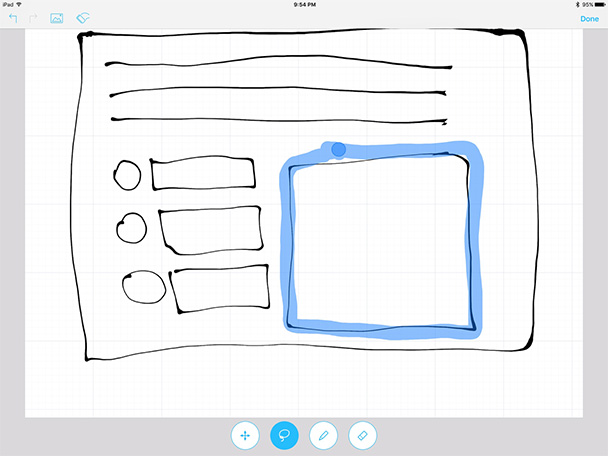
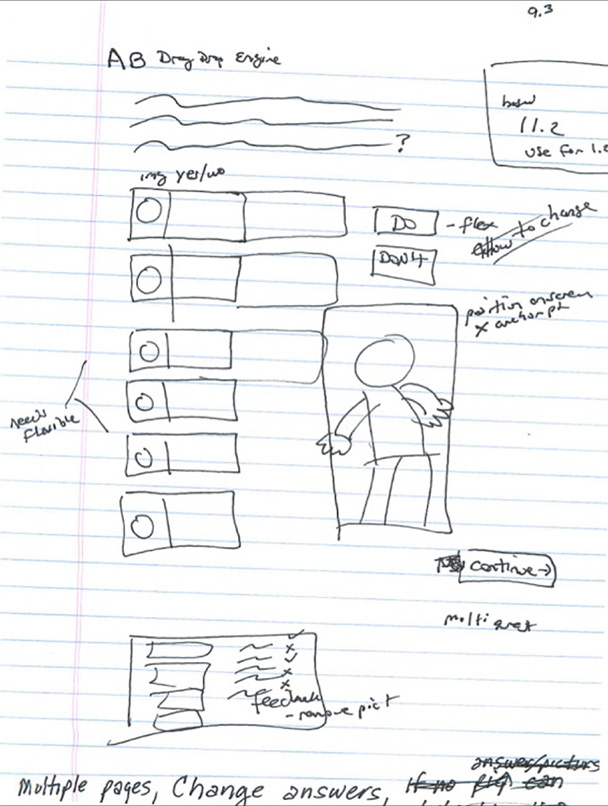
Figure 1: Two visualization sketches
Iwould also encourage, before you launch a tool, to use prototyping in a tool ora PDF to demonstrate and test a concept before you invest in development,because it will save time by getting audience and stakeholder feedback.
PH: Do you have any other advice to offer neweLearning designers?
NF: Attending Guild events keeps that excitement and inspiration andhelps you to imagine the next generation of learning. Participating in theGuild has been such a great experience, as an attendee and then as a participant,from speaking and collaborating through all the active channels that areoffered.
Ithink the first DemoFest we participated in, and we won an award, was severalyears ago when it was first launched. So we’ve been active and learning with TheeLearning Guild and community for a while now. I’ve learned so much, and I keepcoming back for inspiration and ideas as well as to share what we’ve learned.That QR code example we mentioned earlier: It was a great example based on theaudience, needs, and environment of how we can mix learning in an activeenvironment just when it’s needed. We’ve all been talking about QR codes, butI’d never seen such a great, practical example. That gentleman saved hiscompany thousands of dollars. It’s genius. It’s practical. It helps connect thedots of what’s possible and what’s useful.
Ithink that’s why DemoFest is so important to our community. I see that in the upcoming DevLearn 2016 Conference & Expo [November 16 – 18 in Las Vegas], youhave a case study [special focus], which is huge. I think it’s a great way tolearn. I always look for sessions to watch of people talking about what theydid, what worked, what didn’t work—so I can learn from their mistakes and whatthey did that’s positive, so I can use that in what we’re doing. It saves timeand money, and you get that practical advice, which I love.