
By Atefeh Ferdosipour
In recent years, cognitive science and educational technology researchers have repeatedly emphasized that some technologies—most notably artificial intelligence—inevitably raise serious concerns if they are not deeply connected to human nature and designed to be human-centered. In some cases, these concerns may outweigh the clear benefits that the technology provides in our daily lives.
AI has entered the field of education and educational technology at a breathtaking pace, creating significant competition not only at the level of microlearning tools but also across large-scale educational systems to “facilitate” active learning.
At the same time, increasing concerns have emerged in several domains. One of the most fundamental questions is: How does this widespread facilitation of mental processes and the completion of cognitive tasks in a fraction of the time impact learners’ cognitive skills in the long term?
For instance, whereas a student previously might have spent minutes to hours thinking through a problem or assignment, today, with large language models and ubiquitous AI tools, the same task can be completed in mere seconds.
At first glance, this achievement seems remarkable, as it saves substantial time and energy. Yet, the concerning question remains: What is the long-term cost to the learner’s potential cognitive capabilities?
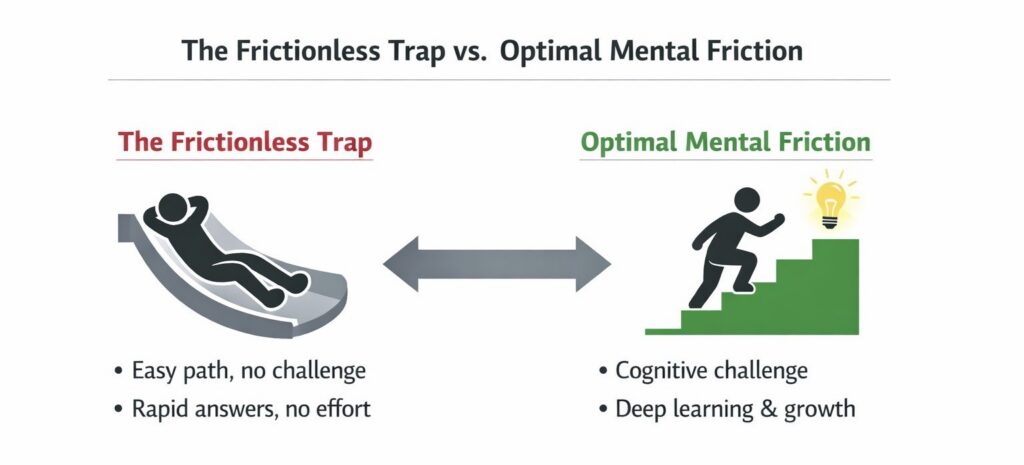
The “Frictionless Trap” and the Problem of Eliminating Cognitive Challenge
This concern can be framed under the concept I call the “frictionless trap.”
It refers to the removal of any mental challenge in solving learning problems through the use of AI.
The frictionless trap occurs when a single click provides access to a multi-thousand-page report in seconds. This situation, rather than solely indicating progress, is a cognitive red flag.
This “frictionlessness” results from eliminating any intermediary, scaffolding, or cognitive barrier between the user and the output. In this article, “output” refers to learning and problem-solving.
As an educational psychologist with years of teaching and research experience in human cognitive systems and deep learning processes, I believe that many AI systems bypass this deep learning process. Yet, because rapid results have always been a primary focus of technologists, the developers of the technology have overlooked this missing link.
Cognitive Friction, Neural Plasticity & the Cost of Learning
Neural plasticity, the brain’s ability to adapt and function in new ways, is not a passive or cost-free event; rather, it is an expensive outcome arising from cycles of effort, challenge, and cognitive strain. The output of this cycle is “deep learning.”
Based on this, the progressive concern can be summarized as follows:
When all cognitive friction is removed, although students may save time, genuine cognitive growth does not occur.
If we examine this issue through a research lens, to safeguard the future of human intelligence, we must stop treating AI as a “fast, high-yield machine.”
Instead, we need to design a substitute framework, which I refer to as AI-based intentional friction, a concept rooted in Lev Vygotsky’s theory of scaffolding.
The Biological Basis of ‘Difficulty’ or Friction in Learning
Neuroscience research indicates that during learning, the brain engages in a biochemical process at the level of neurons, involving the movement and synthesis of proteins.
In the initial stage, when the brain encounters new information with no prior pattern, cognitive load increases. This experience of challenge, confusion, or feeling “mentally stuck” is the essential friction.
In the final stage, if processing occurs correctly, chemical signals trigger structural changes in the brain, consolidating the learned knowledge.
Thus, deep learning cannot happen without passing through this biological cycle.
The key question arises: If AI is to think for humans or support human thinking, shouldn’t it be designed in alignment with human biological and cognitive pathways?
Vygotsky & the Discovery of the Missing Link in Learning
Vygotsky, the founder of the historical–cultural theory of development, differs from Piaget in that he transformed our understanding of cognitive growth from a rigid, internal process into one that can be influenced by the environment.
Decades after its proposal, the core concepts of Vygotsky’s theory remain highly relevant—especially for addressing one of AI’s deepest gaps: the lack of desirable friction. Their effectiveness depends on a deep understanding rather than superficial application.
The Zone of Proximal Development: Where Friction Meets Learning
The Zone of Proximal Development (ZPD) is the heart of Vygotsky’s theory and the focal point of this article. It describes the gap between what a learner can do independently and what they can achieve with environmental support.
Vygotsky explains this process through scaffolding: temporary structures that are built gradually and remain until the learner’s knowledge framework is complete.
In this pathway, cognitive challenge exists—but it is not abrupt or overwhelming. It is guided, structured, and biologically coherent.
Scaffolding vs. Cognitive Outsourcing
In contrast to Vygotsky’s scaffolding, what we observe today with AI is “cognitive outsourcing.”
Large language models have shifted the thinking process toward speed and efficiency:
- Cognitive challenge is eliminated
- Cognitive load does not develop
- The biological learning cycle is not activated
As a result, while problems may be solved, deep learning does not occur.
Designing AI Around Intentional Friction
At this point, the discussion moves from critique to active design.
To design human-centered AI, it must transform from a “responsive machine” to a “challenging machine.” This is what I call AI-based intentional friction.
This approach is directly aimed at instructional designers, platform developers, and AI tool creators—those who decide how a machine responds, not merely what it responds.
We need technologies that engage learners in cognitive challenge rather than simply obeying requests and filling knowledge gaps instantly.
AI Can Become a Mentor
AI can be a powerful mentor—but only when it is designed to behave like a human mentor and not just mimic one superficially. This means we must build models that understand context, listen actively, and adapt their guidance based on the learner’s unique needs.
AI should not replace human judgment; it should complement it by filling gaps where consistent human support is unavailable. When these conditions are met, AI can support learners in deeper, more personalized ways without losing the empathy and intuition that human mentors bring to the table.
Key Principles of This Approach
1. Shifting the Focus
We must shift focus from speed and ease to depth and durability of learning. For example, instead of providing a complete answer immediately, interactions can be designed to make learners pause, reflect, and reassess their assumptions.
2. Prioritizing Thinking
We must prioritize the thinking process over the final product. In practice, this could mean designing activities where reasoning, analysis, and decision-making steps are captured and fed back, even if the final answer is incomplete.
3. Position AI as a Mentor
Rather than view AI as a problem-solver, we should be positioning it as a mentor and cognitive partner. For instance, rather than giving a solution, AI might provide hints that guide the learner toward the next step, mirroring the support a human teacher offers.
4. Teaching AI Skills
We should be teaching students how to think and interact with AI before they use it. This could involve simple instructions, interactive examples, or initial restrictions on access to complete answers, emphasizing that the goal is better thinking, not faster results.
5. Using Scaffolding
Instructors should replace cognitive prosthetics with scaffolding. In real systems, this might involve staged responses, gradual feedback, and reduced machine support over time, progressively shifting responsibility for problem-solving to the learner.
6. Using Socratic Questioning
Students should be taught using the Socratic method of open-ended questioning. For example: In a science project, AI could ask questions like “Why is this the best option?” or “What evidence supports this claim?” guiding the student to follow their own reasoning path.
7. Delaying or Staging Responses
Rather than instantly returning complete solutions, AI “mentors” could, by design, provide staged and delayed responses. In language learning, for example, rather than instantly offering a translation, the AI tool would present translated sentences step-by-step, giving feedback after each stage, enabling learners to understand sentence structure themselves.
8. Creating Intentional Challenges
Creating intentional challenges enables development of critical thinking and creativity. In a science app, for example, rather than suggest easy solutions, the app could create challenges throughout the interaction flow. This would force students to follow a more analytical path to reach the correct answer—with the outcome that learners would simultaneously develop critical thinking and creativity, while respecting the biological cycle of neural plasticity.
Conclusion
Humans did not create AI to think for them; these technologies were developed to simplify life and support deeper human thought. AI and large language models can serve as partners and mentors—not just answer machines.
The absence of “desirable difficulty” or friction in AI interactions is among the most serious concerns for learning and instructional design experts today. This concern is not due to tool speed, but rather because the lack of friction bypasses or eliminates essential stages of the learning process that strengthen human cognitive and neurological foundations.
When machines respond effortlessly, the natural learning pathway described in Vygotsky’s ZPD and scaffolding is disrupted. While this may seem “efficient” in the short term, over time it can undermine higher-order cognitive skills such as problem-solving, critical thinking, and creativity.
To address this challenge and move toward human-centered, friction-based AI, current uses of AI in education must be reconsidered and the principles outlined in the design section implemented.
This shift is essential not only for course designers and platform developers but also for future learners themselves. Inspired by Vygotsky’s theory, AI can be designed to encourage challenge, growth, and cognitive effort, rather than merely providing quick answers.
The absence of desirable difficulty in AI interactions effectively ignores the biology of human learning.
The ultimate goal of using AI in learning should go beyond generating answers—it should aim to cultivate resilient, creative, and capable human minds, fully equipped to tackle complex challenges. This is what true deep learning achieves.
References
Bjork, R. A. (1994). Memory and metamemory considerations in the training of human beings. In J. Metcalfe & A. Shimamura (Eds.), Metacognition: Knowing about knowing (pp. 185–205). MIT Press.
Bjork, E. L., & Bjork, R. A. (2011). Making things hard on yourself, but in a good way: Creating desirable difficulties to enhance learning. Psychology and the Real World: Essays Illustrating Fundamental Contributions to Society, 56–64.
Ferdosipour, Atefeh. (2024). LLMs as a Modern Partner in Vygotsky’s Zone of Proximal Development.
Ferdosipour, Atefeh. (2026). Why Biological Learning Demands the Friction We Seek to Delete.
Ferdosipour, Atefeh. (2026). Is Your LLM Mentor Human Enough?
Fischer, G., & Bidwell, N. J. (2021). Collaborative Design: Leveraging Collective Intelligence and Human–AI Partnerships. Human–Computer Interaction, 36(5–6), 409–460.
Holmes, W., Bialik, M., & Fadel, C. (2019). Artificial intelligence in education: Promises and implications for teaching and learning. Center for Curriculum Redesign.
Karpicke, J. D., & Grimaldi, P. J. (2012). Retrieval-Based Learning: Active Retrieval Promotes Meaningful Learning. Current Directions in Psychological Science, 21(3), 157–163.
Kapur, M. (2008). Productive Failure. Cognition and Instruction, 26(3), 379–424.
Kasneci, E., et al. (2023). ChatGPT for Good? On Opportunities and Challenges of Large Language Models for Education. Learning and Individual Differences, 103, 102274.
Kohnke, L., Zou, D., & Zhang, R. (2023). Exploring generative AI for language learning: Opportunities and challenges. Computer Assisted Language Learning.
Luckin, R., Holmes, W., Griffiths, M., & Forcier, L. B. (2016). Intelligence unleashed: An argument for AI in education. Pearson.
Mollick, E., & Mollick, L. (2023). Assigning AI: Seven approaches for students, with prompts. Harvard Business School Working Paper.
Norman, D. A. (2013). The design of everyday things (Revised ed.). Basic Books.
Risko, E. F., & Gilbert, S. J. (2016). Cognitive offloading. Trends in Cognitive Sciences, 20(9), 676–688.
Selwyn, N. (2022). Should robots replace teachers? AI and the future of education. Polity Press.
Sweller, J., Ayres, P., & Kalyuga, S. (2011). Cognitive Load Theory. Springer.
Vygotsky, L. S. (1978). Mind in society: The development of higher psychological processes. Harvard University Press.
Wood, D., Bruner, J. S., & Ross, G. (1976). The Role of Tutoring in Problem Solving. Journal of Child Psychology and Psychiatry, 17(2), 89–100.
Image credit Elena Chernykh