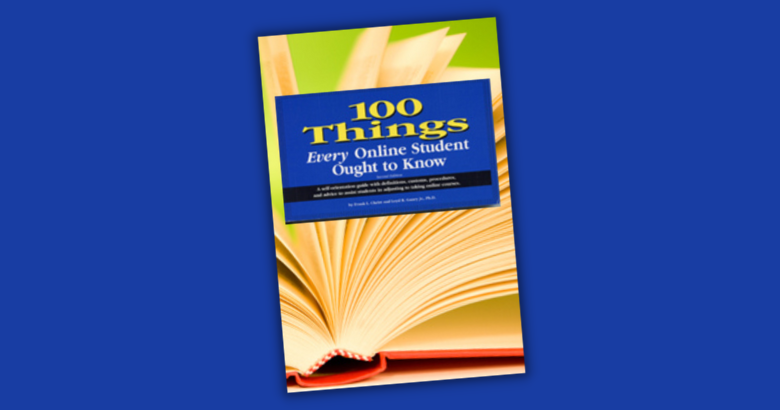
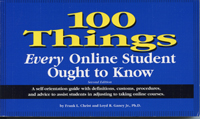
Some books are so simple, and so useful in concept, that we reallyhave to wonder why nobody wrote them sooner, and wonder how they escapednotice for so long. 100 Things Every OnlineStudent Ought to Know is one of those books.
 Themethods for delivery of instruction and education have changed, and so havelearners. Not only are there more educational opportunities online, in everincreasing numbers, but learners themselves are often older than students were ten,twenty, or thirty years ago. This creates some problems, not only for thelearners faced with a completely different environment from the educationalinstitutions they knew as “school,” but also for the institutionsthemselves.
Thissmall manual for adult learners intends to address the mismatches betweenexpectation and experience. While not perfect, it does an excellent job – and it’s much better than simplyleaving the older learners to shift for themselves, become discouraged, andgive up. I also think many of the tips in the book would benefit youngerstudents as well: those who have not formed study habits as well as they might have,and whose online skills may fall far short of what they assume them to be.
What’s so good about this book?
In the 224pages of 100 Things, there areactually 102 tips, and some extras. These “things” worth knowing begin with the mostbasic facts about online degree programs and courses (the increasing numbers ofthem, accreditation, and differences from traditional face-to-face programs).These facts should reassure the student who is doubtful about the quality,validity, and reliability of online institutions and their offerings.
For thestudents with less online experience (and such students are by no means rare,even today), there are sections that explain online access and communication.But Christ and Ganey go on to address the more critical challenges that canface online learners, regardless of age or online experience: onlinepreparation, satisfaction, and success; online learning and study skills andstrategies; how to benefit from online student support; and online “nono’s”. The book concludes with advice from students who have alreadysuccessfully dealt with these challenges.
What could be better about this book?
Therereally isn’t much thatthe authors could improve or fix, given this book is just supposed to be a basicself-orientation “help” for students, not a completetutorial. But here are the tiny points that they might address in a futureedition.
- Some of the information or terminology is a bit outdated(references to using diskettes for storage, for example). The Glossary isshowing its age, too, with some items that were out of date even in 2007(Netscape Navigator?)
- The “additionalresources” section (more reading or references) consists of books that werepublished as much as 14 years ago – and every one of them is a “dead tree” edition,with not a single online resource listed. Students pay plenty for books as it is, and it is hard to believe that they would want to buy even more books – especially ones that may be out of print.
- To be fair,there is also a lengthy “webliography” but I question how current theseresources are, whether they are still available online, and whether there mightnot be better online resources today (I am pretty sure there are).
- The physicalsize and configuration of the book isn’t ideal, in my opinion. It’s four inches byseven inches, bound on the short side, and it does not lie flat when opened –really awkward to use. I could argue that it ought to be available online, butthat might create an obstacle to its use by some students who need it most.There is now a Kindle version available, but I was unable to review it forpossible updates. List price on Amazon for the physical book ($20.30) seems high, but the Kindle version is only $9.95
Bottom line
Inspite of its minor shortcomings, in my opinion this would make a goodorientation guide for adult students who are uncertain about online education. Ibelieve much of it is too elementary for students who are already familiar withand comfortable with online learning and virtual institutions. However, havingsaid that, the sections on online learning and study skills and strategies, andon how to benefit from online student support, might well be of some value forstudents with weaker abilities in those specific areas. The concept might alsobe adaptable for use with training programs in business and government. If youare an online educator, 100 Things EveryOnline Student Ought to Know is at least worth looking at as apossible resource for your adult learners.
Bibliographic information
Christ, FrankL. and Ganey Jr., Loyd R. (2007) 100Things Every Online Student Ought to Know, 2nd Ed. Williamsville, New York:The Cambridge Stratford Study Skills Institute. ISBN 0935637303.
Available on Amazon.com: $20.30 forpaperback, $9.95 for Kindle Edition (October 4, 2010)
To orderthe book direct from the publisher:
Peter W. Stevens
President, The Cambridge Stratford Study SkillsInstitute
8560 Main Street
Williamsville, NY 14221
www.cambridgestratford.com
[email protected]
(800) 747-5614 (Voice)
(716) 626-9076 (Fax)