
By Deb Arnold
The struggle is real: Once you know something, it’s hard to imagine not knowing it—which impairs your ability to communicate (or teach) it to others.
Learning professionals may recognize the “curse of knowledge” as the cognitive bias that trips up subject matter experts who are trying to explain something to novices but can no longer remember what it’s like to be a beginner.
But L&D folks can also be blinded by the curse of knowledge in a context they’re not expecting, and when the stakes are high: while trying to convey the impact of learning programs. I’ve seen it hundreds of times while helping companies apply for learning awards. And when it comes to an L&D program, the more you know, the harder it can be to recognize what others don’t.
What’s worse, that particular curse is lurking around the corner regardless of the audience: Externally, it’s often award judges—or conference organizers or trade publication readers—who don’t know your industry, your company or your program. And internally, stakeholders don’t understand—or care about!—L&D terminology or priorities. But you are “cursed” with knowing all of it.
This visual may help:
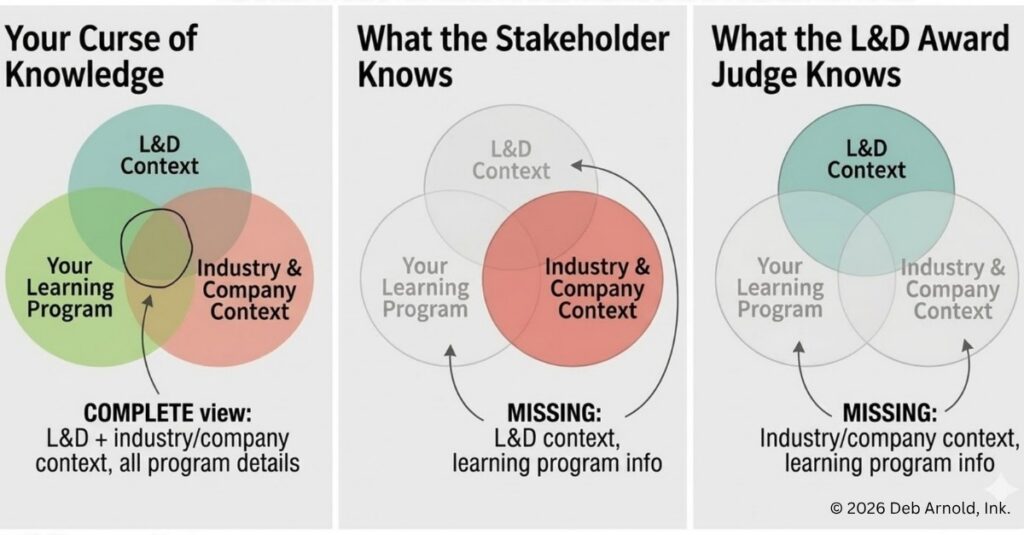
The good news: Over the 18+ years I’ve been helping L&D and talent leaders convey their impact, three key tips have surfaced as fundamental—and fairly easy—ways to break the curse of knowledge, no matter who you’re talking to.
Tip 1: Define the Problem Before You Present the Solution
Learning professionals often lead with their intervention —the program, how it worked, what it achieved — without first clearly establishing why it was needed. This is partly the curse of knowledge in action: After all, if you’ve been living with a business problem for months, its urgency may become self-evident to you. It won’t be obvious to your external reader, and it may not be totally clear to your stakeholders, depending on how far removed they are from your efforts.
Neglecting to lead with the catalyst for your program also makes for suboptimal storytelling. Every good story has a distinct beginning, middle, and end. Without all three, your stakeholder or award judge can get lost—or, worse yet, lose interest.
Good stories also have drama. Introducing the why behind your solution provides a dramatic beginning to your tale. Not all have to be as dramatic as these examples:
- Urgently needing to upskill thousands of consultants in AI to help guide clients through their AI transitions
- High-stakes expansion of a successful product line into three new global markets
- Skyrocketing attrition among new real estate agents due to a sagging housing market
Explaining in sufficient detail the BCOP (Business Challenge, Opportunity, or Problem, or “BEE-cop”) provides the lens through which everything else—the design choices, the investment, the results—can then be understood. Stating the BCOP up front also sets you up to share how you successfully addressed that challenge, opportunity, or problem at the end of your story. More on that in the third tip.
And remember to establish the BCOP with enough context that a smart outsider can grasp both what was broken and what was at stake: your industry, your company, even global economic and/or geopolitical forces at work. Defining up front what success needed to look like will also help you prove impact against specific goals.
Then, you’ll be ready to walk readers through the full story in order: Beginning (BCOP) → Middle (solution) → End (impact).
Tip 2: Speak Their Language—Not Yours
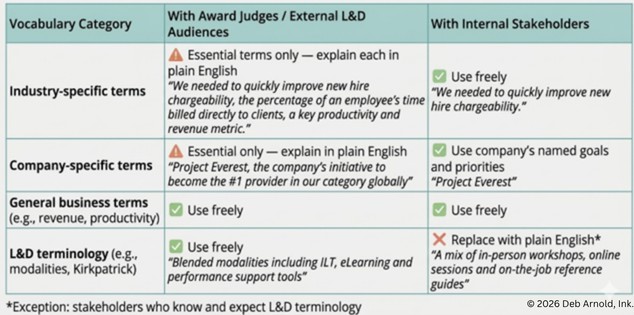
The curse of knowledge is dastardly when it comes to terminology. Our daily vocabulary is second nature. Learning folks speak learning, just like finance folks speak finance. But even though we know, in theory, that business stakeholders speak business, and not the language of learning, when we forget to translate for them, the effect can be devastating—they simply tune us out, and may then turn us down—for budgets, opportunities, true partnerships, and more.
The mirror image of this challenge with external storytelling is that we tend to forget that our audience doesn’t understand our industry and company issues, key metrics, acronyms, etc. That can mean the difference between winning an award and going home empty-handed, or a speaker proposal being accepted or rejected.
With both stakeholder and external audiences, using the terms that come most easily to us, regardless of how understandable they’ll be to others, is totally human. Fortunately, it’s also totally preventable—when we are conscious of the curse and actively work against it.
The handy table below can help direct our efforts.
Tip 3: Never Let a Number Speak for Itself
A client recently shared in an impact story draft that about 20,000 out of 80,000 agents had completed a learning program. Was that impressive? Why or why not? Without knowing the target completion rate or how that result compared to prior programs, it was impossible to tell.
That’s a problem with any audience, the most persistent L&D communication challenge I have encountered, and perhaps the curse of knowledge at its worst. Even when we do everything right and get great results, if we forget to explain how and why they’re great, we impress no one.
Numbers need context to be meaningful. So, always make significance clear by reporting results against comparisons: the goal you set, the prior year’s results, previous version of the program, industry benchmark, competitor results—whichever combinations make the result clearest and most compelling.
One example:
- Meh: The redesigned sales training program helped lift widget sales to $5 million.
- Awesome: The redesigned sales training program helped lift widget sales to $5 million, exceeding the goal of $4 million and beating the $2.8 million in new revenue generated after the previous year’s training.
When it comes to results, stakeholders and award judges (or other outsiders) may not need the same details. The significance of $5 million in widget sales may be obvious to the former, while a 50% response rate for a learner satisfaction survey will be impressive to the latter. Still, it’s best to play it safe and always share context that makes clear both the meaning and significance of your results.
Also: Be sure that your results match your BCOP. If the challenge was to increase revenue, the results should feature higher sales.
Breaking the Curse: Putting It Into Practice Makes Perfect
The essential step to break the curse of knowledge is to cultivate your awareness of it. This short question inventory can help.
Before You Write:
- Who exactly is my audience? Describe them—stakeholders, award judges, L&D peers at other companies—and keep them in mind with every sentence you write.
- Can I complete this sentence? “Against a backdrop of [economic, geopolitical, industry and company context], this program was created in response to [specific BCOP]. It was designed to help [learner audience] to [learning objective] and drive [specific business outcome(s)].” If not, sharpen your story before you try to tell it.
Before You Hit Send:
- Have I done a jargon sweep? Flag every term readers won’t recognize and either cut it, define it or replace it with language they will understand.
- Does every number have enough context? Verify that you have given the audience what they need to assess both whether the result is good and why it matters.
- Does my ending close the loop on my beginning? Prove that you have addressed the stated BCOP.
With vigilance, discipline, and the three tips above, you can break the curse of knowledge—and the payoff is significant. Learning teams that communicate impact clearly and compellingly don’t just win awards. They win budgets, strategic partnerships, organizational credibility, and the recognition their work deserves.
Show the Impact of Your Work!
The Communicating L&D’s Impact online conference, April 15-16, is the perfect opportunity to sharpen your data skills and learn to prove the impact of your work. Learn how to identify the metrics that matter, get tips on using tools to more effectively communicate the story those data tell, and uncover the connections between learning data and progress toward key business goals. Register today!
Image credit: gorodenkoff