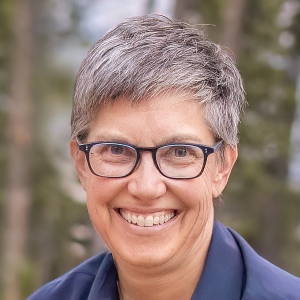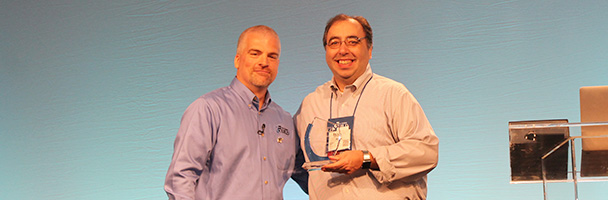
Nick Floro, the president of Sealworks Interactive Studios, has morethan two decades of experience developing eLearning solutions, applications,and web platforms. He sees himself as a “learning architect” who defines thevision of eLearning stakeholders and aligns it with the audience’s needs toprovide an amazing eLearning experience. Nick’s long involvement with TheeLearning Guild has been mutually beneficial. The Guild recognized Nick as aGuild Master at FocusOn Learning 2016.
I recently spoke with Nick about integrating new andemerging technologies into eLearning design.
Pamela S. Hogle: AseLearning developers get caught up in engaging learners with newtechnology—using touch screens, for example, rather than using an input devicelike a mouse—how can we ensure that learners with different abilities don’t getleft behind? For example, a tenet of user-centered design is that anything userscan enter with a mouse must also have a keyboard equivalent. How does thattranslate to a touch-screen universe? Is it possible to personalize content andgive learners greater control while also engaging a broad spectrum of learnerswith different disabilities and levels of technical competence?
Nick Floro: Wow,what a great question.
The key to accessibility or attempting to support everyplatform is that we need to realize that we do not normally have the time,budget, and resources to accomplish this goal perfectly. So we need tounderstand the technology, accessibility, and what is possible within a browseror app on a desktop vs. a mobile device vs. VR/AR/MR [virtual reality/augmentedreality/mixed reality] and what you want to accomplish within a particular deliverable.
It is essential to help the team and stakeholder understandwhat the challenges are, what the possibilities are—and guide them through eachphase of a project by communicating and demonstrating. Think, “How can wedefine the goal into a smaller, simpler, and achievable one,” and then plan howto develop the solution within your timeline.
Our primary objective with most projects, whether a smallaudience of 100 or a global audience of hundreds of thousands of users, is tomeasure the goals of the stakeholder while understanding and defining theaudience needs, and, if accessibility is a primary requirement, then designingcontent and activities that can support each type of technology and thedeliverable.
What does that mean?
- You may decide for each platform to offer aslightly different experience rather than designing the ultimate activity thatworks across all media and devices. That can be as simple as: If a mouse orkeyboard is detected, then present activity #1; if a touch-base device is beingused, then present activity #1 with slight modifications to its features; andif an accessibility-based technology is used, to offer additional supports toallow the user to maintain an amazing experience.
- You may decide to simplify an activity orproject in order to support more technologies. I’m still amazed that we hearthat users can’t scroll on a page or device because of older limitations we hadyears ago. Think about how many times you move your finger up or down whenvisiting a site or when you use your favorite social tool. It’s pretty natural,right?
- You need to build in time and resources to testconcepts and test the technology, and time to evolve a concept or go back tothe drawing board. This is hard to predict, but if you adopt this type ofworkflow, it will ensure improved results. You test it with actual users, thengo back and tweak the design or the concept. For example, we might want to usea scenario, but we learn that the audience really just needs a paragraph or apicture. Or maybe it would be really helpful to have a tool to help themunderstand the concept and how they can share it within their job role. Or wemight think a certain activity is best, but when we talk to the audience, welearn that they really need a tool, or they need something simpler—or we may bejust right. But at least then we have that validation.
Your goal as a learning architect is to understand theneeds, brainstorm the possibilities, and present the concepts to your stakeholder,along with data gathered by testing your idea with your audience.
One of the key things that scares us, when we bring thatinto our workflow, is that we think we have to interview 100 people. Performingan audience interview may sound daunting, but after you do a few, you’lldiscover it’s easy to adopt a simple, informal feedback loop where you:
- Demonstrate a concept with a simple sketch, wireframe,or early prototype;
- Ask simple questions that gather feedback thatcan be measured; and then
- Target 10 – 15 actual users that represent youraudience.
We’ve found that this is the magic number. You can use thesepeople again and again, and they love participating; they feel like part of theprocess. Ask them if they would participate again as you evolve a concept orproject, and take advantage of that. They become advocates to help communicatethe project and help you launch successfully, as well as a vital source offeedback to test an idea or concept. This is a win-win.
I love the idea—we don’t get enough time to do it, typically.If we’re launching a new program, we typically put it in the learning platformand think we’re done. But if you can connect with marketing or you takeadvantage of the feedback people, you can interview them or get a quick audioor video bite, or in writing: “Nick in Pennsylvania did it and he loved it.Why? It helped him do XYZ…” It helps to connect and build that need.
The other thing that we hear [about audience testing] is, “Ican’t do this because my content or my audience doesn’t fit.” I think that’strue in some areas. So, if you’re doing a certain type of training—like sexualharassment—that’s a requirement, and there’s a guide or a standard way, thatmay be OK. But if you’re doing something to help salespeople sell more productor learn about a new product, there may be a better way or a more fun way tocommunicate that data, or a tool that they can go back to over and over, ratherthan just throwing a PowerPoint at them.
Think about it, rather than jumping the gun and saying, “I’mgoing to build it in X tool.” Think about it and test it first.
PH: You havesignificant expertise in a number of tools used for designing and creatingeLearning content. Where would you suggest that new developers and designersfocus their efforts?
NF: I think it’simportant to understand and have a base knowledge of as many technologies andtools as possible at your disposal. I would encourage everyone to add some playtime to their schedule to test an idea, learn a new feature, and take advantageof all the resources around us to learn, grow, and experiment. This is achallenge, and it’s the first to get skipped when you are on a deadline, but ifyou can mix it in—30 minutes here, an hour there per month—you will improve inyour skills and knowledge and be able to design better solutions. This is wherethe Guild is such an invaluable resource.
PH: There’s a lot of buzz about personalized eLearning,microlearning, gamified content. What formats or types of content do you see asmost successful or useful now and in the near future? Why?
NF: The key hereis not to force a new concept or technology into a project, but evaluate: Whatare the possibilities? What is best for your audience? Then pilot and evolvethe concept, rather than saying, “We need XYZ today.”
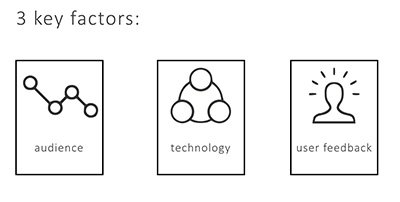
What I’ve observed is just like in other disciplines: What’sold is new again. When you see innovations, you need to analyze what’s best foryour team, your audience, and the technology that you have access to within theorganization.
When evaluating any new technology, be sure to ask:
- How will it help our audience?
- Is it a fit?
- Can we launch it with our timeline and budget?
- How can we do a pilot?
- Can we launch a pilot quickly and effectively?
Technology continues to evolve, and as a techno geek, I loveit! Every year, we see technology shrinking, getting faster and easier tointegrate and connect with each solution. The key is not to force it withoutevaluating whether it is a fit and whether it can help.
One of the most exciting technologies to me is mixed reality(Magic Leap), as seen and discussed at the Austin, Texas, Guild conference[FocusOn Learning 2016; view the replay]. There is so much potential for creating new interactions andthe next generation of experiences, so we just need to watch, learn, and keepit in mind as we move forward and see where it’s a fit in a future project.
PH: Where do yousee it fitting in? Are you integrating any aspects of VR or augmented reality intoprojects?
NF: This is kindof a trap. I’m very excited about that, but I try to be more practical, where Idon’t jump the gun. It’s easy to say, “I’d love to do that,” but to do it isgoing to require a large investment in hardware and development—and that’s notpractical to do every week or every month. But as a learning professional, Ithink it’s important to get excited and dream and think outside the box about,“Wow, this would be really great to do,” but not to lock in and say, “We’regoing to launch a mixed reality solution next week.” Because you may not havethe budget, or the technology is not practical everywhere yet.
Some of the words you threw out there: microlearning, gamification,video—those are a lot easier to implement in simple ways, and then see if it’sa fit with the audience, and then expand upon it.
At FocusOn Learning, the editor of Wired magazine [Scott Dadich] spoke, and he showed the [Magic Leap]video with the schoolkids and the whale—the whale jumped out of the gym floor, and the kids freakedout, and I thought, “That’s so cool.” I loved it and got so inspired!
Tim Cook talked about that yesterday [July 26] in the Apple Financial Results call—he talked about how important that is with this whole Pokémon craze.Keep it practical. Again, thinking: Is it a fit? Does it make sense? It’s funto get excited, but pop that reality hat on. Is this something we can do thisyear? In most cases, the answer is no, unfortunately. But it’s fun to think anddream and get bigger ideas. I love that, and I encourage my team to do that atevery opportunity. It’s something that they should talk about and think about.
I think that’s why DemoFestis so important. I see that in the upcoming DevLearn [November 16 – 18, 2016, in Las Vegas], you have a case study [special focus], which is huge. I think it’s a great way to learn. Ialways look for sessions to watch of people talking about what they did, whatworked, what didn’t work—so I can learn from their mistakes and what they did that’spositive, so I can use that in what we’re doing. It saves time and money, andyou get that practical advice, which I love.