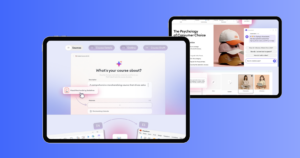
Too many times, evaluating the look and feel of a piece ofe-Learning is reduced to a love-it or hate-it subjective evaluation. With alittle thought, though, you can set objective criteria for your training’s lookand feel and create a framework for deciding when a look and feel is working,and when it is time to go back to the beauty parlor.
The “look” of learning is the combination of the interface design,design elements, copy style, typography, navigation, imagery, motif, underlyingmessages, and themes that give a program its identity. Good-looking learningsupports the content of the training by taking advantage of the naturalmessages and signals that are embedded in your material.
Here’s how to identify the messages flowing through yourtraining program and translate them into requirements for the look and feel ofthe program:
1. List the themes of your training
If you’re training users on how to use the new company-wide emailsystem, your themes are email, mail, letters, correspondence, documents, etc.If you’re training on forklift safety, your themes are: forklifts, pallets, shelves,trucks, moving, packing, boxes, injuries (or lack thereof), health, etc. Thethemes are simply what your training is about. Make this list as long as youlike.
2. List the themes of your organization
Take a step back and think about your company or department identity.I’m not talking about how the organization wants to be perceived, or what itwants to say about itself, but what it is actually about. Best Buy is about electronics,technology, and appliances. American Express is about money, finances, andtravel. Human resources is about payroll, promotions, and performance.
3. List the messages of your training
Earlier you listed the themes of the training. Now list themessages that should stick in the user’s mind after the training. Don’t worryabout being too literal here. In reality, your users will probably be unawareof these messages on a conscious level. No one is likely to finish your courseon the new email system and think, “The new email system is fast anddependable. I can count on it for my important correspondence.” But that mightbe just exactly the message you want to communicate. Writing it out in this waywill help you apply it to the look and feel.
4. List the messages of your company
Now include all that company propaganda you received during yourorientation. Your training will be better received if you can incorporate thereal-world messages of the company rather than the fake messages your company wouldlike to communicate. Target Corporation, for example is always “fast, friendly,and fun.” That’s a pretty easy company message to weave through your training.
5. Sort and weightyour themes and messages
Once you identify the themes and messages you need tocommunicate, it’s time to rank and sort them. Most designs can only communicatea few ideas effectively, so you need to spend some time ranking them. Keep onlythe top two or three in each category. Once you’ve got a good list culled, rankyour themes in order of importance.
6. Translate themesand messages into requirements
Once you’ve finalized your list of messages, translate the list intoa set of requirements for the look and feel of the course. You might say, forexample, “The look and feel must convey the message that Acme Brokerage isideally suited to upscale clients.”
7. Translate yourmessages into visual elements
Now translate your list of requirements into actual visual elements.To evaluate the look and feel of a program objectively, just ask yourself ifthe screen you are looking at satisfies the requirements.
For example, messages that need energy or fun demand brightercolors and relaxed icons and imagery. Illustrations should use softer linesthat are more relaxed. Unusual fonts, happy smiling people, and lots of white spaceall help communicate a sense of energy and fun.
Themes that revolve around trust and dependability need stronger,bolder colors and visual clues that invoke trust.
By creating a list of requirements, you create an objective frameworkfor evaluating the look and feel of a program.