Within the UK, a record number of teachers are leaving theprofession. In 2016, schools recorded a loss of 9.5 percent of staff, the highestlevel for more than a decade. In addition, the number of people choosing theteaching profession is in decline, with fewer people applying for teachertraining schemes. The impact of this has been an increased need for temporarystaffing solutions; schools now spend over £1.3 billion ($1.6 billion) annuallywith education staffing agencies.
Many of these substitute or “supply” teachers areunqualified, requiring only simple compliance procedures—such as backgroundchecks—to be able to work in a classroom setting.
The staff working in the 25,000 schools across the UK, manyof whom are now from overseas, require continuous professional development(CPD) to maintain standards outlined by OFSTED, the Office for Standards andEducation, the school regulation and inspection body. The high turnover ofstaff has increased the pressure on schools and education staffing agencies toensure individuals have opportunities to access personalized CPD when it isneeded most.
Schools do offer CPD, and education supply agencies doendeavor to train supply teachers before they are placed. However, thechallenge has been attracting sufficient attendance to face-to-face sessions,with feedback being that the location and duration of classes can make them difficultto commit to, particularly when they are not mandatory.
The skill gap/need
Having no teaching experience and being placed in a schoolto cover a teacher’s class can be very daunting. A wet and windy Fridayafternoon combined with a group of 35 14-year-olds and a word search to delivercan prove difficult, even for the most experienced teacher.
Knowledge of how students learn, strategies to engage aclass, and techniques to build effective professional relationships are essential.Without this, behavior will deteriorate, which has a direct impact on theprogress and achievement of children and young people, which in turn drivesdown educational standards.
The solution
What has been lacking is “on-demand” access to trainingcourses so that staff can have their development needs met when they need itmost, on any device—at any time.
TeachingCPD is an eLearning portal developed to provideregularly updated, on-demand CPD in the form of bite-sized modules. Each coursetakes between 30 and 90 minutes to complete and is self-paced and fullyinteractive, with a virtual tutor taking learners through important course content(Figure 1).
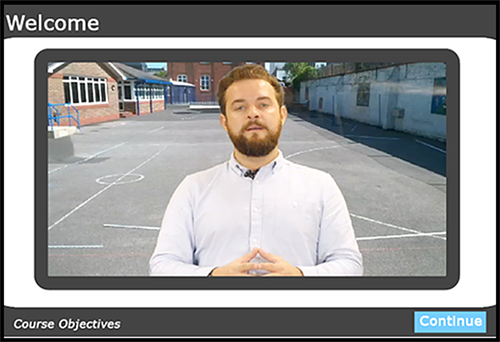
Figure 1: A virtualtutor takes learners through important course content
The online catalog (Figure 2) was developed to allow eventhe most inexperienced “teacher” the opportunity to develop essential skills inthe areas of:
- Safeguarding, child protection and prevent
- British values
- Equality and diversity
- How to be an effective supply teacher
- Special educational needs and disabilities(SEND)
- The UK curriculum
- Behavior management

Figure 2: The online catalog provided even inexperienced teachersthe opportunity to develop essential skills in important areas
A leading CPD accreditation provider, the CPD StandardsOffice, was used to ensure content and course design were both of a suitablyhigh standard.
The development
When selecting authoring software to begin course design,price was initially a major factor. Storyline and Lectora had features that werevery attractive, particularly Storyline with its intuitive user interface. However,price became a barrier to entry, as this entrepreneurial business idea was thusfar unproven; so the idea of spending over £1,000 on software wasn’t really aviable option at this stage.
The incompatibility between Storyline and Mac was anotherconsideration. Although Parallels was an option, there would then have been theadditional expense of Windows—costs were quickly adding up. Adobe Captivateprovided the flexible monthly subscription option and quick access to anindustry-standard authoring package with additional animation, video, andgraphic design functionality as part of the Creative Cloud.
Further research also highlighted that Captivate could publishin HTML5 and develop content that is responsive, allowing users to accesscourses on any device, which was a key differentiator for TeachingCPD.
Video was another important element of course design; theability to have a virtual tutor direct users through the material was animportant factor. TeachingCPD used a high-quality DSLR camera, with theintention of capturing high-quality footage that would be integrated into theSCORM content. However, it became apparent very quickly that having anexpensive camera is one thing, but having the correct lighting, background, andaudio is another thing altogether.
Various retakes took place in a variety of environments rangingfrom unused offices to an actual school setting. The idea of using a real-lifeschool environment was great in principle; however, in practice, it proveddifficult due to distracting background noise and inconsistent lighting.
Eventually, green-screen technology was utilized with high-qualitymicrophone and rented sound space to ensure the quality remained consistent andallowed various school backgrounds to be used, depending on the subject beingdiscussed.
Abode Premiere was utilized to edit the raw footage, andAudacity to ensure the audio was of the very highest quality.
Course development certainly had its challenges. AlthoughCaptivate had its advantages, the interface was far less intuitive than otherauthoring software on the market. Also, do not underestimate the importance ofa high-quality camera, microphone, editing software, and suitable recordingstudio. Looking back at some of the original draft recordings was quite embarrassing.
However, in the end, the result was a catalog of eight high-quality,immersive courses that were each dissected into bite-sized modules ensuringcourses could be completed in one go, or over a longer period.
To host the courses, TeachingCPD required a robust learningmanagement system (LMS) with many specific requirements, including:
- Branching—allowschools and education staffing agencies the opportunity to brand their own“learning community”
- Whitelabel—enable clients to customize the appearance, adding necessary branding
- Lowinitial investment—to keep costs low, there was a need to “try before youbuy” to create a vision of how the portal would look without investing moneyunnecessarily
- SCORM—abilityto upload engaging, interactive content
- Video—optionto add video of a virtual instructor to support learners through the course
- Reportingand tracking—monitor progress, particularly for mandatory modules, andreport on competency and completion
- Gamification—engagelearners with rewards, badges, and leaderboards
- eCommerce—integratedpayment solutions so education staffing agencies could sell courses should theychoose to
- Administration—cleaninterface and easy process to add and remove users
- Mobile—responsivedesign to fit any device
- Certifications—addcustomized branding to certificates for successful learners
After reviewing several portals, we selected Talent LMS, as itnot only met the initial identified needs but also provided options that wouldallow TeachingCPD to offer additional features to clients in the future. Forexample, “live” instructional CPD sessions were not a part of the initialportal offer, but had been identified as a development area that would appealto schools and education staffing agencies later.
The progress
Within five weeks, two education supply agencies had signedup to the subscription-based learning portal, with an additional three agenciessubscribing in the seven weeks that followed.
Each course had the ability for users to set personal objectivesand submit a survey that evaluated the course quality and learning experience. Overall,feedback was very good—not only from learners, but from the school leaders andagency consultants who had trialed the portal as part of the testing stage.
However, as with any new product to market, further changesare still taking place as part of an ongoing evaluation period. Governmentpolicy regularly evolves in the UK, which has meant some footage has needed tobe retaken to keep up with current legislation. In addition, one piece offeedback that has influenced future course development has been with the testmodules that were originally set to be retaken until a user passes. Commentsfrom clients indicated they wanted an actual test score, as opposed to simply100 percent completion; that way they could ascertain the quality of responsefrom the “teacher” as opposed to just finishing the course.
The next steps
The developments in eLearning software and relatedtechnology have allowed TeachingCPD to create a learning portal that provides asolution to a long-standing problem. For too long, unqualified staff with noformal training have been placed in schools to perform the vitally importantjob of ensuring the progress and well-being of young people.
“Pushing” people to learn these essential skills simply doesnot have the right effect—it is inconsistent and has little impact. More thanmost, people who work in schools want to develop, they want to get better, butoften can’t “pull” on the learning they need, where they need it, and when itis needed most.
Talent LMS and Adobe Captivate have played an integral rolein both the hosting and production of course material, resulting in asignificant number of people being better equipped to tackle the challenges thatexist in UK classrooms.
So where next? TeachingCPD hasn’t finished yet. Excitingplans are in motion for the evolution of a learning platform that can influenceeducational standards the world over. Watch this space.