



By Faith Steward
Picture it: Los Angeles, 2023. I was wrapping up a particularly tough week of course creation and evaluation design. After work, I wanted to unwind, not think about more learning.
So I did what I have done for more than 15 years: I put on The Golden Girls.
For anyone who has never watched the show, The Golden Girls is a sitcom about four very different women—Blanche, Dorothy, Rose, and Sophia—who live together in Miami. Their personalities could not be more different, but that is exactly what makes the show work. They challenge each other, complement each other, and make the group stronger because each woman brings something different to the mix.
That night, somewhere between scenes, I had a strange little revelation:
These four women could explain Kirkpatrick’s four levels of evaluation.
It sounds ridiculous, but it also worked.
I had been using Kirkpatrick’s model for years, and I had explained the four levels to colleagues and subject matter experts many times. But too often, SMEs were interested in only one level—usually whether learners liked the training or whether they could recall the content—and dismissed the others as unnecessary. Suddenly, I had a mental picture I could use to explain why that was a problem in a way that felt easier to remember.
Like the four women of The Golden Girls, the four levels work together to create a whole. Remove one, and the model no longer feels complete.
Blanche felt it. Dorothy learned it. Rose did it. Sophia proved it mattered.
I have been using that framework ever since.
Why This Connection Matters
The problem with course evaluation is not usually that learning professionals have never heard of Kirkpatrick. Most of us know the four levels. The challenge is knowing what evidence we actually need and resisting the temptation to stop at the easiest question: Did learners like the training?
A positive reaction can tell us something useful about the learning experience. But it cannot tell us whether people learned, changed their behavior, or produced a meaningful result.
That distinction matters to me because I do not design learning simply so people enjoy the experience. I want learners to understand the content, remember what matters, and, most importantly, use it to change their behavior. The four levels give us a way to look beyond the immediate experience and ask what happened next. The Golden Girls give me a way to remember what each level is actually asking.
Blanche: Did the Learning Experience Land?
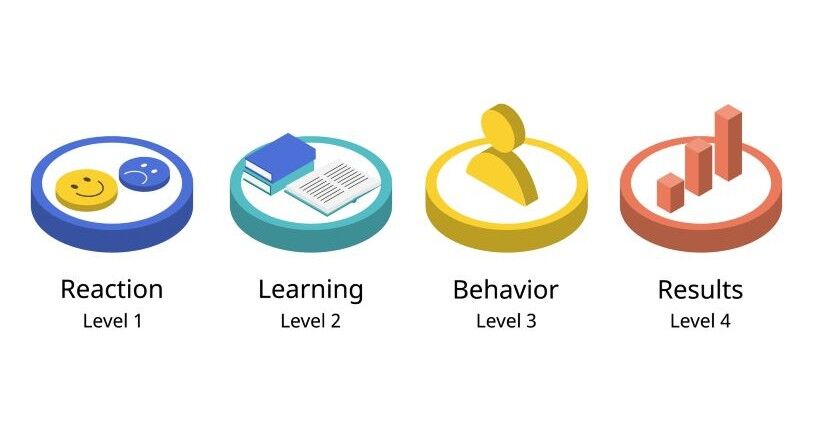
Blanche represents Level 1: Reaction.
Blanche is expressive and deeply attuned to how experiences make her feel. She notices the social experience, the atmosphere, and the emotional response. That makes her a surprisingly good stand-in for Level 1—but there is an important distinction.
Level 1 is not simply, “Did learners like the training?” A useful Level 1 evaluation looks at the learner’s reaction to the experience, including whether it felt relevant, useful, engaging, and supportive of what they were expected to accomplish.
So Blanche asks: How did the learner feel about the experience?
We might ask whether the learning felt relevant to the learner’s work, whether the experience was useful and clear, and whether it supported what learners were there to accomplish.
A learner can give a course a five-star rating because they loved the facilitator, the graphics, or the topic. And while this is useful information, it is not evidence that learning occurred.
And that is where Blanche has to hand the conversation over to Dorothy. Feeling positive about the experience matters, but it does not tell us whether anyone actually learned anything.
Dorothy: Did They Actually Learn It?
Dorothy represents Level 2: Learning.
Dorothy is practical, intelligent, analytical, and often the voice of reason in the group. She is not easily distracted by charm. She wants to know whether something actually makes sense.
That makes her perfect for the next question: Did learners acquire the intended knowledge, skills, judgment, confidence, or other learning outcome?
This is where we need to move beyond questions such as, “How confident do you feel in your understanding?” Confidence can be useful to measure, but confidence is not the same thing as learning.
A better question is: What can the learner now demonstrate that they could not demonstrate before?
Depending on the learning experience, evidence might come from a scenario-based decision, knowledge check, or work sample. The important part is alignment.
If the objective is for learners to recognize the best response to a difficult situation, a multiple-choice question about terminology may tell us whether they can memorize a definition. But it does not necessarily tell us whether they can recognize the right response when faced with it on the job.
Dorothy would probably have something to say about that. She wants evidence—receipts, not just opinions.
And once Dorothy has established that learning occurred, the next question becomes harder: Did anyone actually do anything differently?
That is Rose’s territory.
Rose: Did They Do It?
Rose represents Level 3: Behavior, and this is where the model becomes especially important to me.
Rose is innocent, optimistic, and sometimes wonderfully naïve. She can misunderstand a situation or approach something from a perspective the other women did not expect. But she is also sincere, values-driven, and deeply committed to what she believes is right. Her actions often reveal more about her than her words do.
That makes Rose a useful reminder of what Level 3 is really asking: Did the learning show up in what people actually do?
A learner can enjoy a course, pass the assessment, and tell you that the course was useful. Then Monday morning arrives, and the real test begins. Are they using the skill, making a different decision, changing a process, using the tool, or approaching a conversation differently?
That is behavioral change.
And you usually cannot measure it immediately after the course. Depending on the learning experience, you might follow up after learners have had an opportunity to apply the learning and ask what they have applied, what they are doing differently, what helped them apply it, and what got in the way. You might also use manager feedback, observation, work samples, system data, or other evidence that shows whether the behavior appeared on the job.
This is where a course evaluation can move from “Learners said they liked it” to “Here is what they actually did with it.”
And once we know what people did, Sophia wants to know what difference it made.
Sophia: Did It Make a Difference?
Sophia represents Level 4: Results.
Sophia is the group’s oldest and often wisest voice. When the other women are stuck, they turn to her. She tells a story, cuts through the confusion, offers an unexpected solution, or helps everyone see the situation differently.
Sophia does not just ask what happened. She wants to know what it means.
That makes her the perfect character for the question: Did the learning contribute to a meaningful result?
This is the level where we ask what changed beyond the individual learner. Depending on the learning goal, that might include fewer errors, improved quality, better customer outcomes, greater consistency, or other meaningful performance indicators.
But this is also where evaluation needs honesty. A learner saying, “This training helped me do my job better,” is not the same as evidence of a Level 4 result. And if a performance metric improves after training, that does not automatically prove that the training caused the improvement.
Sophia is asking the tougher question: So, what changed, and what evidence do we have?
You may not always be able to isolate the contribution of learning, but you can still identify the result it was intended to support and look for evidence that helps you understand whether it did.
Sophia takes us from “Something happened” to “Did it matter?” That completes the four-level picture.
The 4 Golden Questions
Blanche felt it. Dorothy learned it. Rose did it. Sophia proved it mattered.
Once I started using this analogy, I realized the characters could do more than help me explain the four levels. They could help me plan evaluation, too.
Before building an evaluation strategy, I always ask four questions:
Blanche: How Did It Land?
What do I need to know about the learner’s experience?
Relevance, usefulness, clarity, engagement, and whether the experience supported what learners were there to accomplish.
Dorothy: What Did They Learn?
What evidence would show that learning occurred?
Knowledge, skills, judgment, practice, demonstration, and performance.
Rose: What Did They Do?
What behavior should change after the learning, and how will I know?
Application, transfer, follow-up, observation, work samples, and manager feedback.
Sophia: What Changed?
What meaningful result was the learning intended to contribute to?
Performance indicators, quality, efficiency, customer outcomes, reduced errors, or other meaningful measures.
Put together: Blanche felt it. Dorothy learned it. Rose did it. Sophia proved it mattered.
That’s the framework I remember.
You Do Not Need to Measure Everything
More evaluation is not automatically better evaluation.
Not every five-minute microlearning module needs a four-level evaluation strategy. The right approach depends on what the learning is intended to accomplish and what evidence you need to make decisions about it.
Think about the Golden Girls. You would not ask Blanche, Dorothy, Rose, and Sophia to solve every problem in exactly the same way. Each has a different role to play, and that is what makes the group work.
Evaluation is similar. Use the questions that fit the learning goal, the behavior you are trying to influence, and the evidence you can realistically collect.
The goal is not to collect all the data you possibly can. It is to collect the evidence you actually need.
A More Memorable Way to Think About Evaluation
I never expected a sitcom I have been watching for more than 15 years to change the way I explain an evaluation model.
But the analogy stuck because the four women are different—and they work together. Evaluation works the same way.
Level 1 tells us about the experience. Level 2 tells us whether learning occurred. Level 3 tells us whether that learning showed up in behavior. Level 4 tells us whether the change contributed to something meaningful.
One level does not replace another. A great reaction does not prove learning. Learning does not prove application. Application does not automatically prove results. Each level answers a different question.
And sometimes the best way to remember these four questions is to stop thinking about four abstract levels and start thinking about four very different women sitting around a kitchen table in Miami, eating cheesecake.
Blanche felt it. Dorothy learned it. Rose did it. Sophia proved it mattered.
Image credit: Piscine


