As a training professional, you spend countless hoursfocusing on the best ways to prove the value of your training program, not onlyto your management team but also to employees.
If you’re reading this, you’re looking for a better approachto evaluating those programs and demonstrating just how valuable your work is.
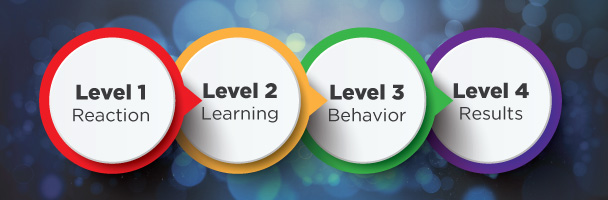
The basic Kirkpatrick Model, as explained by Kirkpatrick Partners, outlines four levels ofevaluation:
- Reaction—“the degree to which participants find the trainingfavorable, engaging, and relevant to their jobs”
- Learning—“the degree to which participants acquire the intendedknowledge, skills, attitude, confidence, and commitment based on theirparticipation in the training”
- Behavior—“the degree to which participants apply what they learnedduring training when they are back on the job”
- Results—“the degree to which targeted outcomes occur as a result ofthe training and the support and accountability package”
In order to really evaluate and demonstrate success, youneed to first know what the desired outcome is, and build a path to successfrom there. Therefore, we’re going to take the classic Kirkpatrick evaluationmodel and reverse it. This is the model that Kirkpatrick Partners now teachesand calls the New World Kirkpatrick Model.
Results
Did you ever find as a kid that doing mazes was easier ifyou started at the “finish” line? I sure did. This is the idea of backwardplanning, and it is an excellent model for evaluating your training program.
Think about what you’re trying to accomplish. Use yourcompany’s goals and strategic initiatives. These are the results you’re lookingto ascertain through your training program. Look for leading indicators, orsigns that you’re on the right track with your program; some online learningprograms offer to collect these data for you. These will also help you provideyour directors with reports on your success.
Behavior
Behaviors are what make the difference between a successfultraining initiative and a flop. This is why you train, to adjust behaviors andactions in order to benefit your company.
Modifying behavior requires that you have management buy-into hold employees accountable to the changes they’re making. Managers can dothis by monitoring, reinforcing, encouraging, and rewarding team members whoparticipate in the training program, or by simply cordoning off some time forthem to take the course.
Keep in mind that not every behavior needs to be evaluated—focusonly on behaviors that are critical to the results of your program. This meansthat the behaviors you’re attempting to adjust with your training need to beobservable and trackable.
Learning
Did your program participants learn what you intended themto learn? This evaluation step is where you gauge whether or not your trainingprovided employees with everything they need to modify behaviors and accomplishthe goal of the training. In other words, it’s test time.
Reinforce the key takeaways of your program with a test.It’s also important to measure how confident and committed employees are toapply what they’ve just learned. This can be done with a post-training poll, anonline survey that follows the eLearning course, or an open discussion aboutthe training.
Reaction
It’s important that you evaluate the reaction to yourtraining as quickly as possible. In fact, the three components of this level(engagement, satisfaction, and relevance) can be evaluated immediately afterthe online course is completed. For example, you can conduct post-trainingsurveys at the end of the session, have pulse checks built in to the program,or have interviews with select participants afterward.
While this level is the most commonly evaluated, it providesthe least valuable information for your program. Keep this in mind when you’respending time on your evaluation; instead, spend more time on results, behaviors, and learning.
Make the commitment
As training professionals, we believe in value in training.Committing to and incorporating a comprehensive evaluation model for yourtraining programs can demonstrate that value to the rest of your organization.
Still, many professionals only commit to evaluating reaction and learning, steps 1 and 2 of the traditional Kirkpatrick Model, nevertaking the time to evaluate whether the program had its intended impact. Thisis exactly why we flipped this classic method on its head. To provide bettertraining, you need better data, and you’re only going to get better data if youshift your focus.
This shift occurs when you stop focusing on the return oninvestment (ROI) and start focusing on the “return on expectations” (ROE). Bymeasuring ROE, you’re focusing your evaluation on the expectations of trainingversus ROI, or a simple breakdown of the program cost.
When efforts are focused on showing ROE, there is acollaborative effort and sharing of credit with other business units. Insteadof everything being about training and what training has accomplished, itbecomes about what the business has accomplished through training.
Evaluation gives access to data galore, whendone properly. Data, when presented to the right people in the right manner,will demonstrate the value of the training program and how it is essential tothe continued success of the organization.