By Elham Arabi, PhD
While the common approach to most training is teaching theories and boosting knowledge with the hope of skill building, skills-based learning focuses on teaching skills that can be used directly on the job. This hands-on approach helps learners practice and develop the abilities to successfully perform tasks in real-world work situations. Ultimately, training must be hands-on and practice-based to help learners build essential skills.
6 Steps to Skills-Based Learning
Here are the steps to consider for skills-based learning:
Note: It is important that you work closely with subject matter experts (SMEs) or if possible, involve sample learners to fully understand their job and tasks.
1. A Thorough Skills Assessment
Conduct a thorough skills assessment to ensure industry alignment or identify performance gaps.
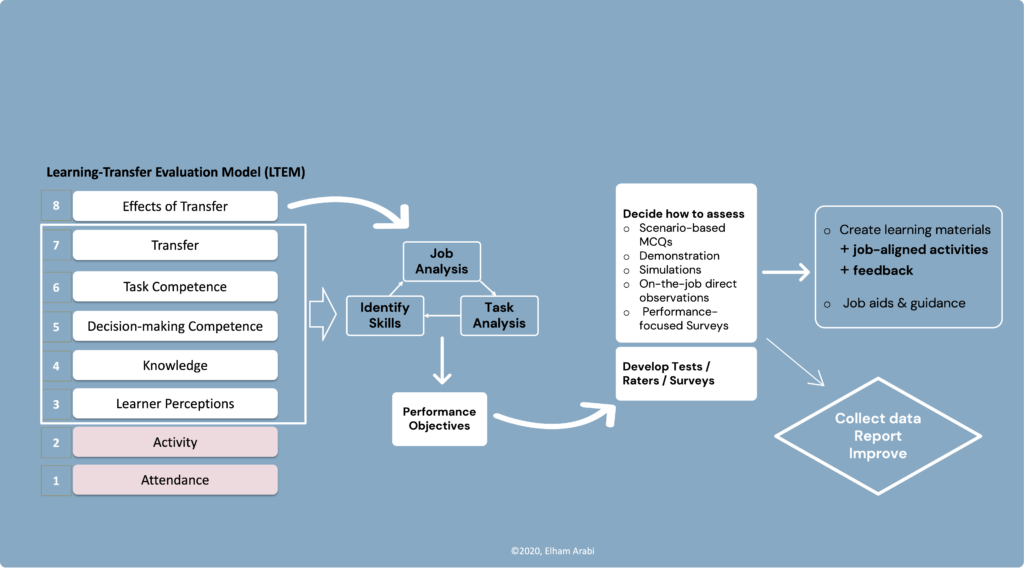
Start with the end in mind. What does success look like? Use an evaluation model—I use the Learning-Transfer Evaluation Model (LTEM)—to identify practical knowledge and skills needed to do the job successfully.
Working through Tier 4 (Knowledge), Tier 5 (Decision Making), and Tier 6 (Task Performance), ask the following questions at each tier:
- What do learners need to know to do a task well?
- What decisions do they need to make during the tasks?
- What tasks must they perform without assistance?
Results-Driven Design
For career advancement, conduct job market research to tailor your job-specific skills and practical knowledge to meet industry demands. You can do primary research by talking to industry experts, LinkedIn connections, or contacts in your target field to learn what skills are valued.
People are generally willing to help when they understand your goal, which is build relevant and cost-effective learning programs. You can also do secondary research by reading industry reports from sources such as Deloitte, McKenzie, World Economic Forum, Boston Consulting Group, and Bureau of Labor Statistics (BLS) to learn what’s happening in the job market and understand current industry demands.
2. Conduct a Task Analysis
Do a task analysis to break down a skill into its component tasks & sub-tasks.
Use a visual tool such as Miro or Whiteboard when working with SMEs to help them see how tasks and sub-tasks connect. Reference the evaluation model as you work from the top down—start with Tier 6 (Task Performance) and work your way to the lower tiers, Decision Making and Knowledge.
Use the following questions to guide both you and your SMEs through the task analysis process:
- What is the first thing the learner needs to do related to this skill?
- What are the steps to do this skill successfully?
- Where do they need to make decisions? And what are they? What cues or signals tell the learner when to move to the next step?
3. Develop Performance Objectives
Develop performance objectives for each task or set of tasks, depending on their importance to the skill.
I deliberately use the term “performance objectives” rather than “learning objectives” to help SMEs shift their focus from knowledge-based content to actual performance and what learners need to do. I use Surgrue’s alternative to Bloom’s Taxonomy to guide us through the process.
Key point: When writing the objectives, constantly ask yourself and your SME, “How will we assess this?” This will ensure that your objectives are measurable and specific.
Rather than writing objectives focused solely on knowledge, embed the knowledge within task-based objectives. Ask yourself: What does the learner need to do with this knowledge? This shifts the focus from simply recalling information to applying it in performance.
Here are some examples of performance objectives:
- Decide when to abort takeoff based on engine performance indicators, warning systems, or runway conditions.
- Troubleshoot AI model performance issues by systematically reviewing data quality and identifying the root cause within 3 attempts in simulated scenarios.
- Identify potential hazards in a workplace environment, correctly recognizing all safety risks during a walk-through assessment.
- Facilitate conflict resolution discussions by asking open-ended questions and guiding parties toward mutually acceptable solutions.
- De-escalate tense conversations using appropriate verbal and non-verbal techniques, successfully reducing conflict intensity.
4. Evaluate Skill Performance
In the next step, you will build assessments to evaluate skill performance.
Use your task analysis to determine the best assessment approach. Shrock and Coscarelli’s Criterion-Referenced Test Development emphasizes testing learners based on their individual performance of the skills, not on how they compare to others.
Test Development Process
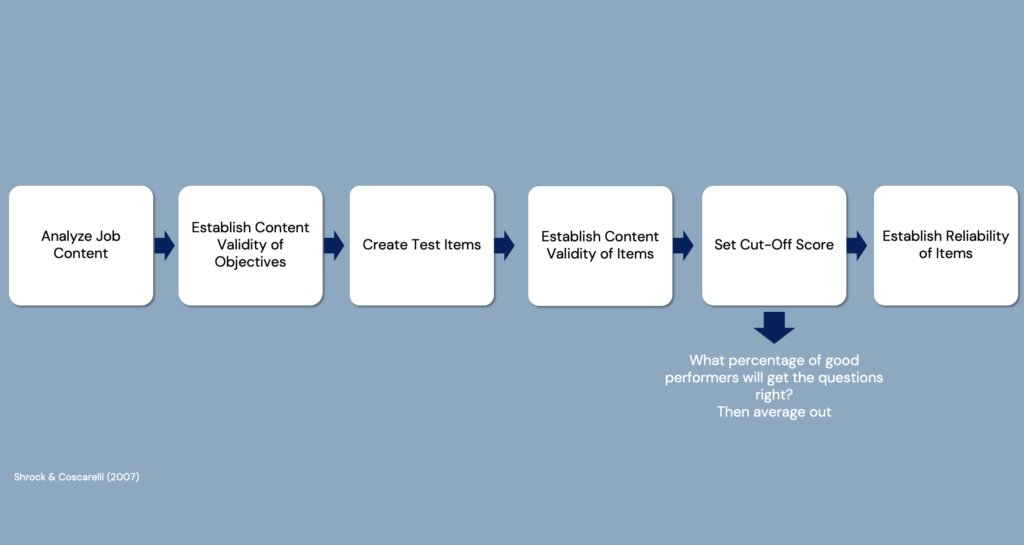
To establish the validity of your performance objectives, verify that they measure what you intend to measure and align with the actual skills and tasks identified in your analysis. Check that each test item directly corresponds to a specific performance objective by asking, “Does this item test what it’s supposed to test?” Have subject matter experts review your objectives and test items for accuracy and relevance. Additionally, ensure test-takers will clearly understand what’s being asked.
To establish the reliability of test items, you can use several methods. One straightforward approach is test-retest reliability: Give the same test to the same group of test-takers twice with a time gap between administrations, then compare the scores. High correlation between the two sets of scores indicates reliable test items.
To assess tiers 4 (Knowledge), 5 (Decision Making), and 6 (Task Performance), use scenario-based questions, role-plays, or task demonstrations. Use multiple-choice questions with good distractors instead of true-false questions, which can easily be guessed, for clearer evidence of learning.
To assess whether learners can perform a procedure, create a skills rubric that clearly distinguishes between when they need assistance and when they can perform tasks independently. Avoid using self-assessments, as learners are not the most accurate judges of their own task performance.
5. Provide Feedback
Provide feedback that shows the consequences of learners’ actions, decision, or lack of knowledge.
There’s ongoing debate about whether assessments for accreditation or certification should include feedback. However, I advocate for feedback because it helps learners benefit from the testing process itself. Rather than simply marking answers as correct or incorrect, effective feedback explains why a choice is right or wrong and what the consequences are. This approach helps learners understand the reasoning behind correct performance while they demonstrate their skills through assessments.
6. Create Practice Opportunities
Finally, you will design practice opportunities, guides, and resources.
To help learners achieve the desired level of performance, ask yourself, “What kinds of practice opportunities should we provide?” Research shows that retrieval practice, not just recall of information, helps learners retain knowledge and develop skills more effectively. Importantly, provide constructive feedback during these practice opportunities.
Final Thoughts
Even the most well-designed training won’t be effective if it doesn’t help learners build the necessary skills. While training might seem like the most viable approach, start by identifying the performance problem and the required skills first.
Upskilling or reskilling does not always require training—consider whether available resources or changes in processes could address the gap. Skill development is contingent on a variety of variables, such as:
- Learner characteristics
- Learners’ confidence levels
- Whether you’re building their self-efficacy
- How you maintain their motivation through relevant, context-aligned practice
Additional questions to consider include: Are you spacing out learning to give learners sufficient time to process information and practice repeatedly to master the skills? Are you incorporating peer support and mentoring rather than expecting mastery from just a few hours of training?
Overall, focus on well-researched learning techniques and considerations before jumping into developing a learning program. A thoughtful, evidence-based approach to identifying performance gaps and designing appropriate solutions will be far more effective than defaulting to training as the automatic answer.
Image credit: matdesign24