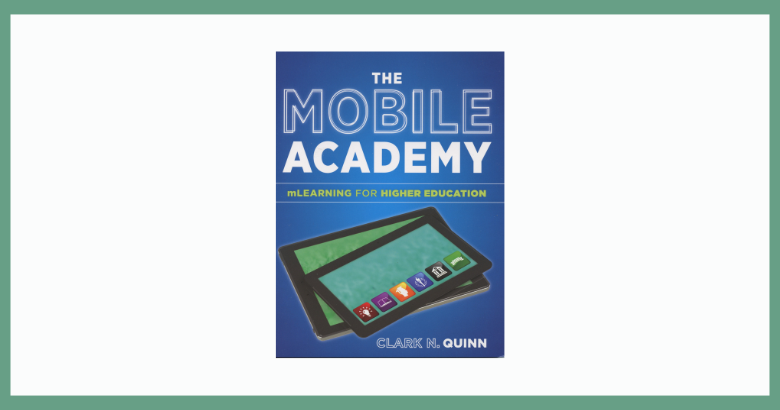
Clark Quinn has just publishedanother book on mLearning, his second this year. The latest work, The Mobile Academy: mLearning for HigherEducation, is intended as a guide to strategy and implementation of mobilelearning for administrators, instructional support staff, and faculty. As such,it is direct, to the point, and extremely practical.
 Research and thinking
In the Foreword, John C. Ittelson, Directorof Outreach to the California Virtual Campus and Professor ofTelecommunications, Multi-Media, and Applied Computing at California StateUniversity Monterey Bay (CSUMB), says, “Reports such as the Horizon Report andorganizations such as EDUCAUSE and other leadership groups point totransformational change that is beginning to occur. How you put this incontext, evaluate, and plan for this coming sea change will determine thecourse of education, and no one has done more research or thinking about theseissues than Clark Quinn.” In the pages that follow, Quinn provides thebackground information needed to successfully put together a strategy for harnessingthe fundamental revolution in education brought about by mobile devices,through mobile learning solutions.
In addition to a model for mobilelearning, Clark offers advice and examples on implementing mobile foradministrative needs, supporting delivery of content and meaningful practice,incorporating social learning, and anticipating emerging modalities such asAugmented Reality, Alternate Reality, and Adaptive Delivery. His discussion ofeach of these areas includes checklists that will guide implementation andquestions that will help the reader consider how to apply the information tomake the higher education process more effective.
What’s in the book?
In this very concise book, ClarkQuinn has packed an amazing amount of information. He begins with two chaptersthat provide the foundations needed to understand just what mobile is, and howit relates to learning. These Foundation chapters are the longest ones in thebook, although at about 14 pages each they are by no means “long.” As I said,the treatment is very concise.
In the first of the Foundationchapters, Quinn provides his convergent model that demonstrates just howpowerful mobile devices have become. Many of us take our smartphones almost forgranted, until we look at all the functions they really can perform. He alsorecaps his “four C’s” of mobile capabilities, which he introduced in Designing mLearning earlier this year.The reader will come away from this chapter with a new appreciation of thebenefits that mobile devices offer to higher education.
In the next chapter, Clarkprovides a review of learning, in a way that provides a shared vocabulary andputs the focus on formal change. He provides another recap of ideas he haspresented in earlier work, the seven C’s of learning. At the same time, heintroduces additional concepts that are essential to understanding how best touse mobile capabilities, such as spaced practice and scaffolding, problem-basedlearning, social learning, and performance support.
The rest of the book proceeds, inchapters of about ten to twelve pages each, to give very precise guides for mobileadministration, content and media, interactivity and assessment, the use ofsocial media and emerging technologies in a mobile context, and dealing withorganizational issues. These chapters are long enough to spark creative thoughtabout ways to apply the ideas presented, and short enough to avoid belaboringthe points. There are plenty of examples, illustrations, checklists, and bulletpoints. The treatment is by no means superficial; it simply respects thereader’s time and intelligence.
Why this book? Why now?
Although 90% of the world populationnow has access to mobile networks, and even though there are 116 subscriptionsto mobile services for every 100 eligible individuals, higher education, forthe most part, has been slow to adopt the technology. Less than 25% of these institutionshave embraced mobile learning and administration, creating a serious mismatchbetween the services provided and the expectations of the students on mostcampuses.
More serious than this mismatch isthe missed opportunity for deeper and more persistent learning. As Quinn pointsout, “Mobile is not a cure but is a tool to achieve the ends, and consequentlyit is a catalyst for change.” Other sectors – corporate, government, and evenK-12 education – are moving quickly to apply mobile technology. There are manyways to make use of mobile devices in the classroom, and to extend the learningexperience, and these ways are growing even more rapidly with the introductionof tablets.
In addition to the stated purpose ofthe book, I think that Clark Quinn has also produced a work that will be usefulin settings other than higher education. If, for example, you are looking for aquick overview of mobile learning that you can provide to busy executives, The Mobile Academy could be a greatchoice.
Business has already discovered thatit is essential to have a clear strategy for accommodating mobile.Universities, where the implementation of these technologies is more complexand challenging, have an even greater need for a plan and a system to keep upwith rapid changes in the mobile field. In my opinion, Clark Quinn has providedan excellent foundation for creating such a strategic plan.
Bibliographic information
Quinn,Clark N. (2011) The Mobile Academy:mLearning for Higher Education. San Francisco: Jossey-Bass. 120 pages. ISBN978-1-118-07265-3.
Amazon.com:$36.52 (Paperback); $22.00 (Kindle Edition)
Barnesand Noble (online): $35.50 (Paperback); $32.00 (Nook Book)
Jossey-Bass(online): $40.00 (Paperback)