



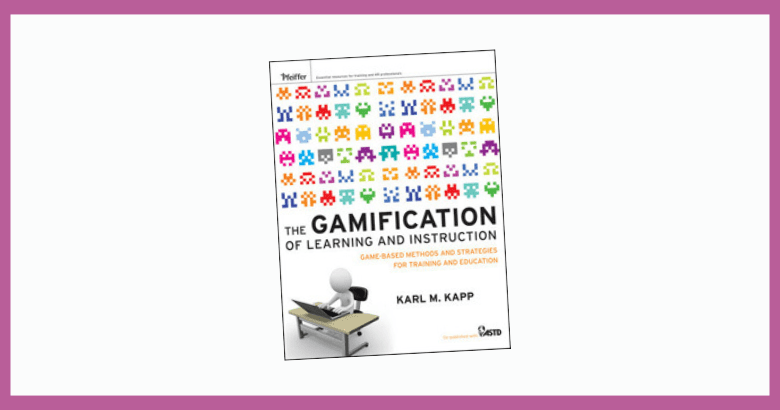
If you’re up to the challenge, Karl Kapp’slatest book offers best practices, design considerations, and pragmaticrecommendations that will surely change the way you think about enhancing yourlearning initiatives through the use of games.
 From the outset, Kapp argues thatlearning professionals already know gamification. Whether academics, teachers,corporate trainers, or instructional designers, today’s learning expertssuccessfully transform lackluster content into blockbuster learning experiences,and immerse learners in real-world environments with real-time feedback, givingthem a sense of success and accomplishment. But we must strike a balance toensure successful outcomes for our learners. It isn’t about awarding points tolearners for logging onto an online course or about creating other artificialrewards and incentives. Rather, we should leverage the unique elements of games– curiosity, permission to fail, engagement with others – and present learningcontent through stories and contextual challenges, giving learners a sense ofcontrol and power to make decisions. The sense of accomplishment and masterythat comes from successful gamification efforts can lead to increasedmotivation, behavior change, and, ultimately, real learning.
Kapp’s goal for the book was to bringtogether all that is known about games, learning, and instruction, and create asort of one-stop shop. In TheGamification of Learning and Instruction, he achieves this goal and muchmore.
What’s in the book?
Kapp organizesthe plethora of information about gamification and instruction into 14 chaptersthat expand and explain multiple themes. He begins by building a foundation ofdefinitions, game elements, theories, and related concepts. From thisfoundation, he moves into a review of research and looks at the effectivenessof games and specific game elements used in learning. Next, and perhaps mosthelpful to the learning practitioner, Kapp presents a framework for effectivegame design and discusses the importance of considering learning domains and choosingthe best design for given content. Readers will also appreciate thestep-by-step design approach and project management tools included in Chapter9. In the final section of the book, several guest contributors share theirperspectives and case studies, and Kapp provides two examples of thegamification of learning in action.
The real valueof The Gamification of Learning andInstruction comes from dozens of examples, tips, and descriptions of how tointersect learning and games successfully. Kapp often reinforces the point thatcareful planning and thoughtful design are critical to successful learningoutcomes.
Who should read this book?
Simply put,anyone interested in creating effective learning through gamification orchanging how people and organizations think about the concept of gamificationshould read this book.
Kapp hasmasterfully provided a foundation of terminology, definitions, and examplesthat will help those who are new to the concept of gamification and learningbetter understand the implications of good – and not-so-good– design. For those using the book as a primer, Kapp suggests reading thechapters in chronological order, pausing at the end of each to ensureabsorption and understanding of the material. While certainly helpful indemonstrating Kapp’s arguments, the dozens of examples and illustrations shouldbe carefully considered by the novice reader in terms of his/her organizationalcontext and instructional reality.
Another suggestionis to use the book as a field manual of sorts, with teams reading and reviewingchapters as a group in a discussion-based format. This approach makes perfectsense, and will certainly lead to thought-provoking discussions, a deepersynthesis of the material, and, just maybe, an improved approach to usinggame-based methods for learning in your organization.
The final word
The title of thefinal chapter in the book says it best – “If you want to learn more, playgames.” Games are ubiquitous in the world today. Crossing generations andspanning the globe, games are part of our lives as never before. Take the timeto play games – instructional and non-instructional; as a learner and as adesigner. Analyze the elements used and think about how you can apply thosesame elements in your designs. Talk to others about their experiences andreactions to playing games. Most of all, remember that the gamification oflearning is not a case of “build it and they will come”; the most impactfullearning comes from placing learners in the right environments, and with theproper context, to make decisions that change behavior and meet the desiredoutcomes.
Bibliographic information
Kapp, Karl. (May1, 2012) The Gamification of Learning andInstruction: Game-Based Methods and Strategies for Training and Education.San Francisco: Pfeiffer. ISBN: 978-1-118-09634-5. 336 pages.
Publisher’s ListPrice: $60.00
Amazon: $50.60(Hardcover only; no Kindle edition)
Barnes andNoble: $52.74 (Hardcover only; no Nook edition)


