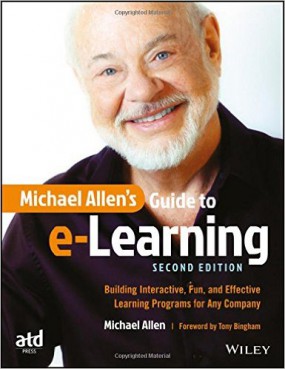
When the first edition of MichaelAllen’s Guide to e-Learning: Building Interactive, Fun, and Effective LearningPrograms for Any Company appeared 13 years ago, the eLearning world was notwhat it is today. The eLearning Guild was only a year old. SCORM was shiny andnew, and modern learning management systems (LMSs) were only beginning toappear (although LMS as a concept had been around since PLATO in the 1970s).There was:
- No mobile ecosystem
- No social media, at least not as we know it today
- No cloud computing
- No practical way to deliver interactive video over the Internet(there was programmable and random access videodisc and laserdisc for thedesktop, however)
- No enormous array of “rapid authoring” tools (the termitself only appeared in 2004)
Michael Allen wrote the first edition of Guide for instructional designers, who by and large created contentthat was still in the early stages of transition from classroom training,delivered by human beings in a classroom setting, to technology-mediatedinstruction, most of which was not delivered through a web browser. Managerswho approved training expenditures and staffing often needed a lot ofconvincing that eLearning was a “thing” and not a fad. The users of eLearning—thelearners—were not used to downloading content, although iTunes and the iPod, alongwith early eCommerce sites, were laying the groundwork for mobile and thealways-connected, always-on environment we enjoy today. As a result, much ofthe first edition of Allen’s book had to deal with skepticism about eLearning.Nobody was sure what worked or where “the information highway” was leading.
A lot of things have changed, but not the basics.
What’s new, and what’s surprising
I think this is an important book, and one that everyone inthe field of eLearning should read and consider today, but it is important tounderstand why Allen has chosen to write this second edition now. This editionis significantly different from the first edition, for a different world.Superficially, it may resemble the first edition, but inside you will find thatthe similarity largely ends with the title. It is true that Allen takes thesame pragmatic, no-nonsense, craftsman-like approach to eLearning design thathe did in the first edition. He is, as he has always been, about thoughtfulsolutions to business problems and human performance, as you would expect froma practitioner who has been in the field of eLearning for many years and infact developed the first widely adopted eLearning authoring tools.
That said, readers who are new to eLearning design and developmentwill be surprised—perhaps dismayed—by what Allen has to say about the state ofsoftware creation and our response to technology. But permit me to quote him atlength. The words that follow, taken from the first chapter of the new edition,may be the most important words in this review and the ones that you must keepin mind as you read the book:
“People of many backgrounds, skills,and talents find themselves involved in creating instructional applicationsbecause interactive technology is more accessible than ever before. Creationtools that emphasize speed and minimal instructional knowledge seduce theunwary into instructional design roles where, although well-meaning, they arenot ready or able to make good design decisions.
There’s no doubt we are blessed withmore ways than ever to help people and organizations perform better. It’s allvery exciting. At the same time, even more expertise is required to choose aneffective path—to avoid what’s novel and new but not the best fit.
Unprepared courseware developers, withfar too many instructional models, tools, and delivery technologies, arespurred on by eye-catching examples that have great appeal, but actually missmost instructional opportunities. This has created a new environment in our industry.…
[M]y answer to the question What’s new? could well be everything. And yet, the most importantguidelines remain the enduring basics of what we know about learning andperformance. Through all these changes, it’s more important than ever to begrounded in, and guided by, the basic principles of human learning andperformance.”
Delivering the argument
Strong words, perhaps. But in my opinion, he makes good onthem. The entire focus of the second edition is to help fill up whatever may belacking in the readers’ knowledge of those enduring basics.
How does he do that? First, Allen explains that he is notdismissing the recent developments in technology and delivery channels: social,mobile, and games. He isn’t even actually dismissing rapid development tools,although he would certainly never advocate their use as the default.
Allen cautions strongly against the suggestion that buildingcourseware is more a matter of implementation than a matter of design, or thatknowledge about appropriate and effective instructional design should be pushedaside in the interest of expediency. He appreciates that mobility, games,video, real-time simulations, MOOCs, and social apps offer possibilities withgreat value in some cases, but it’s design that matters most, followed byappropriate selection of delivery. Even eLearning itself is, for Allen, adelivery platform with “an interesting set of capabilities,” not aninstructional approach.
Second, Allen presents a solid framework for creating effectiveand valuable learning. This appears in chapters 7 and 8, following hispresentation of the rationale for the book in chapters 1 through 4, his“Executive’s Guide to Good e-Learning” in Chapter 5, and his strategic overviewin Chapter 6, “Where Does e-Learning Fit?” While those chapters contain echoesof similar content in the earlier edition, chapters 7 and 8 are the heart ofthe present volume. Allen certainly could have presented those two chapters atthe beginning of the book, but he chose to make his case for their necessityfirst. If you are already familiar with the rationale for good design beforemaking technology decisions, feel free to skip over the first six chapters. Youcan always go back and read them.
The heart of the matter
Chapter 7 consists of what Allen calls “simple success strategies.”There are seven of these strategies. The first four will be familiar to anyonewho has ever taken a course on instructional design: Set clear outcome goalsfor your product, match your instructional strategy to your outcome goals,beware of “awareness” goals, and design backward (you may think of this as theclassic “begin with the end in mind”).
When Allen comes to the fifth simple success strategy, hegives the reader what he considers “the most helpful discovery in my endeavorsto help e-learning realize its potential”: the identification of the fourcomponents of impactful, interactive instructional experiences. He says thesefour components—context, challenge, activity, and feedback (CCAF) —define and compriselearning events, including serious learning games. This is a serious insightinto instructional design, and he expands on his thoughts in Chapter 12, “CCAFand Interactive Instruction.”
Allen gives his procedural basis for eLearning development ashis seventh success strategy: SAM, the “successive approximation method.” Thismethod appeared originally in the first edition as “Savvy: A Successful Programof Successive Approximation.” (Allen covers SAM in depth in his book Leaving ADDIE for SAM, and the method receives further explanation in theassociated Field Guide—bothof which have been reviewed for LearningSolutions Magazine—as well as in Pamela Hogle’s September 20, 2016 Learning Solutions Magazine spotlight article,“Waterfalls or Whirlpools: Why Use an Instructional Development Model?”) Heexpands on the topic in Chapter 14, “Successive Approximation and SAM.”
The final philosophical basis for Allen’s framework appears inThe Serious eLearning Manifesto,which he cites in Chapter 8, along with commentary on the 22 principles itcontains. This document is the result of work by Allen and three of hiscolleagues, Julie Dirksen, Clark Quinn, and Will Thalheimer. The eLearningGuild is a signatory to the Manifesto,along with more than a thousand professionals worldwide. This chapter is worthyof serious contemplation, and I will not attempt to summarize it here. Youcould start by reading the LearningSolutions Magazine article on the Manifesto.
What else is in the book?
I have summarized what seem to me to be the most significantparts of the second edition, although there is much more in the Guide. Allen includes content thatexpands on the first edition’s advice about learner motivation. He coverstopics that were in the first edition on “Seven Magic Keys to Motivationale-Learning,” navigation, and instructional interactivity.
A significant addition is in Part 3 of the second edition, “SeriousLearning Games.” If you are interested in this instructional alternative, youshould definitely buy the book for this section alone.
Why read this?
We read articles and weblogs every day decrying the state ofeLearning. It is called boring, ineffective, and not worth the time and expenseinvolved in its creation. And perhaps much of eLearning fits that description.Unfortunately, the suggestions for improving the situation are varied and alltoo often consist of solicitations to buy this product, that system, the otherservice. The prescriptions are varied and not necessarily grounded inexperience, let alone research. But in this new edition of his Guide, Allen brings decades of research,experience, and success to his design recommendations, and even if some of whathe says may be hard to take or to accept, it is certainly worth considering. Irecommend serious, thoughtful reading of MichaelAllen’s Guide to e-Learning, 2nd Edition.