



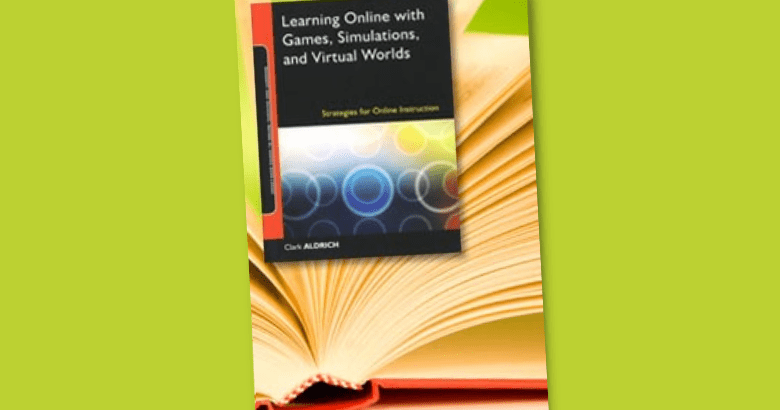

Sometimes, skinny little books manage todistill a great deal of information into highly usable form. When they can dothis without over-simplifying the subject matter, you know that you are readingsomething that is destined to be a classic. Clark Aldrich has produced one ofthese books in Learning Online withGames, Simulations, and Virtual Worlds.
On the first page,Aldrich gives us this promise, which the rest of the book delivers:
“This book contains the guidelines forinstructors who will be selecting, planning, and implementing curricula usinggames, simulations, and virtual worlds in a distributed classroom environment(that is, one in which students are not face to face with each other or withthe instructor). … This material focuses on both the front-loaded prepactivities necessary for successful use and the instructor’s role in a’learning to do’ (as opposed to a ‘learning to know’) course.”
Straight to the heart of the matter
Aldrich begins with avery fundamental question, the one that many traditional designers,instructors, educators, and their managers ask first: “What are games,simulations, and virtual worlds really, and why should I care?”
Answering that questionconsumes the first third of the book, which may seem like a very long reply.However, in it, Aldrich walks the reader through research findings, and thereasons why games, simulations, and virtual worlds work. He also provides amodel for the way all of the various buzzwords and acronyms relate to eachother.
Aldrich offers a term for these strategiescollectively: HIVE (Highly Interactive Virtual Environments). You may find thisuseful as a replacement for ILS (Interactive Learning Simulations). However, myguess is that, if you have to explain games, simulations, and virtual worlds toa decision-maker, you will do better to just skip the acronyms. Aldrich does anexcellent job of explaining the similarities and differences between thevarious terms as well, and the nuances of meaning attached to each of them. Ialso found his discussion of interactivity levels very interesting, and alsopotentially useful for instructors who design and deliver live online events.
Thelongest single chapter of the first part of his book is Aldrich’s explanationof Sims (simulations), which he describes as a “new model of content.” I’dobject that simulations have been around for a very long time, but he immediatelyprovides what could be one of the most useful single sentences in the book: “Wedon’t want to just re-create the classroom in a virtual 3-D world.” He suggestsputting that on a yellow sticky note and attaching it to your computer displayscreen. Aldrich breaks the world of Sims down into five specific genres, greatbackground material if you have to explain this concept to others.
Making decisions about HIVEs
Just knowing some definitions isn’t enough, ofcourse. Part Two of Learning Online withGames, Simulations, and Virtual Worlds addresses knowing when to use highlyinteractive content. There are some areas where HIVEs fit, and some in whichtraditional approaches work best.
The factors that count in making thisdetermination include the nature of the content, of course. But they alsoinclude costs, which can be considerable. There is a handy table thatsummarizes budget totals for off-the-shelf and for custom interactiveapplications in five different formats. These are broad estimates, but they maybe the best available for 2009 numbers.
Next is a pretty detailed description of thesteps needed to prepare for using highly interactive environments, includinghow to evaluate your options and how to prepare the support material. Fordesigners who have little or no experience with simulations and virtual worlds,Aldrich explains where to find free examples and how to use Second Life, as ameans of getting familiar with these environments.
The bulk of Part Two involves explaining how toorganize content, how to provide technical support, and how to pilot a HIVE.This is all excellent, solid advice, and Aldrich provides an example of a HIVEdeployment to illustrate the points. The concluding chapter of the second partshows ways in which a HIVE can be evaluated – you do want to know if yourdesign worked, don’t you?
The rest of the job
It is true that justknowing what a HIVE is and how to put one together is not enough. You stillhave to be able to convince the boss, your colleagues, and the learners. Theconcluding chapter in Learning Onlinewith Games, Simulations, and Virtual Worlds addresses the concerns thatyour stakeholders will have. Aldrich suggests a number of specific actions totake in order to achieve this very important task.
Do you need this book?
There are threesituations in which Learning Online withGames, Simulations, and Virtual Worlds would be a good investment. You willhave to decide for yourself if you are in one of these.
First, if you are newto the entire concept of games, simulations, and virtual worlds, I thinkAldrich has done a great job of summarizing it. And, I might add, he points outthe challenges that HIVEs present – they are not a universal answer toinstructional problems. You can read this entire book in an afternoon and comeaway with a really good idea of what is involved.
Second, perhaps you arealready familiar with the concept, but are just about to propose using a HIVEas part of a curriculum. This book will help you pitch the idea to those who mustbe convinced. You will be able to anticipate their concerns, and will havesolid information with which to back up your proposal.
Finally, suppose youare about to be involved for your very first time in a project to develop aHIVE. Perhaps this was your idea, or perhaps you were “tapped” as a SubjectMatter Expert. Maybe your boss thought this would be a good professionaldevelopment experience. Whatever the reason, Clark Aldrich has put together aprimer that will help you hit the ground running, and will also give yousupport for making solid contributions during the design and development of theapplication.
Bibliographic information
Aldrich, Clark. (2009) Learning Online with Games, Simulations, and Virtual Worlds: Strategiesfor Online Instruction. Jossey-Bass: San Francisco. 134 pages. ISBN978-0-470-43834-3
List price: $28.00 (Guild members receive a 20% discount when buyingdirect from Wiley – see the Discount Programs tab on our Web site for details)
Amazon price: $25.20 new (+ S&H)
Kindle price: $15.40


