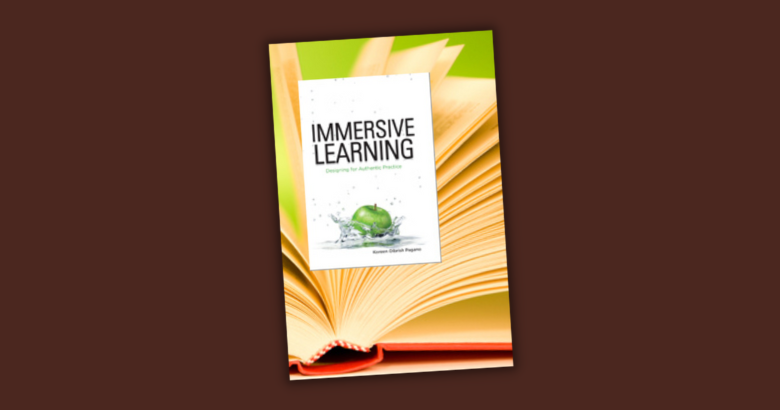
At the outsetof her book, Immersive Learning:Designing for Authentic Practice, author Koreen Olbrish Pagano asks acritical question, “Does providing information to learners lead to improvedperformance and behavior change?” She posits that it may be possible, but moreoften than not, the simple act of knowledge acquisition does not change anindividual’s performance. To gain skills that lead to real behavior change, wemust create opportunities for our learners to practice those skills. And, asthe title of her book suggests, Pagano provides a framework for thinking aboutimmersive learning design and easy-to-follow guidance to design immersivelearning environments that will allow your learners to practice and to fail … and,ultimately, to learn.
What’s in the book?
Immersive Learning is dividedinto four sections—the first gives a broad overview and explanation of theconcept of immersive learning, the second defines an immersive learning designprocess, the third provides numerous real-world examples of immersive learningin action, and the fourth is a quick wrap-up looking at the future of immersivelearning.
In the firsttwo chapters of Immersive Learning,Pagano sets the stage for the remainder of the book by explaining the general characteristicsof immersive learning and outlining three important design principles—realism: the extent to which theenvironment in which you are immersed is lifelike; achievement: the mechanism by which success toward performancegoals is measured within the immersive learning environment; and presence: the extent to which thelearner feels like she is connected or present immediately within the immersivelearning environment. Recognizing that immersive learning environmentsencompass any number of mediums (e.g., games, simulations, virtual worlds,mobile learning, augmented reality, etc.), Pagano makes the point that,“immersive learning is not about the technology; it is about the designprinciples that allow learners to practice in context, apply their knowledge,and improve their skills and competence.”
With that inmind, the second section and primary focus of the book outlines an immersivelearning design process using the ADDIE model as a general framework. TheAnalysis phase is where the rubber meets the road. As Pagano explains, “Themost powerful tool in the immersive learning designer’s tool kit is the abilityto ask questions… For immersive learning design, you can’t forgo the analysis,because the analysis becomes your design.” Specifically, designers should focuson identifying meaningful issues that affect performance to create realisticscenarios in environments for learners to practice addressing those issues. Athorough analysis can also help designers uncover other ways undesirablebehaviors are inadvertently reinforced in an organization, as well as specificfailure points and their causes. As a starting point, Pagano provides a seriesof questions to help guide some of this critical analysis work andacknowledges, “Your goal should be to approach immersive design from a positionof questioner—never assuming an answer, and always seeking new sources ofinformation to make your immersive environment as effective as possible.”
Recognizing that analysis will be ongoingthroughout the immersive learning-design process, Pagano explains three levelsof design decisions to guide your work. (Figure 1) First, define performanceobjectives and benchmarks that focus on what your learners should be able to dofollowing the realistic practice. Secondly, design the world in which yourlearners will be immersed. And lastly, design the performance evaluation thatsupports your learners in achieving the performance objectives you defined fromyour analysis work. Above all, Pagano reminds us to use a couple of “F” words …make it Fun and design for Flow. Your design work will encompass a number ofconsiderations, including the immersive environment itself, the story line,your cast of characters, and the role of the learner and his or her userexperience. To help guide this part of the process, Pagano provides thoroughexplanation and examples based on her experience both as an immersive learningdesigner and as a graduate course instructor.
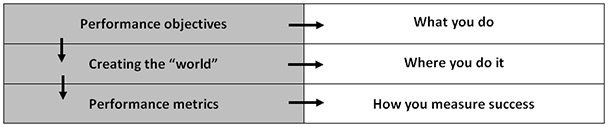
Figure 1: Koreen Olbrish Pagano’s simple design flow for immersivedesign.
Aspreviously mentioned, the book does not focus on specific technologies that youcan use to develop immersive learning environments. However, the depth ofPagano’s personal knowledge and experience really shines through, with herdetailed descriptions of the most recognizable immersive learning designcategories: games, simulations, virtual worlds, alternate reality games (ARGs),and 3-D immersive environments. For anyone curious about the similarities,differences, and interconnectedness of these mediums, you’ll definitelyappreciate Pagano’s explanations and considerations for each.
The final chaptersof this section are dedicated to a quick synopsis of implementation andevaluation details. The strength of these chapters lies in Pagano’s practicaladvice for implementing immersive learning experiences where learners have thefreedom and support to fail, and outlining simple evaluation strategies tomeasure your learners’ change in performance.
The thirdand final section of Immersive Learningdetails numerous case studies that show how various businesses andorganizations have designed and implemented immersive learning solutions. Theseexamples are particularly helpful, as they illustrate just how broadly you canapply immersive learning design principles.
Should you read it?
In a word, yes.Immersive Learning is a quick read, fullof Pagano’s real-world insights, commonsense guidance, and straightforwardadvice to help you design authentic practice experiences for your learners thatlead to changed behavior and improved performance. The case-study examplescertainly help clarify what is possible, and the step-by-step guidance in thefinal wrap-up charts a path forward. Perhaps Pagano says it best, “We are notsimply helping people ‘learn.’ We are helping people perform at a higher levelto improve organizational performance.” And to help you design and buildscalable practice that bridges the gap between knowledge acquisition and realbehavior change, consider adding ImmersiveLearning to your reading list for 2014.
Bibliographic information
Pagano, Koreen Olbrish. Immersive Learning: Designing for Authentic Practice. Alexandria,VA: ASTD Press, 2013