I’ve long been an advocate ofmatching our learning interventions to how our brains really learn. Whilethere’s justifiable skepticism about some of the so-called brain science, workthat systematically leverages research in cognitive learning is welcome.
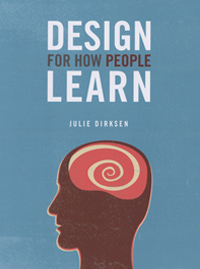 Now, Julie Dirksen, known forher work on usability in eLearning, has written Design for How People Learn, a guide to better learningdesign, and I have to say it’s a reallygood book! Julie used to work for Michael Allen (CEO of Allen Interactions andauthor of Michael Allen’s Guide toeLearning), and with her own studies into cognition and learning, shereally gets the necessary underpinning.
A lively, fun, valuable read
Don’t be misled, however: thisis not a stuffy academic book. In fact, reading this book is fun. There’s avery liberal use of drawings, stock photos, and other ways to make the ideas sheis presenting visually concrete – and the prose is pithy andhumorous. In short, this is a fun read as well as a valuable one. Julie Dirksendoesn’t take herself too seriously, yet she addresses the subject matter withappropriate passion and insight, yielding a welcome balance. I don’t know ifthis a hallmark of the imprint but credit goes to her publisher for supportingsuch a lively style.
The book focuses on a verypractical approach to designing learning, drawing upon what we know about howour brain works, and then applying it. And, most importantly, the book goesbeyond the traditional ID paradigm about intro, concept, example, etc., andincludes the emotional (motivational) side of the equation. Dirksen also(thankfully) points out the role of performance support, helping designersrecognize that not every solution is a course.
A nice touch is the use of arecurring metaphor of an elephant and the rider, emphasizing how we as learnershave pressures to accommodate short-term goals as well as a focus on long-termgoals – and the tension between them.This recurrent theme helps illustrate how our best intentions go awry if wedon’t focus on the competing desires of, and demands on, the learner. She usesthis structure to help design solutions that can leverage both requirements tooptimal advantage with minimal interference.
Focuses on the issues
Julie starts by addressing theperformance gap, does a good job of emphasizing knowing your learners, andfocuses on what the goal should be. Even the chapter titles lay out the issuesat hand:
- Wheredo we start?
- Whoare your learners?
- What’s the goal?
- Howdo we remember?
- Howdo you get their attention?
- Designfor knowledge
- Designfor skills
- Designfor motivation
- Designfor environment
- Conclusion
Lots of concrete examplesillustrate the principles. Drawing on both Julie’s experience and hypotheticalexamples, the book brings to life the ideas that she talks about. You can seequite viscerally how the concepts play out in context. She also draws upon awide variety of influences for models to think about, which I strongly support,yet she grounds the models in metaphors to make them accessible.
She provides nice references,too, with a list of readings at the end of every chapter that both grounds thediscussion and provides further directions. And Julie’s not afraid to take on some common myths – for instance debunking learning styles. On the other hand,she does refer to Bloom’s Taxonomy, which is familiar,though arguably flawed.
Quibbles
The book doesn’t quiteaccomplish everything I wishdesigners would draw upon; for example there’s no real discussion of when toabandon formal solutions and look to the community for solutions. There areminor hints and tips that could’ve been included (I’ll be sending her a listfor the 2nd edition J. Yet these are minor quibbles.
Recommendation: Buy this book!
Frankly, this is the best bookon learning design I’ve seen for the beginning designer, particularly those whohaven’t had the necessary foundations and experience. This is the quick start anyone designinglearning should use to get to success the fastest. I reckon if everyonedesigning learning had this book under their belt, we’d have a lot less garbage eLearning. Buy it, read it, pass it on, spread the word.Between reading this, and Collins and Brown’s Cognitive Apprenticeship, you’ve got a good head start on a “life experience” Master’s degree ininstructional design.
Bibliographic information
Dirksen, Julie. (2012) Designfor How People Learn. Berkeley: New Riders. 260 pages.
ISBN978-0-321-76843-4.
Publisher’s List price: US$39.99
Available online at https://www.peachpit.com/CreativeEdge
Amazon: US$22.89 (paperback); US$13.68(Kindle)
Barnes & Noble: US$22.89 (paperback);US$20.79 (Nook)