
What if,mere moments prior to takeoff, you discovered that the extent of your pilot’sflight training consisted of a few books he read during the previous weekend?No flight simulator. No practice. No opportunity for feedback in a safeenvironment. Would you feel confident that he could perform effectively at themoment of need? Probably not!
Althoughthis scenario is a bit hyperbolic, we should remind ourselves of the importanceof providing performance-based instruction to our learners that ensures wetransfer and sustain real learning over time. As learning professionals, ourcharge is to sustain organizational competence and create a “performance zone”in our organizations.
Performancesupport pioneer Gloria Gery explains, “The performance zone is the metaphoricalplace in which things come together. It is the place where people ‘get it,’where the right things happen, where the employee’s response exactly matchesthe requirements of the situation. It is the place where employees put togetherall the individual dance steps that they have mastered. The dance, the dancers,and the music are one.” AGILE instructional design, developed by ConradGottfredson, can help us get there.
Step one: Align

Figure 1: The first step in AGILE instructional design is Align
Organizationswith the capacity to see change before it happens will be more successful. Andto build this capacity, advises Gottfredson, today’s learning function mustalign with the strategy and intelligence functions. Recognizing that mostorganizational strategies are relatively unstable due to any number of externalfactors, it is even more important for the learning function to gatherintelligence from the external environment. Think for a moment about yourorganization. What opportunities, threats, or potential crises are on thehorizon? How can the learning function help respond to those changes?
But it’s not just about strategy andintelligence alignment. We must also align with our learners—the performers in our organizations. Toreach the performance zone, we have to make sure our solutions accommodate the five moments of learning need, while also attending to our performers’ learningdispositions. Take a moment now to rate your current learning and performancestrategy. To what degree does your current strategy accommodate all fivemoments of need?
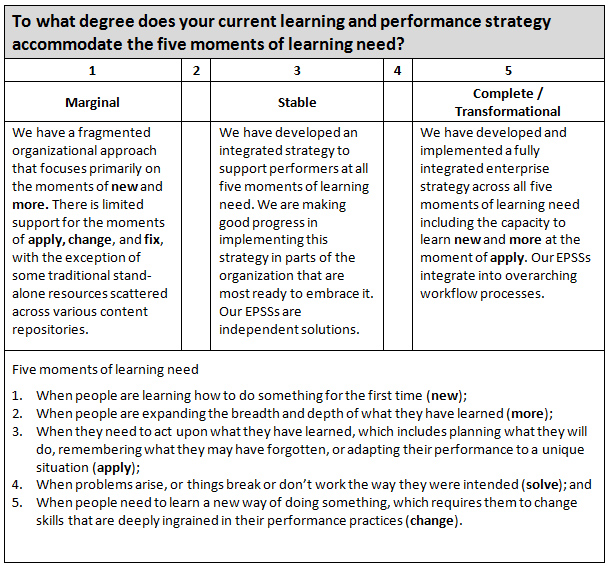 Table 1: Ratingyour learning and performance strategy according to the five moments oflearning need by Gottfredson and Mosher
With thatinformation in hand, you can wrap-up the align step by scoping and validatingbusiness-performance needs. Thinking about your organization and a currentproject, consider the following questions:
- What are the overarching business challenges and opportunities?
- What are the requisite business goals?
- What should be the business results?
Step Two: Get Set
Figure 2: Thesecond step in AGILE instructional design is get set
If we canall agree on the importance of preparing our learners to perform and givingthem the information they need, when they need it, then we can move into thesecond step of AGILE instructional design—get set. Gottfredson advises beginningthis step by estimating resources with your answers to a few additionalquestions:
- What are the performance goals?
- Who are the audiences?
- What is the estimated number of tasks?
- What existing tools and/or systems are required?
With thisinformation in hand, you can now move to the central activities of the get setstep—rapid task analysis (RTA) and critical skills analysis (CSA). The rapidtask analysis (RTA), explains Gottfredson, is “a systematic approach foridentifying the job tasks and related concepts for specific job roles andorganizing the tasks and concepts into meaningful business processes.” Beforeproceeding, let’s quickly review some key terms related to conducting an RTA:
- Step: A discreteaction that does not stand alone in its ability to achieve a practical outcome.
- Task: A discreteset of steps that together achieve a specific outcome.
- Process: A set oftasks that, orchestrated together, can achieve a broader outcome.
- Concept:Information that describes what something is (and sometimes, what it isn’t) andwhy it is important. Concepts provide the context for performance.
Mostimportantly, when conducting the RTA with your subject matter experts (SMEs), Gottfredsonrecommends the key focus should first be on identifying a random list of tasks statedin performance terms. Only after the list of tasks is generated, should youwork with your SMEs to group, order, and map concepts for each task.
After completing the RTA, you can rate theimpact of failure using the critical skills analysis (CSA). This rating canhelp you justify the allocation of learning and performance support resourcesfor each task and concept. You can use performance-support solutions to addresstasks and concepts rated on the lower end of the scale, while considering formallearning for those tasks and concepts on the upper end of the scale.
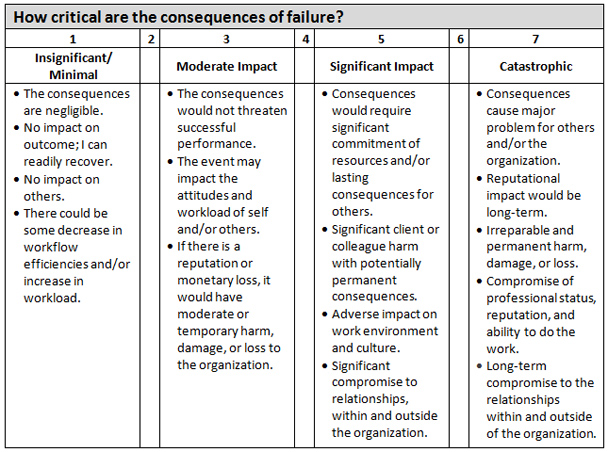 Table 2: Ratethe impact of failure using the critical skills analysis developed by ConradGottfredson
Youuse the RTA and CSA in the creation of a learning experience and performance(LEaP) plan, which, along with the iterate & implement, leverage, andevaluate steps, will be addressed in the next and final case-study installment.Stay tuned!