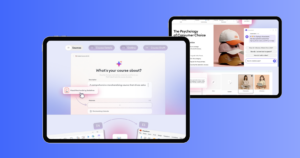
Youand your development team have created the perfect content for theinstructor-led training class, or perhaps a stunning eLearning course, only tofind out you need to make it available on a mobile app. What now? Is thecontent built in such a way that it can be easily converted to another deliverymethod? If not, your organization is missing a huge opportunity to save timeand money.
Consumersare demanding that they be able to access content from whatever devices they use,whether those devices are smartphones, tablets, laptops, desktops, or all ofthe above. According to Forrester Research, about 74 percent of knowledgeworkers use two or more devices for work and 52 percent use three or more. Froma business perspective, this means it has never been more critical orstrategically important to be able to deliver your learning content to anydevice, venue, or application, including at the learner’s moment ofneed.
Youmight be thinking, who has the time, money, or energy to do that? It is acommon misconception in the learning space to think that this kind of tailoreddelivery is a difficult, complex, expensive matter, but there is actually asimple solution. Single sourcing is a term you need to familiarize yourselfwith, and pronto!
Whatsingle-source development means
Sowhat exactly is single-source content? In short, single-source learningdevelopment is about three things. One, creating content as smaller modulesinstead of large, monolithic courses; two, separating the individual contentpieces from the overall presentation; and three, maintaining a collaborative development-teamenvironment.
Typically,developers expect that they must be able to deliver courses in many differentways, including instructor led, virtual classroom, self-paced eLearning, and inmultiple formats as blended learning. This means that the same material must beavailable across all of these formats. When developers organize content correctly,it can appear in multiple deliverables simultaneously, or the learning deliverysystem can sort it and farm it out in formats best suited for each learner’sneeds. The beauty of this method is that developers create content one time atthe individual topic level, with the ability for constant reuse.
The benefitsof single-source
Byits very definition, single-source means that organizations save tremendoustime and resources associated with having to create the same content multipletimes for different outputs. This results in some key business benefits:
Future-proofedcontent
Asingle-source content strategy is the only way to be prepared for any futuretechnologies. If content is in open format such as XML, the content will notneed to be recreated when a new platform emerges. Instead, organizations simplyadd a new output format to their existing repertoire of learning products andrepublish existing content to that new format. Just think: five years ago, noone was thinking about having content available on tablets.
Shortenedtime-to-market
Intoday’s hyper-competitive market, being late to the game with customizedlearning products that can be delivered to any desired situation (classroom,mobile, desktop, job site, etc.) can have a significant negative impact on revenueand customer satisfaction. To illustrate, a publishing company that uses aglobally dispersed group of SMEs to create their training materials previouslyneeded 18 months to create and deliver a new course. By adopting acollaborative and non-linear single-source development process, they can createa whole new course in five months.
Decreasedredundancy
According to the Chapman Alliance, 30 percent of thecost of eLearning is currently attributed to redundant content developmentprocesses, including authoring, QA, and SME/stakeholder review. When you addmobile to the mix, this level of redundancy simply doesn’t scale well now thatorganizations need to support many different platforms. According to onetraining organization, “Every time we needed to create a new, derivativeversion of a course, we simply made a copy and changed it for the new instance.Now we have dozens of versions of the same course, and none of them arelinked.”
Single sourcing creates an environment where you canmake content changes instantaneously, across all learning delivery formats, toeliminate this unnecessary redundancy.
Insummary, single sourcing is an option to help achieve consistency in yourcontent for branding, and between instructional and performance supportapplications. Don’t forget that because content is in smaller modules, it canbe re-used more easily than ever before.