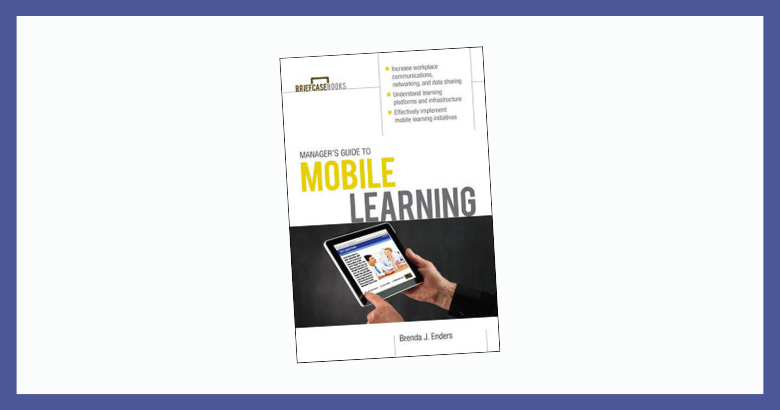
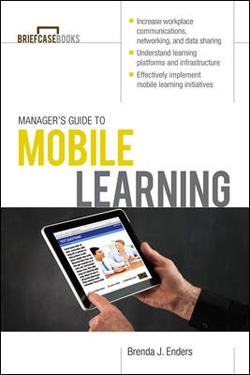
It shouldcome as no surprise that mobile device usage has penetrated nearly every cornerof the globe. From hip coffee shops in the US to Internet cafés in east Africaand most everywhere in between, our mobile devices are almost always at arm’sreach. So how can we, as learning managers, harness the potential of thisubiquitous technology? In her book Manager’sGuide to Mobile Learning, Brenda Enders charts a path for implementing andmanaging mobile learning, or mLearning, projects with helpful advice, examples,and tips based on her own experiences.
What’s in the book?
The firstfour chapters of Manager’s Guide toMobile Learning provide an overview of mobile learning, setting the stagefor the step-by-step insights in subsequent chapters. These chapters introducethe state of the industry; outline business drivers, benefits, and challengesof mLearning; underscore the power of mLearning in reaching learners anytime,anywhere; and detail the types of mLearning experiences that organizations shouldconsider.
The strengthof this section lies in the details provided around myths, benefits, andchallenges associated with mLearning. Thankfully, Enders is quick to point outthat “mobile learning isn’t really about the technology or the device, and itshouldn’t be a primary mechanism to deliver your eLearning courses.” Rather,mobile learning initiatives should be viewed as a way to expand learningopportunities, giving learners access to location- and context-specific contentanytime, anywhere, and at the moment of need (as explained by Bob Mosher andConrad Gottfredson, “Are You Meeting All Five Moments of Learning Need?,” in Learning Solutions Magazine).
The middlesection of the book, Chapters 5 through 8, walks readers through the stepsrequired to craft an mLearning vision statement, identify various stakeholderrequirements, analyze technical considerations, and determine whether in-housedevelopment or an outside vendor makes the most sense for an mLearning project.For experienced managers, some of this section may seem a bit rudimentary, buttools such as a sample mobile readiness survey and lists of questions to ask atvarious stages throughout a project’s lifecycle will be helpful to most.Perhaps the most beneficial discussion in this section lies in the pros/consand security, platform, and tracking considerations related to BYOD—bring yourown device. Indeed, many companies are adopting BYOD policies, and this chapterwill certainly help educate managers as they prepare for conversations withvarious project stakeholders, most especially IT departments.
The finalthree chapters of the book focus generally on project management, with ideasand insights for engaging stakeholders, working through the developmentprocess, and piloting and launching an mLearning project. As before,experienced managers may find eight pages dedicated to the ADDIE model toofundamental and not specific to mobile learning. Although Enders does discussbenefits of an agile approach over ADDIE specific to mobile learning, she makesno reference to Michael Allen’s SAM, which seems to be an obvious omission, asthe successive approximation model is an iterative, agile approach toinstructional design. That said, this section offers helpful pearls of wisdomthat can be applied to piloting and implementing most any learning initiative—whethermLearning, eLearning, or a blend of both.
The bottom line
As part ofthe Briefcase Books series, Manager’sGuide to Mobile Learning is designed to provide practical information in aneasy-to-read format. Numerous sidebars and call-out boxes provide additionaldetails relevant to the topic at hand. These nuggets, scattered throughout thebook, provide the perfect dose of real-world application. Along with the“Manager’s Checklists” at the conclusion of each chapter, readers are sure towalk away with ideas and inspiration that can be put to use immediately.
Though rare,a few lists and references will quickly outdate the book as new companies,tools, and methodologies enter the market. Even so, Enders’ Manager’s Guide to Mobile Learning is full of questions, planningconsiderations, and guidance that will improve the odds that your nextmLearning project is a success and generates positive results for yourorganization.
Bibliographic information
Enders, Brenda. Manager’s Guide to Mobile Learning. Madison, WI: McGraw-Hill, 2013.