



Learning Culture
The alignment of an organization’s systems, structures, and people that represents its views and commitments to continuous learning, performance improvement, and growth.
-

How Committed Leaders Contribute to Learners’ Success
Successful learning requires commitment from both the learners and their leaders. Learn what that means and how to show your commitment to learning culture.
-

David Kelly’s Curated Content for 8/14/23
This week’s curated content explores the importance of collaboration between L&D and HR, how to avoid having fear limit your growth, the risks of AI adoption, and more.
-

Closing the skills gap: How do I get started?
Do you know how to identify the skills gap at your organization? This eBook will help you get started with a skills gap assessment and walk you through the key steps in solving this common challenge.
-
Ensure That PDF Resources Are Accessible to Learners Using Assistive Technology
Did you know that many learners using assistive technology such as screen readers may not be able to access the PDFs included in your eLearning courses or virtual training? This can result in frustration and halt your learners’ progress until you remediate the PDF, which is a time-consuming process. In this hands-on session you will learn how to create a PDF that can be accessed using assistive technology, providing all learners a frictionless experience. First, we’ll examine what makes a PDF accessible or inaccessible. Next, we will walk through the process of creating an accessible document. Using either Adobe InDesign…
-
Key Considerations for Building Inclusive & Accessible eLearning
Have you ever wondered why tabbing may be important in online training materials? Or how to write “inclusive” text? This session focuses on designing accessible and inclusive eLearning to improve the experience for all learners—and avoid the need for costly, time-consuming “fixes.” Our focus on accessibility goes beyond the basics of alt text and screen reader accessibility to share a cross-platform view of what features are available, what is essential, and how to ensure that all learners can participate fully. We will discuss considerations for choosing new software and platforms for creating and sharing eLearning and explore ways to verify…
-
Design for Inclusivity: Diversity, Racial Equity, & Inclusion
To be effective, DEI (Diversity, Equity, and Inclusion) efforts must not be isolated to DEI-specific learning and training. Similar to accessibility, design that centers on equity, inclusion, and diversity will go a long way toward reinforcing an organization’s DEI values. In this session you will learn strategies for designing learning with a DEI lens. We will explore all aspects of the design process, from assessment and content design to evaluation. Specifically, we will look at content design—sourcing diverse media resources, avoiding stereotypical images or scenarios, and minimizing jargon. We’ll also explore ways to evaluate our own learning design biases to…
-
Build Accessible & User-Friendly Courses in Articulate Storyline & Rise
Articulate Storyline and Rise are wonderful for creating engaging learner experiences. They also have incredible accessibility features that you may not know about! Learn how to create courses that are fully accessible and user-friendly for all learners. In this session we’ll cover what it takes to create courses in Articulate Storyline and Rise that are accessible and compliant with Section 508. We’ll cover best practices for developing accessible courses in Articulate 360, including the interactions and elements to avoid. Incorporating alt-text, closed captions, and even transcripts is easy, and we’ll practice the ins and outs of formatting content for keyboard…
-
Nurture an Inclusive Culture: What L&D Can Contribute
Creating an inclusive culture—one where all people can work, learn, and thrive—is an essential element of improving accessibility and diversity in your organization. It’s a process that requires ongoing attention, starting with fostering and nurturing psychological safety. In this session, we’ll define key concepts such as diversity and power imbalances, microaggressions, implicit bias, and social identities. We’ll provide guidance on handling issues when they arise and describe strategies for employees to learn and use when they experience or witness incidents that compromise a colleague’s psychological safety. From there, we’ll delve into what L&D teams can do to create a culture…
-
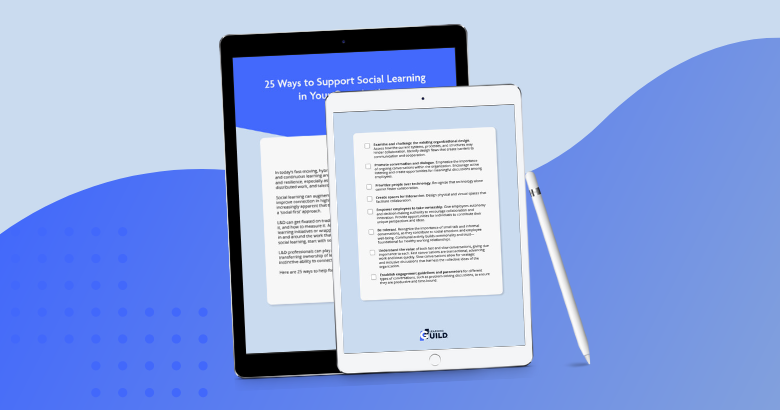
25 Ways to Support Social Learning in Your Organization
Accelerate organizational agility and empower your workforce with this comprehensive checklist designed to foster knowledge sharing, collaboration, and continuous learning in today’s fast-paced, hybrid work environments.
-

We All Just Want to Have Fun
Onboarding is the perfect opportunity to introduce fun as part of your company culture and demonstrate it to your new people.