



Instructional Design
Applying learning theory and design strategies to meet specific performance goals through the creation of instructional materials and formal learning experiences.
-

Automation in L&D Does Not Have to Be Difficult
It’s not the technology that’s the problem with automating L&D. It’s the culture.
-

Software Stacks and Learning Experience Platforms
Learning experience platforms (LXPs or LEPs) are a relatively new software category. Learn what they can do to improve the online learning experience.
-
Monthy MeetUp: Shawn Rosler on Using Podcasts for Performance
Forthis month’s Monthly Meetup, we welcome Shawn Rosler of Office Practicum, whojoins us with a presentation on “Podcasts for Performance: Leveraging a Pastimefor Your Learners.” He’ll share why podcasts are a cost-efficient,time-efficient platform to share knowledge, empowering SMEs to connect directlywith learners as “guests” on your training-focused podcasts.
-
Use a Cloud-based Storyboard to Ensure Course Alignment
A cloud-based storyboard system can enhance collaboration between IDs and SMEs to achieve proper alignment.
-

Select Data Analysis Tools for Instructional Development
Learn to use software review sites to select analytics applications for your instructional development project.
-

Expand your L&D Solutions with AR Learning Experiences
Augmented reality (AR) is continuing to emerge. Nearly everyone’s mobile device now supports AR content. AR enhances the end users’ view with additional content and experiences. How can this be useful for learning? How can we build learning content within the learner’s real-world view, or guide and support the learner’s performance via AR? What does it take to get started? In this session you will learn how AR can enhance and support learning. We will cover what you need to know when you start designing and developing AR learning experiences, and explore tools and resources you can use to quickly…
-
Out of One, Many: Creating Instructional Media Derivatives from Video
Many designers create video-based content without considering how to leverage a video into other forms of media. Your audience will consume your message in various formats based upon where they are in the learning journey, their preferred method for consuming instructional content, and the learning environment. What if there was a proven workflow that could plan video, audio, image, and text-based outputs that aligned to your audience’s needs? In this session, you will learn how to plan your video production to produce various media derivatives that will support the different stages of a learning journey. You’ll experience how to take…
-
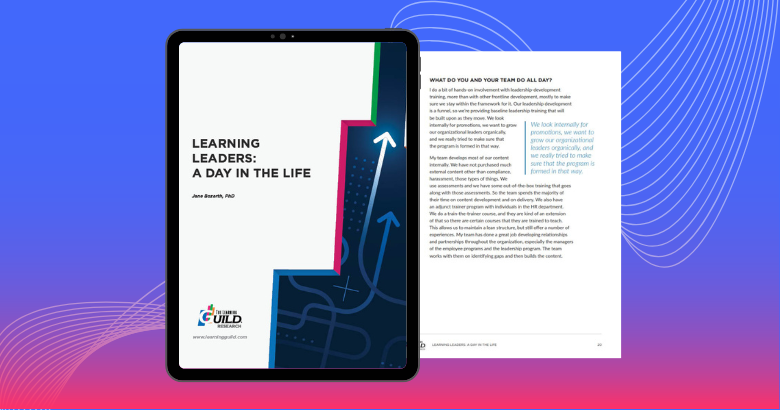
Learning Leaders: A Day In The Life
This research report follows a day in the life of five L&D managers as they discuss different aspects of their jobs, such as developing staff, their hiring processes, and other elements of their work.
-
Give the Tools to your SMEs and Fast Track your Process!
In a perfect world, every organization has the time and resources to create world-class training to support every new business initiative, change, or great idea. But in the real world, we don’t always have this luxury. Is there a way to reduce the amount of time we spend on design and development on each project? Does every business initiative require training? Which ones should we spend our time on? Can anyone create learning materials? In this session, you’ll learn from how I created some simple processes and tools that enabled my SMEs and stakeholders to design, and in some cases,…
-
More than Captions: The Journey to Accessible Learning
Accessible learning is inclusive learning but like many important improvements in learning and development, it’s rarely a simple path to creating accessible learning experiences that meet the needs of your learning population. There are questions you never thought to ask, research into unfamiliar topics, and trial and error. In this case study session, you’ll learn how RSM is working towards creating a sustainable model for accessible learning experiences in live, virtual, and eLearning environments. You’ll learn how the first steps towards improving accessibility can be sparked by curiosity, research, networking, and questions such as: “How do we do live closed…