




Steve Foreman
President, InfoMedia Designs
Steve Foreman is the author of The LMS Guidebook and president of InfoMedia Designs, a provider of eLearning infrastructure consulting services and technology solutions to large companies, academic institutions, professional associations, government, and military. Steve works with forward-looking organizations to find new and effective ways to apply computer technology to support human performance. His work includes enterprise learning strategy, learning and performance ecosystem solutions, LMS selection and implementation, learning-technology architecture and integration, expert-knowledge harvesting, knowledge management, and innovative performance-centered solutions that blend working and learning.
Latest from Steve Foreman
-
2022 Trends in Learning Technology
This report breaks down results from a recent Learning Guild survey on learning platforms to inform readers about issues such as adoption and implementation time.
By Steve Foreman • -

iSpring Updates Its LMS: A Review
iSpring Learn is a cost effective LMS with features designed for small and mid-sized businesses.
By Steve Foreman • -

7 Steps to Establish Your Data-driven Learning Strategy
Is your current strategy for learning projects data-driven? Take these seven steps to establish a data-driven learning strategy for L&D.
By Steve Foreman • -
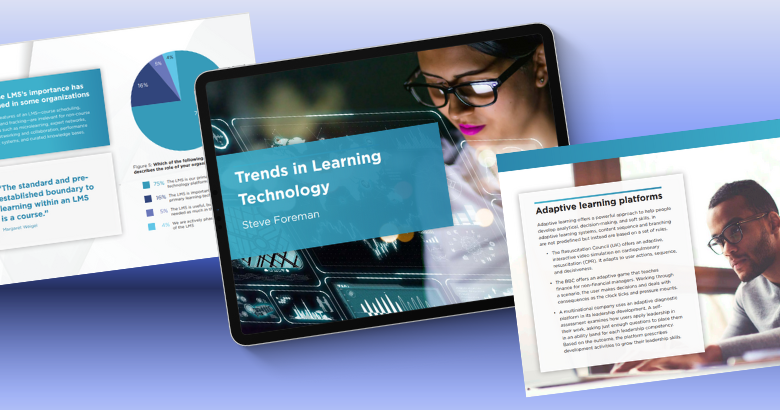
Trends in Learning Technology
How has learning technology changed L&D? This report examines multiple learning tools and platforms to explore their uses in our industry today.
By Steve Foreman • -

Access to Experts: Seven Steps to Leveraging the Expertise in Your Organization
Can people in your organization get critical expert advice with ease and confidence? Here are seven steps to create or improve your expert network.
By Steve Foreman • -
Managing Organizational Knowledge
Managing organizational knowledge can make the difference between enterprise success and failure. This white paper explores the potential of knowledge management and what it means for organizational learning.
By marc-rosenberg, Steve Foreman • -

eLearning Authoring: Taking the Next Step with xAPI
Authoring tools make it possible to create eLearning products, even by designers with no programming skills. These tools evolve constantly, but few of them have done much with the Experience API (xAPI). xAPI can do more than simply replicate SCORM’s tracking mechanisms. In this article, the authors offer new visions for xAPI that will create more effective and engaging online courses.
-

Are You an ISD, a Business Process Engineer, or Both?
When human performance problems have their root causes in broken business processes, missing policies, inadequate standards, or poorly designed systems, training alone (including eLearning) may not be an effective solution. The Experience API can help in these cases. Here is a fictitious scenario that illustrates how to use xAPI to optimize the work environment.
-

xAPI and Analytics: Measuring Your Way to Success
Applying xAPI and analytics to measure learning and work outcomes enables you to go beyond just front-end analysis to continuously analyze your learning and performance solution’s impact on business results. This approach enables you to adapt your learning and performance solutions in response to the ever-changing needs and priorities of the business. Read all about how to do this here!
-

Learning and Performance Ecosystems: Current State and Challenges
Steve Foreman analyzes the results of a survey about the prevalence of learning and performance ecosystems, their building blocks, and the key challenges faced in developing innovative learning and performance solutions.
By Steve Foreman •