



Latest from No Author
-

Your LMS Called. It Wants 2016 Back: Why Organizations Need a Learning Partner Built for the AI Era.
Most LMSs were built to prove that people finished training, not that the training made a difference. So L&D teams report completions to a business that wants results. Meanwhile, the most advanced organizations have moved on. Take industrial manufacturer VEIDEC, which replaced static, classroom-style courses with on-demand, AI-localized microlearning, driving a +13.5% revenue lift across core European markets and an 11.6x sales surge on key focus products. Leading organizations measure things differently, expect more from their learning partners, and are already testing the AI that will be standard practice within 18 months. In this session, Fuse Founder Steve Dineen and AI…
-

No Evidence, No Adoption: Why Capability Frameworks Stall After Launch
Capability frameworks take months to build. They get signed off, rolled out, used for one review cycle, and then they go quiet. Managers stop referencing them. Employees don’t open their plans again. The framework becomes a system nobody visits. Design is not what went wrong. What separates the frameworks that are embedded from the ones that quietly die, is whether they produce tangible results. An assessment finds a gap. The gap becomes a plan the employee owns. The plan becomes targeted learning. Run it once and it is an exercise. Run it again against the same standard to yield results.…
-

Balancing AI and Human Expertise to Scale Global Learning at Cummins
Global training only works when it reaches people in their own language. But keeping content current across a hundred-plus languages every time it changes is one of the hardest scale challenges in learning and enablement today. Cummins, a global power and technology leader with more than 70,000 employees, tackled this by building a localization approach that pairs AI-assisted translation with structured human review and technical validation. Their enablement team moved away from manual course rebuilds, to a workflow where reviewers focus on nuance, terminology, and compliance while AI handles repetitive first-pass translation at scale. The team was able to significantly…
-

Designing Interactions That Drive Learning, Not Just Engagement
Great interactions do more than keep learners clicking; they help learners think, decide, practice, and apply. In this webinar, we’ll explore how instructional designers can move beyond interactions that simply add visual interest and instead create experiences that support meaningful learning outcomes. Through practical examples, discover how to design interactions that encourage active participation, reinforce key concepts, provide purposeful feedback, and give learners opportunities to practice skills in context. By the end of the webinar, you will be able to:
-
Demo of MadCap Syndicate: Give Your AI Coach the Trusted Content It Needs
AI-powered digital coaches need more than a strong interface. They need current, governed learning content behind them. Without that foundation, coaches risk delivering inaccurate answers, outdated information, or the wrong resources. In this demo, see how MadCap Create and MadCap Syndicate make approved learning content available to AI agents through search, APIs, and MCP. Explore how organizations can connect digital coaches and other AI experiences with trusted learning content, including documents, rich media, and eLearning assets, and deliver those resources to learners when they need them.
-
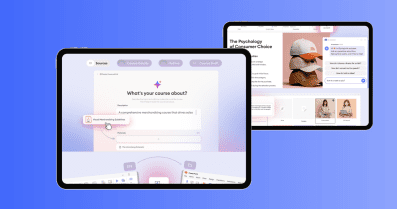
AI Innovation in Course Development: The iSpring Suite AI Example
Artificial intelligence (AI) is becoming a more integrated part of course development. Beyond drafting text, today’s AI capabilities can support tasks across the production workflow, from developing course structures and creating visuals to generating narration and translating content. AI Innovation in Course Development: The iSpring Suite AI Example explores six practical ways AI is changing course production, using iSpring Suite AI as a case in point. See how AI can help turn trusted source materials into structured course drafts, create targeted visuals and voiceovers, localize content, develop presenter-led videos, and provide guidance during authoring. Explore what these capabilities look like…
-
Use AI Effectively & Safely in High-Risk Environments
This session explores the practical boundaries between human decision-making and AI-supported work in instructional design. It introduces a clear distinction between traditional automation and generative AI and examines how each can be used effectively without compromising accuracy, compliance, or defensibility. Grounded in experience across military, education, and DOE-aligned training environments, this session focuses on the realities of designing training in high-consequence, regulated contexts where decisions must be auditable and outcomes must be defensible. Through real-world examples and contrasting use cases, we will explore where AI can act as a true force multiplier, where it introduces hidden risks, and how to…
-
Getting Real About AI in Professional Coaching: What to Do & What to Avoid
We will examine what worked really well and what didn’t. I will share outcomes that surprised us as I walk through our design decisions and show where we saw genuine value, where AI fell short, and what we would do differently. You’ll map your own programs against an AI-readiness framework and receive a downloadable AI Coaching Integration Checklist, a practical one-page tool that walks through key questions to ask. You will leave with:
-
Tame SME Chaos with an Efficient AI‑Powered Workflow
This practical session introduces an AI-powered workflow for transforming unstructured SME input into a clear, usable learning blueprint while keeping instructional judgment firmly in human hands. Using real-world case examples, the session demonstrates how AI can be applied at three key points: We will examine examples of AI outputs that worked well and those that missed the mark to highlight common pitfalls, lessons learned, and best practices. You will practice identifying gaps, challenging assumptions, and using instructional design principles to refine AI?generated analysis. We will emphasize transferable prompts, review strategies, and safeguards that you can apply across tools and organizations.…
-
Diagnose, Then Design: Using AI to Close the Gaps Training Alone Can’t Fix
This session draws from real-world application in a financial services environment to explore how to use AI as a reasoning partner in performance diagnosis. Throughout the session, you will work through a four-part framework, apply it to a real challenge from your own organization, and leave with a clearer picture of what’s actually blocking performance and what kind of intervention will actually help. You will learn to: