What if taking atraining course were as interesting and engaging as watching a good movie? Whatif people in your organization were not only eager to take your e-Learningcourse but were disappointed when it was over? Sound too good to be true? Well,maybe it’s not. Maybe the challenge is not a technical one but a creative one.
Some companies aresuccessfully using the techniques and approaches that the film and TVindustries use to capture and cultivate our attention, and are applying them toorganizational learning.
Before citing somespecific examples lets look at what’s been going on in e-Learning in recentyears. Let’s look at how we hoped e-Learning would be embraced versus how it actuallyhas been embraced. The expected rate of adoption of e-Learning in themarketplace differs significantly from the actual adoption rate. (See Figure 1.) There are a myriad reasons for this but it seems that learner resistance and finding the time are very near thetop of the list.
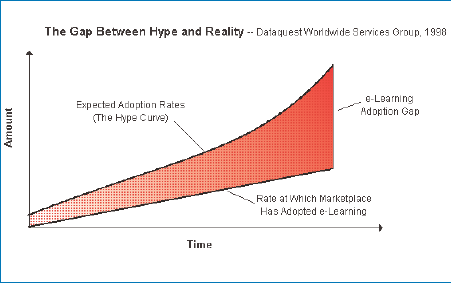
FIGURE 1 The expected rate of adoption of e-Learning differs significantly from the actual adoption rate.
Finding the time is acorporate culture and management issue but I believe learner resistance issomething very different. Could it be that people resist e-Learning in theircompanies because, well…it’s boring? Could it be due to the fact that most e-Learningis still text-based with the odd JPEG or MPEG thrown in for good measure?
“We providee-Learning” tells you as much about how a company delivers learning as “I’m aconsultant” tells you what someone does for a living. At one end of thee-Learning spectrum is the static page full of text with a “Next” link at thebottom. At the other end is rich, compelling, well designed, interactivemultimedia that engages intrigues, excites, and more importantly… seems towork. It’s the latter that I will address here — the fun stuff that learnerslove to engage with and want more of. Most e-Learning we see lives somewhere onthe scale between these extremes and too often it’s towards the lower end ofthe scale. Too many companies invested in the idea of e-Learning rather thaninvesting in the design of effective e-Learning. Some organizations are moreconcerned with broadcasting the fact that they now have “e-Learning solutions”than in shaping and determining its value.
The costeffectiveness paradox
Organizations speak alot about the cost effectiveness of e-Learning solutions. Every e-Learningwebsite you see shows the graph of e-Learning costs vs. traditional instructor-led-training(ILT) costs and how hundreds of thousands of dollars can be saved. However, theresearch shows that most evidence for effectiveness is purely qualitative. TheKirkpatrick evaluation levels 2 through 4 are rarely applied to e-Learning (SeeSidebar 1 “Kirkpatrick Evaluation Levels”).
Kirkpatrick’s four progressive levels of evaluation: Level 4: Results is ameasure of the businessoutcomes that occurbecause they aredoing their jobsdifferently. Level 3: Transfer is a measureof changes in their behaviorwhen they return to the jobafter the training program. Level 2: Learning is a measureof what they learned. Level 1: Reaction is a measure of learners’ reactions to the course. |  |
Judith B. Strother ofthe Florida Institute of Technology reviewed e-Learning research in April 2002with a paper entitled, “An Assessment of the Effectiveness of e-Learning in CorporateTraining Programs.” She writes:
“Wise trainingmanagers realize ‘the bitterness of poor quality remains long after thesweetness of low price has been forgotten.’ To justify making decisions about trainingprograms independently of training cost considerations, managers need concrete measuresof program effectiveness. While there is no doubt that we see an increasingnumber of case studies showing success with e-Learning, it is still difficult tofind solid research measures of learner achievement in the specialized settingof a corporate training program.”
“An American Societyof Training and Development (ASTD) study found that 67 percent of the trainingdirectors interviewed do not measure the effectiveness of their web-basedprograms at all.” And in her conclusion:
“While few peopledebate the obvious advantages of e-Learning, systematic research is needed toconfirm that learners are actually acquiring and using the skills that arebeing taught online, and that e-Learning is the best way to achieve the outcomesin a corporate environment.”
Most of us believethat e-Learning definitely has value and can be effective but as the researchshows — most companies are not measuring the learning, transfer and results inany quantitative fashion.
So we don’t reallyknow how effective traditional e-Learning is — we can only go by smile sheetsand a warm feeling in our stomach. Could it be that e-Learning is much lesseffective than it could be? Could it be we are just now scratching the surfaceof its possibilities? Yes — I believe this to be the case. And it’s not themedium and the technology that’s holding us back, it’s the way we are utilizingthem. It’s a lack of instructional design sophistication and creativity. If wewant to see the true power of what new media technologies can do for learningthen we need to take our focus off of e-Learning management for a moment andput it on instructional design using the breadth of media that’s available tous.
I’ve highlightedseveral companies that are doing just this and making an effort to use therichness of new media to bring something more powerful and engaging to thee-Learning experience. As well as looking at e-Learning in the cognitive domain (the predominant useof e-Learning today) we’ll take a look at e-Learning in the affective domain; such things ascommunication, management, leadership skills, and other professionaldevelopment skills. (See sidebar 2, “Bloom’s Domains”)
The results of Benjamin Bloom’s research in the 1950’s on the analysis of academic learning behaviors produced what is known today in the field of education, as Bloom’s Taxonomy. This hierarchy of learning behaviors was categorized into three interrelated and overlapping learning domains: the cognitive (knowledge), affective (attitude), and psychomotor (skills).
The Cognitive Domain
The Cognitive Learning Domain is exhibited by a person’s intellectual abilities. Cognitive learning behaviors are characterized by observable and unobservable skills such as comprehending information, organizing ideas, and evaluating information and actions.
The Affective Domain
The Affective Learning Domain addresses a learner’s emotions towards learning experiences. A learner’s attitudes, interest, attention, awareness, and values are demonstrated by affective behaviors. Most soft-skills training is primarily concerned with this domain.
The Psychomotor Domain
The psychomotor domain refers to the use of basic motor skills, coordination, and physical movement. These physical behaviors are learned through repetitive practice. A learner’s ability to perform these skills is based on precision, speed, distance, and technique.
“Soft skills” ande-Learning
The management,leadership and professional development area of training has so far proveddifficult for many e-Learning companies to implement effectively. It is a challengefor e-Learning because we are attempting not to simply inform, teach cognitive skills,and build literacy but to change someone’s attitude, behavior and the way theyrelate in the world.
Teaching these skillseffectively using technology solutions has always been a challenge but somecompanies are putting a stake in the ground with some compelling solutions.Some of these companies are thinking “outside the box” and using new media inways we don’t often see in e-Learning.
So what is it that isneeded to teach soft skills effectively? How can we affect someone’s behavior?How do we affect a learner’s relationships with others, develop awareness,influence value judgments, and change attitudes and behavior?
In each of theseareas we want to create a lasting change. In order to effect lasting changes in behavior we need to affect a person’s emotions. In arecent eLearning Guild online poll, people were asked, “What is your biggestchallenge in implementing e-Learning?” Respondents said “learner resistance”was by far the biggest challenge. Why is this? Do people not enjoy learning? Idoubt it. Is the subject matter not relevant to their job? Perhaps. Are theyare too busy to attend training? Maybe. Could it be that the training isn’tinteresting, engaging, compelling and fun? A resounding Yes! Current e-Learningsolutions are not engaging their audience sufficiently. It’s the same problem wehave in schools — children play interactive video games, watch TV and movies,and then are bored to death watching Mr. Smith scribble words on a whiteboard.
In order to engage,interest and motivate, our emotions need to be put in gear. When this happensthe reticular activating system in your brain gets activated. (See sidebar 3,“Reticular Activating System” .)
The Reticular Activating System is the attention center in the brain. It is the key to learning and is thought to be the center of motivation. The Reticular Activating System is a complex bunch of neurons which serves as a focal point for signals from the external world and from your inside world. It is the part of your brain where the world outside and your thoughts and feelings meet. It plays a significant role in determining whether a person can learn and remember things well or not, and whether a person is highly motivated or bored easily.
Moving images,sounds, music, light, interaction, drama and narrative all get the reticularactivating system working overtime. Bullet points in a browser don’t!
What typicallyprovides most of these in our life? Television and movies? Is watching TVrelaxing? Yes. Is it engaging? Yes. Is it enjoyable? Yes. Do we learn anything?Yes. Does it affect the way we behave and think about the world? Yes.
TV and movies are, byfar, two of the most powerful motivators and influencers in our life. And welove to watch them. They engage our interest and stimulate our emotions. We getengaged whenever and wherever we see a screen flickering. We even learn aboutthings we’re not interested in.
What if e-Learninghad this power to draw people in and have them glued? Could soft skills betaught more effectively? You betcha! Would learner resistance still be aproblem? Probably not!
Companies using mediaeffectively
Only a few companiesseem to be innovating in this genre of training product. Notables are NinthHouse, Trainingscape and substanz: — all based (coincidentally) in
Ninth House
Ninth House is knownfor providing business skills training, which leverages content from thinkerssuch as Tom Peters, Ken Blanchard, and Peter Senge. They have a catalog ofbusiness and management courses that utilize rich media and interactivesimulations.
CEO Jeff Snipes sayshis strategy is, “…to create content so compelling that job training becomesa healthful habit, the corporate equivalent of daily exercise,”
Snipes works with amix of
1. Intellectualproperty of business thinkers (the content of the training)
2. Engaging use ofmedia (the form of the delivery)
3. Implementation(transferring what is learned to the workplace) They have paid particularattention to the second one — the use of media. In their “eSeries,” Ninth Houseuses full motion video and interactive simulations to provide what they say is,“…high learner absorption and retention via engaging, entertaining andinteractive ways that enables learning by experience.”
The interactivesimulations allow employees to practice skills learned in the courses beforeapplying them in the real world. By making decisions for characters in a seriesof TV-style episodes, learners test their knowledge in stories surrounding afictional business and some of the challenges it faces.
One of theseinteractive simulations is “High Impact Hiring” based on a book by Joseph Rosseand Robert Levin called High-ImpactHiring: A Comprehensive Guide to Performance-Based Hiring. The course teacheshiring managers to use performance-based strategies to quickly and successfullyidentify the right talent for their organization in a highly competitive labor market.
This video dramatakes place at WileyToys.com where Ty Meldy, the Division Director is searchingfor a new division controller. “Helpful” co-workers who want to assist him withthe search and help him make the right hiring decisions surround him. The storycombines professionally produced, TV-style drama and each video segmentaddresses a specific learning point. (See Figure 2.)

FIGURE 2 The “High Impact Hiring” video drama teaches managers to use performance based strategies.
The drama islight-hearted and humorous and at the end of each segment the learner is askedto make a choice of the best strategy or course of action. Then a video segmentis played out showing you the consequences of your choice — a type ofmulti-path story that guides you in the right direction. You can observe firsthand the outcome and possible impact of a poor decision. In the case of Ty youcan often see comical consequences of poor choices you have him make. You getto experience failure gently.
The interactivesimulations are part of a larger training process that includes developing awareness,visual modeling of performance, role-playing, workplace application and rewardsprograms. Ninth House has also used rich media in its “Instant Advice” productto create some “just-in-time” online learning modules their customers can accessanytime they have a question. With a keyword search you can bring up a windowwith streaming video that addresses such topics as “Asking for Help,”“Providing Praise,” etc. — small video nuggets that convey information in a memorableform.
“Our goal is to bringtogether knowledge, technology, and entertainment to create broadband learningexperiences that stick,” says Snipes.
Trainingscape
Trainingscape, withthe tagline “Emotionally Charged Learning,” is utilizing similar entertainmentindustry approaches to deliver its animation and video movies. They have astaff of professional producers, cameramen, and actors, and create titles forprofessional development, leadership and compliance.
Eric Schiffer, theCEO at Trainingscape says, “Our goal has been to use sophisticated movieindustry techniques to be able to engage people at an emotional level and thereforereinforce and cement their learning.” Schiffer and his team are proud of theirlatest offering on Situational Leadership” — it’s what you might call a SciFi trainingmovie. It’s set in the year 2176 and designed to teach the leadership processthat Dr. Paul Hersey has pioneered and evolved during the past 30 years.
Schiffer compares hisproduct to watching a feature film and getting pulled in emotionally. “We takeyou on a journey — we pull you from your current reality into this new world.”The new leadership “journey” as they call it, streams animation segments acrossthe net and is presented through Flash via a browser. (See Figure 3.)

FIGURE 3 “Situational Leadership”
applies sophisticated animation.
The journey startswith a screen image as if you are sitting in a movie theater. The movie playsout in the center of the screen and we see text fade in slowly and dramaticallyto set the scene. “An environmental catastrophe forced a mass exodus of Earth.Oxygen is the sole currency for the new interstellar communities. Only fournations have survived,
Schiffer does not seehis products as occupying the same space as other e- Learning products in theindustry. He considers what Trainingscape is doing is worlds away from what’scurrently available in the marketplace. “Our competition is not othere-Learning companies, it’s Time Warner, Disney and Electronic Arts.”
substanz:
substanz: is anothercompany that utilizes the emotional impact of film and has taken management andleadership training one step further. substanz: also uses stories and themedium of movies to engage learners but with a twist — you can interact withthe characters and experience multiple perspectives. They call their product a“hyperstory.”
A hyperstory issimilar in concept to a hyper-link except that instead of linking to anotherpage you link to another perspective. Substanz: describes it as “aninteractive, multi-perspective ‘story’ that uses the engaging quality of amovie to create an evolving learning experience.”
Hyperstories areshort movies with live actors, dialog and a storyline that highlights aspecific scenario. The story is told in classic movie-style drama andsubstanz:, like Trainingscape, has gone to great lengths to create high-endproductions. The sets, scripting and acting are impressive.
At certain timeswithin the hyperstory, you can choose to change perspective and see exactly thesame events but from another character’s point of view. When you do this,things appear a little different. What seemed an appropriate comment or behaviorthrough one set of eyes, now takes on new meaning from this other viewpoint.The concrete events that happen remain exactly the same but the interpretation andnuance are different.
Craig Ashby, one ofthe founders of substanz: says the multiple perspectives within the interactivemovies are key to their approach to teaching management and leadership skills.“Multiple perspectives are important because in any management or professionaldevelopment training one of the biggest hurdles to overcome are those ofunderstanding and appreciating another’s point of view. Understanding andvaluing another opinion, attitude, or behavior is the first major step in beingable to change our own response and behavior.”
One of the firsthyperstory products that substanz: developed was a “Transition to Management”training program for the Boeing Leadership Center.
Boeing was facing thechallenge of assisting up to a thousand new, first-level managers, from diversebusiness units, in making the transition from individual contributors tomanager-leaders. They wanted something other than a point-and-click leadership-training program, something that could really engage and involve theiraudience. They needed a program that could be delivered remotely and yet stillfeel human and enriching to the participants.
One of the specificgoals that they needed to achieve was to use an exciting, experiential, story-basedlearning tool that incorporated new types of interfaces and restored learnercontrol. They also wanted to create a program that wasn’t based on “right” and“wrong” but that instead stimulated open dialog.
“Transition toManagement” is based around a fictitious magazine called “One”. (See Figure 4.)As trainees experience the hyperstory on their PC or laptop, a drama unfoldsbased on the three main characters: a newly promoted manager, a team member anda manager of another department. We see Chloe, the new manager, hold her firststaff meeting as team leader and deliver a speech to the co-workers she used towork alongside. Everything appears to go well, Chloe is energized, communicateswell and feels she has inspired the team.
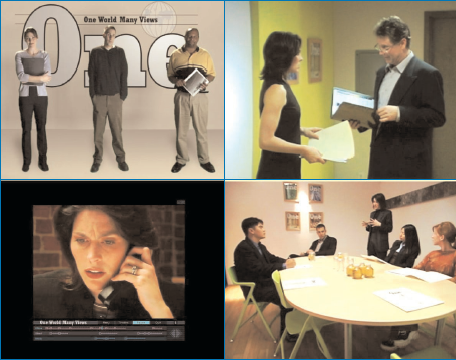
FIGURE 4 Four scenes from the “Transition to Management” hyperstory illustrate production values that add emotional impact.
Back in her office, alittle later, things start to heat up when her old team mate and friend Stuartstrides into her office and asks for a raise — he feels his contributions tothe business are not recognized. He is upset and a little aggressive. Chloe isa little shocked by this and as the story develops we see the relationshipbetween Chloe and Stuart start to deteriorate. Her relationship and rapportwith other staff also starts to become a little uneven.
We can sympathizewith Chloe, she seems to be managing things, listening to concerns andcommunicating well… or is she? After watching the story all the way throughthe management trainees have a teleconference and a facilitated discussion abouttheir impressions, judgments and reactions.
Shortly afterwardsthe participants discover that they have been seeing everything from Chloe’sperspective. Trainees are now told that at certain key points in the story it’spossible to click on other characters in the story and see things from theirperspective. When they do this, things begin to look a little different.
When they click onStuart in the staff meeting they see Chloe delivering the same speech as beforebut in a more dis-jointed and nervous fashion. It is evident she is notinvolving the team in her conversation but appears to be talking at them. Stuartraises a hand several times, perhaps to ask a question or clarify something, buthis request goes unnoticed by Chloe. The other staff exchange glances and raiseeyebrows. There are a few uncomfortable pauses in Chloe’s speech that add tothe sense that she is unsure of herself and her new role.
Later when Stuartstrides into Chloe’s office he no longer seems the aggressive, demanding personthat we saw earlier but a much calmer individual making what seems likereasonable, measured requests of his manager. We are reminded, as we seeStuart’s view of the situation, that it is our perceptions and biases thatdefine our reality, not simply the words that are spoken. At the nextteleconference for the trainees the discussions take on a new dimension as theyconsider each character’s interpretation of events and their resultingbehavior. No black and white answers but rather a whole array of subtleties, complexitiesand grays.
“The hyperstory isnot intended as a complete stand-alone training solution, it’s a catalyst inthe learning process,” says Ashby, “it’s designed to engage, stimulate interestand be the reference point for discussion.”
So far, it seems, thetrainees have embraced this interactive movie approach to learning. The resultsinclude very high completion rates, a much higher level of engagement intraining, and a greater enthusiasm for participating in the training.
Engaging the learner
Too many organizationslook to fast delivery, learning management or online testing and evaluation forsolving some of their learning challenges. However, the real issue is engagingthe learner such that he or she wants to learn, wants to know more and discovermore. Getting and maintaining the learner’s attention is the key.
Because animations,movies and hyperstories are created in a medium that we are all intimate with,our attention is captured immediately. It’s not easy to just watch a part of it— we have to see it all, get the whole story, and see how things play out.Compare this to reading text in a browser or listening to an instructor teach frombullet-points on an overhead.
Stories are powerful!We remember stories because they are a narrative of events. Events can havemeaning on their own, but a much greater meaning and impact when strungtogether. Think of the meaning of words individually or inside a sentence. Pixelsof a graphic image seen close up are simply squares of color, but from adistance they become a recognizable pattern. Our brain is a powerful patternrecognition device. Stories are patterns of events. Think of all the greatspeakers who relate a story to make a point.
Well-produced andwell-scripted film can relate a dramatic story that affects us on an emotionallevel. The colors, camera movements, and incidental music all combine to affectand move the viewer at a deeper emotional level. If emotion is attached to animage or event it is cemented forever in our brain’s vast web of neurons.
And in the case ofthe substanz: hyperstories, we have the tool of multiple perspectives. The ideaof being able to access a different “reality” — to see a situation frommultiple points of view hits on one of the crucial keys to management, leadershipand professional development. The idea of being able to understand and live inanother’s shoes… empathy. Think of the amount of communication problems inorganizations that stem from either not understanding or not appreciatinganother’s point of view.
An enormous number ofcompanies have attempted to move e-Learning forward by means of technologyalone. They hang on to the linear, stream-of-information theory of learning,and use technology only to deliver it faster and further. They focus on movingit, delivering it and managing it. They rarely focus on “it” — that is, theform and substance of the learning. It’s using new media to bring the form andcontent of learning to life that’s going to solve the “learner resistance”problem we are seeing. Concentrating on bringing the content to life —literally — can enable e-Learning to become what effective learning has alwaysbeen — interesting, engaging and fun.
(Editor’s note: There are many skill sets, budget issues, anddevelopment cycle changes involved in creating compelling content. We will beaddressing these in future articles.)