In this article, I outline how performance support became a pivotalcomponent in the approach taken by Bayer’s crop science division to shapefunctional skills and contribute to achieving business outcomes. I will beginby telling you a little about our company and the crop science division.
Bayer is a life science company with a more than 150-year history andcore competencies in health care and agriculture. It develops new molecules foruse in products and solutions to improve the health of humans, animals, andplants. Bayer’s research and development activities are based on a profoundunderstanding of the biochemical processes in living organisms.
With its products, Bayer aims to contribute to finding solutions to someof the major challenges of our time. The growing and increasingly aging worldpopulation requires improved medical care and an adequate supply of food. Bayeris working to improve people’s quality of life by preventing, alleviating, andcuring diseases. The company helps to provide a reliable supply of high-qualityfood, feed, and plant-based raw materials.
The crop science division has businesses in seeds, crop protection, andnon-agricultural pest control. It is organized into two operating units: cropprotection/seeds and environmental science. Crop protection/seeds markets abroad portfolio of high-value seeds along with chemical and biological pestmanagement solutions, at the same time providing customer service for modernand sustainable agriculture. All marketing and sales colleagues in this areaare the target group for SkillCamp, the learning initiative described here.
Organizationalcontext (strategy, and marketing and sales)
Bayer’s crop science division is headquartered in Germany and isstructured in global, regional, and local country organizations. Marketing andsales (M&S) activities are organized as “commercial excellence” andpartially coordinated by a global marketing department. Global trainingactivities are steered from headquarters.
Whatis the SkillCamp learning framework?
SkillCamp is a globally steered marketing and sales (commercialexcellence) training initiative targeting several thousand marketing and salescolleagues across many countries. The central element for all of SkillCamp isour customer-centric 12-step go-to-market approach, which covers four stages(Figure 1):
1) Creating (customer) insights
2) Creating value propositions
3) Creating success
4) Measuring success
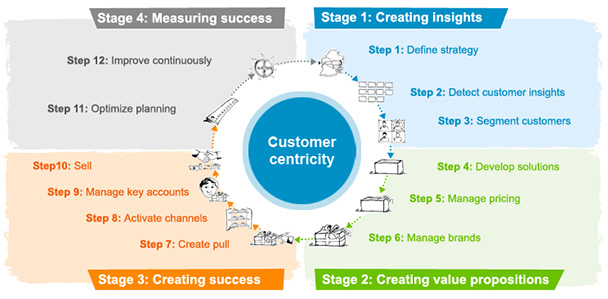
Figure1: The 12-step go-to-market approach
The cornerstone of all SkillCamp learning activities is an electronicrepository for all relevant and actionable information that serves as a singlepoint of reference and truth for all global colleagues in marketing and salesas well as their key interfaces. This so-called EPSS (electronic performance supportsystem) needs constant updates and revision via a tightly organized “curation”process to ensure that content remains current and can always be trusted. (Moredetails on this below.)
The first SkillCamp training format that we developed was a three-daySkillCamp foundational training that aims to provide a sustainable overview ofour 12-step go-to-market approach for commercial excellence, using astate-of-the-art mix of methodologies (lectures,exercises, case studies, simulation elements, crop science, and other industryexamples), and an introduction to our performance support system,SkillCamp Online.
While this format was rolled out to more than 4,000 colleagues within threeyears and continues to be available on an ongoing basis, we continually addother training formats—for example, webinars or classroom deep dives inspecific areas of our go-to-market approach.
This way, SkillCamp links seamlessly into a lot of other traininginitiatives within Bayer as a much larger company.
Initialsetup and motivation
While the crop sciencedivision had professional marketing and sales training as well as co-operationswith universities before the creation of SkillCamp, there was also somefundamental criticism toward these approaches.
Content was oftenaddressed more from an academic or textbook perspective, even when working withcase studies. Learning content was detached from the real working environmentof the learning individual. Once participants returned from the inspiringclassroom training to their offices, they were quickly overtaken by their dailytasks and worked with colleagues who shared none of the insights from thattraining. We saw opportunities to align marketing and sales activities in abetter way by integrating learning through a comprehensive performance support solutionto the workplace.
Before SkillCampwas started, Bayer made a strategic decision to accelerate the transformationtoward stronger and more integrated marketing and sales organizations. Relevantcompetency criteria were defined with a top-down as well as a bottom-upalignment approach. In order to really meet our internal needs for a learningframework, we held many stakeholder interviews, for example with seniormanagers, marketing and sales leaders, subject matter experts, and potentialparticipants.
As we ventured intoimplementing our new approaches, we soon realized that we really needed a commonstoryline and common language to consistently convey our messages, processes,and ideas.
This is where we createdSkillCamp as our marketing and sales training framework. It takes content andcustomizes it with the relevant industry details and competency elements.
As we createdSkillCamp and looked for a compelling story on how to teach commercialexcellence, we defined our storyline not only for training, but for commercialexcellence as such. In this way, our 12-step go-to-market approach was actuallycreated from the need for a motivation for commercial excellence withinSkillCamp.
We linked thereality of our business to how we teach it. One of our mantras is: “We need toteach what we do and we need to do what we teach.” The creation of training islinked to our strategic goals.
The 12 steps arenow the essential framework of commercial excellence in Bayer’s crop science division.
Performancesupport
Conrad Gottfredson and Bob Mosher define performance support (PS) as “providingintuitive, tailored aid to a person at his or her moment of need to ensure the mosteffective performance on the job” (see References). This could be, for example,checklists, templates, job aids, or simply signs in a hallway.
An EPSS is a technologythat, through following a PS methodology, helps people to learn in the workflow and recover ontheir own quickly from mistakes they make.
SkillCamp focuses on providing our commercial excellence resources from asingle source of reference, the EPSS that we call SkillCamp Online. Besidesproviding moment-of-need task and concept support, SkillCamp Online also providesresources such as checklists, templates, contacts, glossary terms, tools,plans, examples, concepts, and videos.
The basic ideais that an employee downloads, for example, an Excel tool and starts using itin her workflow. In SkillCamp Online, she will then find the manual or detailedexplanation on how to use or fill in this Excel tool. She can have the EPSSopen in parallel and use it as a help function that guides her through theprocess of using the tool for her own purposes.
In this way,SkillCamp Online serves as a single point of reference to find tools, and itprovides performance support for applying the tools.
Contentstructure
The contextfor all content in our performance support system are the 12 steps outlinedearlier (see Figure 1) that represent areas of work for our marketing and salesstaff and their key interfaces. The content along our 12 steps is broken downinto work tasks. Work tasks are broken down further into actions below eachtask. For all described tasks, we also provide relevant resources like tools,checklists, or examples. We believe that truly connecting the learning contentto the “context” of the Bayer employees is crucial for its success.
We illustratethis principle with the content pyramid described by Gottfredson in “the fivemoments of learning need” (Figure 2).
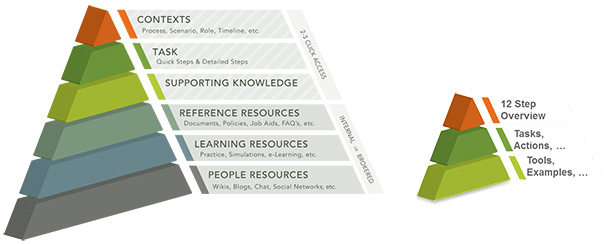
Figure2: Gottfredson’s content pyramid (left) and the 12-step process (right),related via color coding
The overallidea is that employees can navigate and learn about all relevant resources atone single point of reference. Within the overall SkillCamp learning framework,we will provide classroom and other training formats on certain tasks orclosely related areas. But at any time, users can access and use the entiretyof content that could be relevant for their daily work in SkillCamp Online. Toensure that our employees use our SkillCamp Online resources in the right way,we have integrated these resources as an important tool within our trainings.In fact, in the meantime, the SkillCamp Online tool replaces the traditionalPowerPoint slides in many areas.
SkillCampsuccess criteria and metrics
When designingSkillCamp, we held many stakeholder interviews and learned that key elements ofa successful learning approach would be a common and consistently used terminologyor language, a close cooperation between marketing and sales, relevant examplesfrom our and other industries, continuity, top-down support, and a close linkto implementation.
Based on thisinsight, we defined our first challenges, which were:
- To train around 4,500 colleagues in marketing and sales functions andtheir key interfaces with a SkillCamp foundational classroom training
- To ensure a common mindset and language around our 12-step go-to-market approach
- To provide relevant and actionable processes and tools for the dailywork of those colleagues in an EPSS
SkillCampobjectives
Once running with our trainings, we defined five clear objectives forSkillCamp as a sustainable functional learning and performance initiative.These objectives are defined along the learning journey of the individuallearner. SkillCamp:
- Provides sustainable learning, i.e., learning thatsticks
- Helps learners to use available resources, e.g., viaan EPSS called SkillCamp Online that hosts resources like tools, examples,plans, and videos
- Aims to improve the performance of individual learnersand their communities—for example, their effectiveness, speed, depth ofknowledge, or contextual understanding
- Aims to improve sharing and community building acrossour organization globally, regionally, and locally
- Continuously improves the content, learning material,know-how, and messaging of commercial excellence
We measure these objectives with specific indicators for each of ourfive goals.
Thereturn on investment of the SkillCamp initiative must be seen in the resultsgenerated via the learning or via the application of what has been learned. Theinvestment in SkillCamp and SkillCamp Online cannot be justified only viaclassic feedback mechanisms like participation rates and participant feedbacksheets. We must also ask whether participants actually apply the learning intheir daily life at their moment of need, whether they actively use SkillCamp (Online)resources, and how they interact with our performance support and learningoffers. Eventually, we should be able to see if these measures lead to moresuccess in our market space.
Stakeholdersand SkillCamp advocates
It is essential to align and to be continually in touch with allrelevant stakeholders of such a global change initiative as SkillCamp in orderto get and keep their buy-in, support, and resources.
In addition to the identified stakeholders, we are building a communityof SkillCamp advocates. These are interested colleagues from around the worldwho give SkillCamp a local voice. Becoming a SkillCamp advocate is independentof one’s hierarchy or role within the organization; interest in the topic oflearning, facilitating, and supporting SkillCamp counts more toward being partof that group. SkillCamp advocates play a more and more central role inpromoting, explaining, leveraging, and improving all the ways people can use SkillCampas a meaningful learning framework to support our strategic goals.
Successfactors for large learning initiatives
We identified the following success factors for our SkillCampinitiative:
1) A clear andcommonly agreed upon objective with global alignment. It was veryimportant for us to clearly define the scope for SkillCamp: SkillCamp aims tocreate a common mindset for commercial excellence and provides globallyaccepted trainings and performance support resources for the marketing andsales functions. In order to achieve this, we held a lot of stakeholder interviews,continuously aligned what we were doing with global, regional, and localstakeholders, and eventually pressure-tested our first and foundationaltraining format with all marketing heads in our organization. We rolled out ourfirst learning format top-down in order to ensure maximum buy-in andmultiplication via our management layers.
2) Agreement tocall it a change initiative. Via linking training to ourstrategic company objectives, we positioned SkillCamp close to the business andtherefore were able to treat it as a global change initiative that really aimsto trigger behavioral changes in the learners that clearly can affect ourbusiness success.
3) The use ofperformance support. Our performance support system, SkillCamp Online, is acornerstone of the success of our initiative. It represents the single sourceof reference for our learners. It is an embedded system that providescontextual resources for daily work tasks. It enables the transfer andapplication of new insights and tools from the training stage into daily work,and therefore enables learners to sustainably access and use these resourcesand new skills.
4) The presenceof urgency. Without the new business focus on marketing and salesexcellence a few years ago, the total restart of our marketing and saleslearning activities would not have been possible. Only with a firm anchoring instrategic business objectives is it possible to successfully establish and runa large change or learning project.
5) Setting theright organizational framework to avoid potential break points. This pointaims to look at success factors from the perspective of potential breakpoints.In fact, we had asked this question during our stakeholder interviews: “Whatcan go wrong with an initiative like SkillCamp? Or … what are potential break points?”
Looking at SkillCamp from this point of view, it became clear that it could nothave worked without a clear organizational setup and clear responsibilities.Without the backing from top management, conflicting messages from otherprojects or academies would have made it very difficult for SkillCamp tothrive. If we had not connected SkillCamp with business objectives in the formof a change initiative, many would not have understood or invested intoSkillCamp because they would not have understood the relevance for them. Aclassic classroom or business school approach would not have been enough tomake it tangible, relevant, and sustainable in daily life. And finally, had wenot talked to all stakeholders and critics up front, it was likely that they wouldbring forward their concerns at a later stage. Such a delay would have left farfewer opportunities to build in their insights as well.
Keymessages
- Clarify: Whenembarking on large learning initiatives, it is important to clarify exactlywhat the objectives of the different stakeholders are and establish a consensuson the way forward. In our case, it took around nine months to get clarity.
- Establishclear milestones and objectives: In our case, we decided to target themajority of our global M&S staff with our foundational training andperformance support communication in order to really move the needle. We alsolinked SkillCamp to strategic company objectives and established clearSkillCamp objectives as well.
- Take yourtime: In our case, it took roughly three years to spread SkillCamp throughoutthe organization and establish buy-in and a very positive feedback regardingthe usefulness of the approach. SkillCamp was set up as a continuousinitiative, not as a project.
- Multiply: It helps todefine, in the beginning, large learning initiatives like SkillCamp as changeinitiatives. Once running, it is important to have a clearly identified groupof champions or advocates helping drive the initiative and making it locallyrelevant.
- Support performance: SkillCamp ison a continuous journey to reduce PowerPoint slides in training context.Instead, we want to explain where to find and how to apply relevant resourcesat the individual learner’s point of need with a state-of-the-art electronicperformance support system.
Outlook
The SkillCamp learning framework now offers several learning formatsbesides an extensive performance support approach. Examples are webinars orclassroom trainings. Since we rolled out our SkillCamp foundational trainingand introduced performance support for marketing and sales, employees now trulyuse a common language and common processes for commercial excellence. If amarketing manager from Malaysia meets a colleague from India at a regionalconference, they can quickly align and exchange their activities along our 12-stepgo-to-market approach. A sales manager from the US can easily contact the rightcolleagues at headquarters for specific questions, and a manager from NewZealand can benefit from a case study provided in France. A common language,common basic approaches, examples, tools, concepts, videos, and contacts areshared in the community via our EPSS.
Innovation for SkillCamp will likely lie in personalizing the contentprovided in our performance support, be it for specific roles or even forindividuals. Another interesting area is improved community features that couldhelp learners interact with one another when applying tools in their daily work,at their moment of need. If we can help the organization to interact in faster,more efficient, and interactive ways to serve the needs of our customers viausing commonly shared learning and performance support resources, we can make learningmuch more business relevant.
References
Gottfredson, Conrad, andBob Mosher. Innovative Performance Support:Strategies and Practices for Learning in the Workflow. New York, NY: McGraw-HillEducation, 2010.