
With publication of the2016 US eLearning Salary &Compensation Report, the gender pay gap continues to be a highlycontroversial topic, as it was for last year’s report. When we did our 2015survey, a large number of salary report readers said they wanted morecommentary and research about gender pay differences in a future report, whileothers said gender was not an issue for them and they did not want morediscussion of that topic.
Our sense was that weshould include more research and information about this important topic in thisyear’s report and other Guild publications. In this follow-up to our 2016salary report, we focus on additional information regarding the US gender paygap.
Gender and pay demographics
First, a few basics. Our analysis of gender and salaryvariables for 2015 was based upon the following demographics:
- Of this year’s grand total of 4,488 globalrespondents, 3,536 were United States respondents. In other words, 78.8% of allresponses received were from the US.
- Of this year’s total of 3,536 US respondents,1,327 (37.5%) were men.
- Of this year’s US respondents, 2,209 (62.5%)were women.
US average base salaries and gender
Regarding US salaries by gender (Figure 1), we found thatthe average salary for US men who participated in the 2016 survey is $88,347,while the average salary for 2016 US women participants is $75,561.
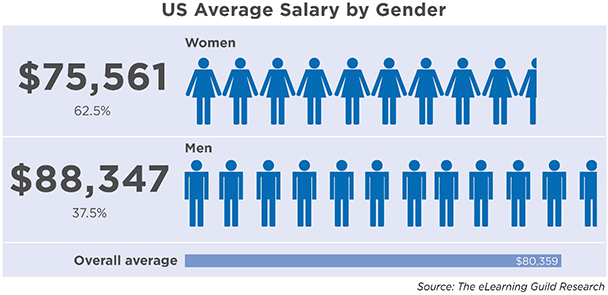
Figure 1: USaverage salaryby gender
Given the US average base salaries shown in Figure 2, theaverage base salaries for US women are nearly 14.5% less than for the US menwho participated in this study. The average US base salary for all studyparticipants, regardless of gender, is $80,359.
US average totalcompensation and gender
This year’s data provided us with an overall view of the USaverage total compensation (Figure 2).
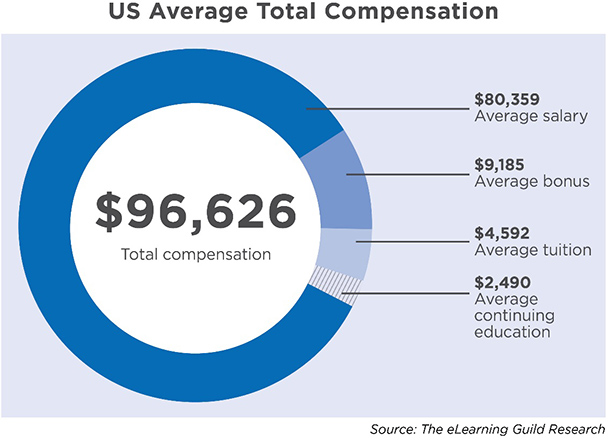
Figure 2: USaverage total compensation
Based on these data, the US average base salary has dropped by0.89% since last year, from $81,079 to $80,359.
The US averagebonus is $9,185. This US average is almost exactly in line with this year’sglobal bonus average of $9,036. (See the complete salary report for morediscussion of merit-increase timing as this relates to average amount of bonus.)
The US average tuition reimbursement amount is $4,592, and theaverage continuing education reimbursement amount is $2,490. Some companiesoffer both benefits; others, only one of the two. Keep in mind that theInternal Revenue Service has strict rules governing these types of benefitprograms as well as an annual dollar limit of $5,250 (see References).
Now, let us look at US average total compensation data bygender (Figure 3). We again see the 14.5% gap in total base salary and an evenwider gap of 35.3% in average bonus amounts. The gap between women’s averagetuition reimbursement ($4,516) and men’s ($4,713) is relatively small at 4.2%. Wesee another gap between women’s average continuing education reimbursement($2,280) and men’s ($2,819), but this time, the gap between the tworeimbursement amounts is substantially larger at 19.1%.
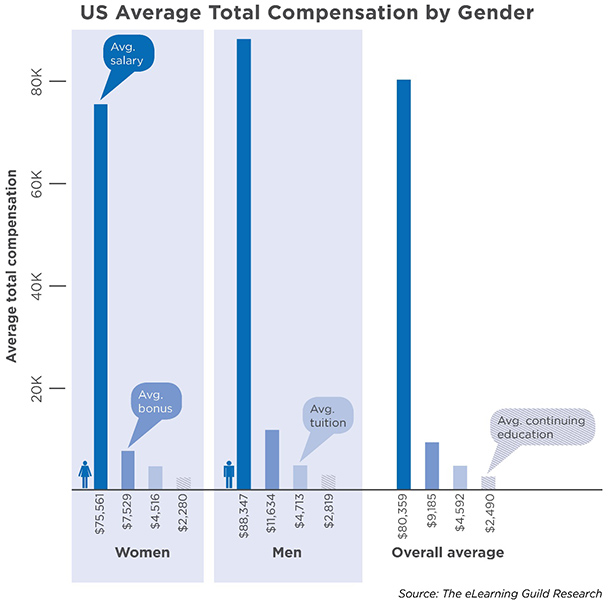
Figure 3: US average total compensationby gender
The gender pay gap controversy
It may come asa surprise to some that there are strong opinions about the existence of whatis called the “gender pay gap.” Our purpose here is only to frame thecontroversy and suggest some additional reading so that readers can form their ownopinions on the matter.
Viewpoint: The gender pay gap is real. The AmericanAssociation of University Womendefines the pay gap as follows: “The difference in men’s and women’s medianearnings, usually reported as either the earnings ratio between men and womenor as an actual pay gap. … The median value is the middle value, with equalnumbers of full-time workers earning more and earning less.”
In a report (seeReferences), the organization also states:
In 2014, women working full time inthe United States typically were paid just 79 percent of what men were paid, agap of 21 percent[.] The gap has narrowed since the 1970s … due largely to women’sprogress in education and workforce participation and to men’s wages rising ata slower rate. But progress has stalled in recent years, and the pay gap doesnot appear likely to go away on its own.
Viewpoint: The gender pay gap is mischaracterized. In starkcontrast, Hanna Rosin reported on “The Gender Wage Gap Lie” for Slate back in 2013 (see References), andsaid this:
How many times have you heard that “womenare paid 77 cents on the dollar for doing the same work as men”? Barack Obamasaid it during his last campaign. Women’s groups say it every April 9, which isEqual Pay Day. In preparation for Labor Day, a group protesting outside Macy’sthis week repeated it, too, holding up signs and sending out press releasessaying “women make $.77 to every dollar men make on the job.” I’ve heard theline enough times that I feel the need to set the record straight: It’s nottrue.
Theofficial Bureau of Labor Department statistics show that the median earnings offull-time female workers is 77 percent of the median earnings of full-time maleworkers. But that is very different than “77 cents on the dollar for doing thesame work as men.” The latter gives the impression that a man and a womanstanding next to each other doing the same job for the same number of hours getpaid different salaries. That’s not at all the case. “Full time” officiallymeans 35 hours, but men work more hours than women. That’s the first problem:We could be comparing men working 40 hours to women working 35.
Viewpoint: The gender pay gap isoverblown. Considerthis other viewpoint from Romina Boccia at the Heritage Foundation (seeReferences):
At78 cents on the dollar, the so-called wage gap represents the earnings ratiobetween male and female full-time median wage workers based on the CensusBureau’s 2013 Current Population Survey. If you divide the median earnings forwomen by those of men, you arrive at the wage gap. … When accounting forrelevant factors that affect pay, such as education, choice of industry andoccupation, hours worked, experience and career interruptions, the differencebetween average male and female wages shrinks to about 5 to 7 cents on thedollar. In other words, the earnings ratio between women and men becomes 93percent to 95 percent after accounting for relevant differentials betweenindividuals.
The gender pay message can be confusing
Not only are these viewpoints conflicting,but the statistical data and analytical interpretations reported in ournational media can be confusing at best and misleading at worst. For example,in some analytical circles and news reports, the gender pay gap seems to beshrinking.
Acase in point: In September 2015, WallStreet Journal writer Eric Morath reported, “The gender wage gap narrowedto the lowest level on record last year, but for every dollar a man earnedwomen took home 21 cents less, on average” (see References). The article wenton to say, “Women working full-time, year-round jobs earned 78.6% of whatsimilar men did in 2014, according to a Census report.” As shown in Figure 1, “that’sthe smallest gap on record back to 1960,” Morath writes. “The latest readingmarks a narrowing from 77.6% in 2013, but the change is not statistically significant. In fact, the pay gap hasn’tchanged meaningfully since 2007, when it was 77.8%.”

Source: The Wall Street Journal, September16, 2015
Figure 4: Female-to-male earnings ratio and medianearnings of full-time, year-round workers 15 years and older by sex: 1960 –2014
The Wall Street Journal took aslightly less positive viewpoint in October 2015, when Morath reported, “Thegender pay gap is widening again because men’s earnings are growing thisyear at twice the rate of women’s” (seeReferences). Morath continues: “The median weekly earnings for full-time male workerswas $889 in the third quarter, the Labor Department said.… That’sa 2.2% increase from a year earlier. Meanwhile, full-time female workers’earnings were $721, up 0.8% from a year earlier.”
It can be a somewhat confusing message: In the first article, the newspaperreported that “the narrowing of the gap last year was largely a reflection ofstagnant male earnings, rather than a robust increase in pay for women.” Then,just a month later, it concluded as follows: “The latest data marks the thirdstraight quarter that the increase in male earnings was at least double that offemale workers. As a result, women who work full time earned 81.1 cents forevery dollar a man earned from July through September [2015]. That’s down morethan a penny from a year earlier.”
Gender pay differences: where do we go from here?
If you believe that the status of gender payand equality needs to be improved, you may have reason for optimism. Consider,for example, McKinsey & Company’s position on the “road ahead” for genderequality. A recent article in McKinseyQuarterly (see References) states:
To the extent that private andpublic institutions have made the necessary commitment from the top and areworking to intervene in the ecosystem of change, we are confident they will,given time, reach their goal. Too many companies have yet to grasp the case forchange, however, and still lack both commitment and a program of action. Forthese institutions, gender parity will take longer to achieve.
Regardless of current viewpoints on the issue of ongoing pay inequalityfor women, we believe that these different perspectives will persist for sometime. As a result, it is incumbent upon all of us, as members of the workforce,to keep current on the latest statistics and to become more informed andcritical readers of all published material on this subject.
References
2016 US eLearning Salary & Compensation Report
The eLearning Guild Releases 2016 Global eLearning Salary & Compensation Report
AmericanAssociation of University Women. The Simple TruthAbout the Gender Pay Gap, Fall 2015 ed.
https://www.aauw.org/files/2015/09/The-Simple-Truth-Fall-2015.pdf
Barton, Dominic,Sandrine Devillard, and Judith Hazlewood. “Gender equality: Taking stock of where weare.” McKinsey Quarterly. September2015.
https://www.mckinsey.com/insights/organization/gender_equality_taking_stock_of_where_we_are
Boccia, Romina. “Is There a RealWage Gap Between Men and Women?” The DailySignal. 14 April 2015.
https://dailysignal.com/2015/04/14/is-there-a-real-wage-gap-between-men-and-women/
Internal RevenueService. “Employer-Provided Educational Assistance.”
https://www.irs.gov/publications/p970/ch11.html
Morath, Eric. “The Gender PayGap Widens as Men’s Earnings Grow Twice as Fast as Women’s.” Wall Street Journal. 20 October 2015.
https://blogs.wsj.com/economics/2015/10/20/the-gender-pay-gap-widens-as-mens-earnings-growtwice-as-fast-as-womens/
Morath, Eric. “Gender Wage GapSmallest on Record, but Women Still Earn 21% Less Than Men.” Wall Street Journal. 16 September 2015.
https://blogs.wsj.com/economics/2015/09/16/gender-wage-gap-smallest-on-record-but-women-still-earn-21-less-than-men/
https://www.slate.com/articles/double_x/doublex/2013/08/gender_pay_gap_the_familiar_line_that_women_make_77_cents_to_every_man_s.html