Two factors have been affectingthe healthcare industry over the past several years. First, the passage of theAffordable Care Act (ACA) highlights the already intense focus on quality-basedpayments for patient care. Instead of paying physicians and hospitals forvolume of care, they are now measured on outcomes: tracking errors, patientsafety, and mortality and morbidity and paid accordingly.
Second, there is the needfor relevant continuing education to respond to the changing healthcareenvironment and expectations.
The continuingeducation model is now expected to link a healthcare professional’s performancewith a goal to improve patient outcomes. While evidence exists that continuingmedical education (CME) is effective, the changing landscape now requires amore tangible link to show improved physician performance as documented in the section“Does continuing medical education (CME) improve physicianperformance and patient health outcomes?” in Effectiveness of Continuing Medical Education: Updated Synthesis ofSystematic Reviews, by Dr. Ronald Cervero and Dr. Julie K. Gaines.
Driven by both external and internalfactors, the healthcare industry is now leveraging the aspects of onlinelearning that make it a priceless tool for improving workflow and processes, aswell as for identifying gaps and performance improvement opportunities.
eLearningstimulates change in practice and performance
There is an abundant array of articlesoutlining how online learning can and should change performance on the job. Butnowhere is that more critical than in the healthcare setting. Effecting changein performance in healthcare can mean the difference between life and death, orat the very least, can help prevent avoidable errors.
This shift from live meetings forcontinuing education to online or a combination of the two (blended learning) helpsmove education from an exercise solely in knowledge acquisition to one of simulatedand actual performance improvement and behavioral change.
With eLearning, healthcare providerscan engage in continuing education “with context.” eLearning supports theaddition of interactive elements that foster behavior or process change, suchas simulation techniques, case-based or clinical case scenarios, and pre- andpost-testing to identify and close knowledge gaps.
With the post-learning activities,hospitals and healthcare systems can then measure performance improvement andtrack outcomes on an ongoing basis to ensure new processes and procedures notonly take hold, but also remain in force for long-term gain.
Online education helps change new-mother experience
In 1991, the Baby-FriendlyHospital Initiative (BFHI) was launched by the World Health Organization (WHO)and UNICEF, and kicked off a global effort to implement practices that protect,promote, and support breastfeeding. The US-based Baby-Friendly Hospital Initiativeencourages and recognizes hospitals and birthing centers that offer an “optimallevel of care for infant feeding and mother/baby bonding.”
Accordingto the CDC, although from 2000 – 2008, thepercentage of women who initiated breastfeeding increased from 47.4 percent to58.9 percent for blacks, and 71.8 percent to 75.2 percent for whites, only 23.4percent met the recommended breastfeeding duration of 12 months, indicatingwomen may need more support to continue breastfeeding.
TheVirginia Department of Health (VDH), as part of a statewide initiative, soughtto foster the adoption of exclusive breastfeeding and to encourage hospitalsand maternity centers to participate in this program through the development ofthe Virginia Maternity Center Breastfeeding-Friendly Designation (VA MCBFD)Program. Nurses and pediatricians needed to be well informed about the evidencesupporting breastfeeding so they could implement standardized approaches tosupport and coordinate the care of mother and baby.
Online education helps supportcoordinated, multi-disciplinary care
For new,and especially first-time mothers, the first two days are critical for easingboth baby and mother into breastfeeding. VDH recognized the importance ofeducating caregivers on breastfeeding and developed content, but they needed aplatform and technologies. VDH collaborated with the University of VirginiaOffice of CME to create a multi-dimensional learning platform that provides acomprehensive educational experience for nurses and pediatricians.
TheBreastfeeding Consortium project (https://bfconsortium.org ) is led by the UVA School of Medicine in collaborationwith HIT Global, Telligen, and Scitent. This unique platform promotesbreastfeeding training through eLearning, performance improvement, and aregistry tracking and quality assurance system to educate and inspirehealthcare providers to work better as a team to improve the success rate forbreastfeeding.
The firstpart of this effort involved developing an online breastfeeding trainingcourse with Scitent. The aim was to design a flexible online course that wouldsupport the entire “New Mom” team: from the nurse and lactation consultant tothe pediatrician and compliance team (Figure 1).
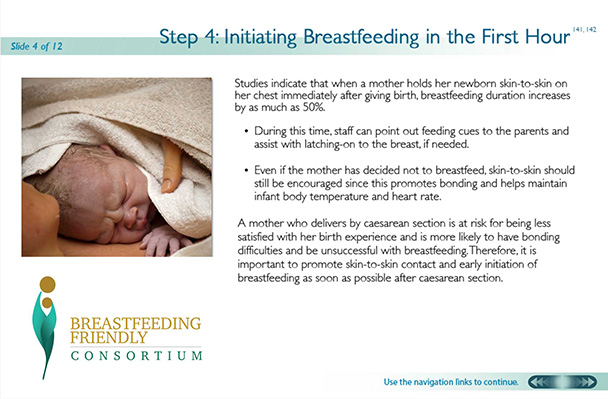
Figure 1: An online breastfeeding training course supports the “New Mom” team: from the nurse and lactation consultant to the pediatrician and compliance team.
The educational content speaks to all team members and includesinformation on history, culture, and breastfeeding challenges, as well as casescenarios and information on caring for infants with special needs. However,the content is also designed to address the unique role of each team memberwhile also showing how roles interconnect. In the case of the physician,essential clinical content geared toward the pediatrician (specialist) isoffered through an online performance improvement module created by HIT-Globalthat awards Maintenance of Certification (MOC) Part IV to pediatricians (Figures 2 and 3).
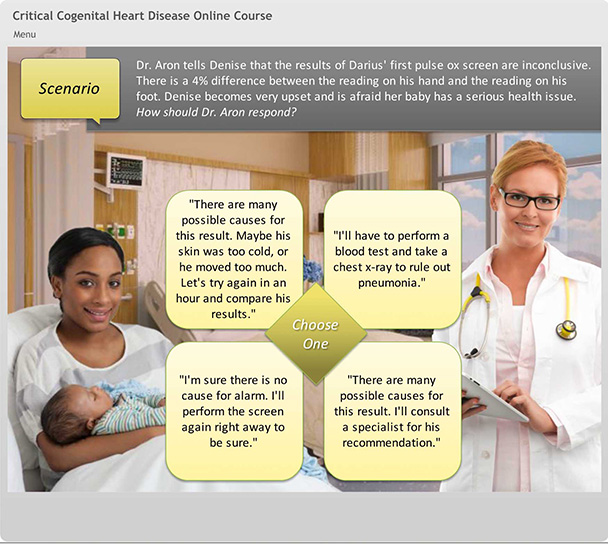
Figure 2: eLearning in healthcare is aided by the inclusion of case studies and case-based scenarios so that professionals learn what to do, in a real-world context.
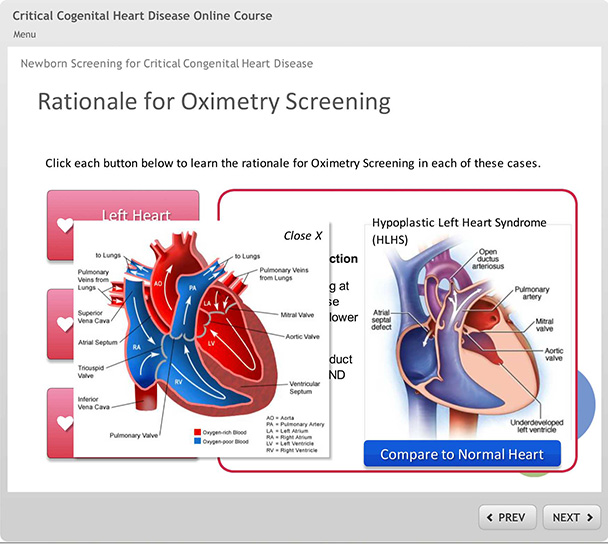
Figure 3: A newborn screening course focuses on critical congenital heart disease (CCHD) and is delivered in two configurations – one for nurses, and one for physicians who have to interpret the results and enact follow-up procedures for a failed screen.
In addition to supporting cross-team education needs, theBreastfeeding eLearning course was designed to support healthcare staff inother ways, including:
- Use of multimedia and video to highlight do’sand don’ts and how to recognize key techniques, such as, “Is the baby latchingon correctly?”
- Inclusion of case studies and case-based reviewsto learn what to do in a real-world context
- Ability to stop and start learning so busyproviders can pick up where they left off and drive the pace of learning
- Learning that can be blended with in-person andon-site training
- Integration with an individual PerformanceImprovement Course and Hospital Chart Auditing tool
The second piece of this effort is performance improvement. Theperformance improvement aspect was developed initially for individualphysicians wanting to improve their knowledge and support of breastfeeding. Itwas later expanded so hospitals could enter multi-physician or practitionerbaseline data to identify gaps in practice, develop educational efforts toaddress these gaps, and then document a sustained change in practice.
The final element in the platform is the patient registry. Hospitalscan voluntarily utilize a web-based tool to capture clinical data in real-time,and compare variations in a provider’s performance against breastfeedingclinical guidelines.
This immediate feedback highlights gaps in care, orvariations that are not consistent with exclusive breastfeeding. Theavailability of resources and access to the learning platform helps maintain aculture of continued improvement towards meeting the current standards of care.
eLearningreminds providers of the patient experience
Another UVA Health System initiative, Newborn ScreeningEducation https://www.newbornscreeningeducation.org/,utilizes online learning modules to educate the newborn care team (nurse andpediatrician) on priorities for newborn care, while also introducing adifferentiated approach for each provider based on their role.
The Newborn Screening Education Project is a joint venture between the VDH, theUniversity of Virginia Office of Continuing Medical Education and Scitent toprovide healthcare professionals and institutions nationwide withcertified continuing medicaleducation opportunities to ensure that every well newborn isaccurately screened prior to discharge from the hospital.
Onelearning course focuses on screening for critical congenital heart disease(CCHD) and is delivered in two configurations—one for nurses, and one forphysicians who have to interpret the results and enact follow-up procedures fora failed screen. Further, nurses are presented with an additional online module—AProvider’s Guide to What Parents Need to Know About Critical Congenital HeartDisease—which helps nurses communicate with parents and address theirconcerns about why their newborn needs the testing, and the need for follow-upif the baby experiences a failed screen.
This type of differentiated online learning leverages commongoals while using multiple learning approaches to reinforce consistent patientcare priorities that may vary, depending on a provider’s relationship with thenewborn or mother. While both the physician and nurse need the same data tomake informed decisions on the infant’s cardiac function, they each havedifferent roles in implementing a plan of action.
Onlinelearning adapts to providers’ workflow
While live meetings in healthcare will continue, as theformat can provide an important way to connect and network with others in theirfield, a continued increase in online learning is an effective strategy for receivingtime-sensitive and focused learning that can impact performance.
eLearning delivers consistent cross-team learning, allowsproviders to consume engaging content in short bursts (between rounds or at theend of a shift), presents case-based scenarios and real-time testing toreinforce learning, and allows providers to integrate learning with performanceimprovement initiatives.
In an industry where knowledge has the power toheal, online learning will continue to grow and evolve to meet rapid advancesin healthcare and delivery.