My July 2012column, “Why I Hate Instructional Objectives,” caused a lotof consternation. Some readers understood my point, but others were ratherupset. To them, the article was near heresy. Nevertheless, it was a greatdiscussion. So, at the risk of causing another uproar, I’m at it again.
I hate ADDIE.
(If you don’tknow what ADDIE is, see Figure 1.)
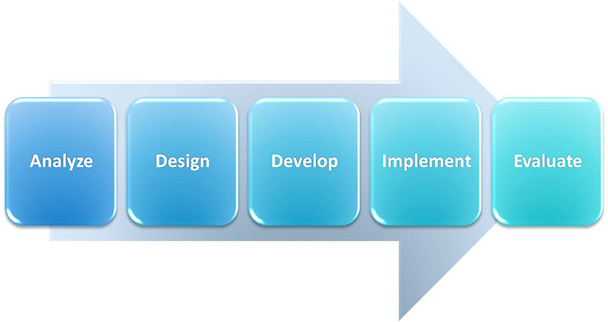 Figure 1: The generic ADDIE model we’ve come to know and love (or hate)
Well, I don’tactually hate what ADDIE stands for—a systematic, professional process todevelop effective and efficient learning programs—but I am concerned that strictobedience to a single process puts blinders on us, hindering our ability to seealternatives. Here’s why.
ADDIEcan be too sequential
Not all ADDIEmodels are explicitly linear, in a graphical sense. Some are circular, some aresquare, and some are even three-dimensional. There can be dozens of steps andsub-steps. I’ve seen an ADDIE model take up seventwo-inch binders! Some models have arrows in one direction and some have arrowspointing everywhere. Even with so many iterations, perceptions of how to use ADDIEare primarily sequential.
Who says that analysis,design, development, implementation, and evaluation should be done in locksteporder? Shouldn’t we consider evaluation earlier, and circle back to revise whatwe have done based upon testing, rapid prototyping, or a more agile methodology?Of course. Yet strict adherence to ADDIE sometimes causes people to eschew thenext phase until they have done, signed off, and put to bed the last one, evenif they think otherwise. This can be very inefficient and costly, but moreimportantly, it can lead to a lack of divergent thinking on how a particular courseshould be put together.
ADDIEoften focuses on compliance rather than results
Manyorganizations rely on ADDIE-type models to verify that all the steps of thedesign and development process have been completed, not necessarily whether theright decisions were made. This may make process folks happy, but it is alsounfortunate. When process trumps product, watch out. Creativity andout-of-the-box thinking get lost as the true intent of ADDIE gets hijacked tosupport a bureaucratic compliance process. When management is more interestedin whether all the boxes are ticked than what learning strategies are employed,or if they worked, and when evaluating actual course effectiveness waits untilthe first offering, when changes are costly and organizationally more difficultto make, you get what you might expect: lots of courses with hundreds of pagesof exacting ADDIE documentation, but in the classroom, or online, everythinglooks pretty much the same.
ADDIEcan be painfully slow
It can oftentake months to produce ADDIE-compliant documentation, not to mentionADDIE-compliant courses. Who has that kind of time anymore? Compliance has itsvirtues, but speed isn’t one of them. How much time can you devote to an overlyformal, structured process, requiring lots of non-courseware documentation? Ifthis describes your work, how can you make it go faster, without jeopardizingquality, and, if you can, does this change your methodology to something newerand more adaptive?
Designis often the stepchild of ADDIE
Can you reallyuse a sequential, step-by-step process to design high quality training? Yes,the process can prescribe what you shoulddo: writing objectives, asking questions, providing practice, etc., but how wellthose design elements are actually implemented is as much art as science, andas much experience as process, as any good instructional designer will tell you.Instructional design and ADDIE are not the same thing; instructional design ismuch more, and we get into trouble when we confuse the two. Creativity,heuristics, experience, best practices, trial and error, experimentation, and eveninformed hunches play a role. You won’t find them in most ADDIE applications. And,as we are discovering, this problem can be exacerbated in an eLearning project.
ADDIEcan inhibit non-ADDIE thinking
Perhaps thebiggest concern about ADDIE is that it’s been blasted into our heads, and intoour practice for so long, we may not just take it for granted, but take it forgospel. “ADDIE is how we do it; it’s how we’ve always done it; and it’s howwe’re going to do it in the future.” Spoken or unspoken, is this a healthyattitude? Does it limit our agility to respond to changing learning needs? Doesit move your organization, or the field forward? If you rise up to innovate, wouldthe process slap you down? In our drive to make our design process simple andconsistent, have we inadvertently made it too simplistic and too rigid (they are not mutually exclusive)?
ADDIE comestrippingly off the tongue. It’s easy to explain. It’s easy to document. Itlooks good on our posters, flowcharts and design manuals. It’s comfortable; perhapstoo comfortable. This is a question every training organization should ask. IsADDIE serving our needs well? Are there pieces missing? Would we benefit from amore adaptable approach?
Some learningand development organizations make ADDIE work by taking it in a more flexibledirection, with less focus on process and more on outcomes. But for too manyorganizations, ADDIE is the law. Sure we must analyze performance problems,design great learning, and get it developed. We must implement it seamlesslyand cost-effectively, and we sure better know if it’s working. But there’s moreto it than five boxes and a few arrows … much more. So let’s keep the goodparts of what ADDIE represents but throw off the shackles that hold us to thebelief that the ADDIE way is the onlyway.
There are lots ofinsightful voices on the state of instructional design models, like Allison Rossett and Michael Allen. There’s even a compilation of articles and posts onthis debate. So now it’s your turn. Agree, disagree, or have a new perspective?Have at it.