Are we still arguing about the potential for games to helppeople get better at their jobs? I’ve never been able to wrap my head aroundthis conflict. In real life, we are surrounded by game elements as influencerstry to shift our behaviors and achieve their desired outcomes.
For example, how many stars do you have in your Starbucks Rewards account right now? Do you have any certificates hanging onthe wall in your office? Have you cheered or cried while watching a movielately? The worldwide gaming industry raked in $91 billion last year, out-earning theHollywood box office, but we’re still hemming and hawing over the potential forthese same concepts at work. Why?!

Figure 1: I’m not going out of my way to stay there because I lovethe accommodations…
The argument against games and gamification has never madesense to me because I’ve been immersed in these concepts my entire life—bothacademically and professionally. Did you play Oregon Trailin grade school? It’s my earliest memory of gameplay within learning. Not onlydid it help me better understand the historical context, but it also continuesto remind me just how deadly a broken arm can be when you’re crossing a river.
Fast-forward to my 19-year-old manager self at AMC Theatres.I was always running contests and sharing stories to motivate my team membersto drive concession sales or improve customer service scores. My application ofgame mechanics has continued to progress as I shifted from operational tolearning and development roles over the past 15 years.
Rather than reiterate the conceptual potential of gameelements (Karl Kapphas that handled), I’d like to share a few of my biggest takeaways fromgame-related projects I’ve worked on throughout my career.
Connection
I told a lot of stories when I worked for Disney. Some werescripted, third-party retellings of guest experiences, but most were personalmemories about my time with the company. Content elements like narrative andcharacter were essential tools for engaging cast members in almost everylearning program. Sure, these stories demonstrated the desired behaviors wewere looking to instill. However, I was quick to realize the real value ofnarrative in this environment. This was how we helped cast members connect withthe greater organization and its mission. After all, changing bed sheets andwiping down restaurant tables isn’t fundamentally magical. However, when we putthese common tasks in the context of the greater impact the Disney experiencecould have on our guests, we were more successful in fostering the desiredperformance.
I took this strategy to the next level when I got intocustom learning design. We had recently established new guest serviceguidelines for the 65,000 cast members at the Walt Disney World Resort.However, given the extensive variety of roles performed on property, theseguidelines were quite high-level. We needed a way to help cast members connectthese expectations to their day-to-day behaviors. To that end, I built an ILTseries to immerse cast members into a story based on their specific worklocation.
The skeleton of the class was the same for every location,always asking participants to apply guest-service tactics to overcome afictitious obstacle. However, the narrative elements and activities were builtfor the specific location and featured familiar elements. For example, thefirst session, which was designed for a new Kim Possible attraction at Epcot,tasked cast members to defeat a villain character. Sure, it sounds cheesy now,but the series was successful based on both participant feedback and improved guest-servicescores. We had created a game-based bridge to help cast members connect theirdaily work activities to the greater expectations of the organization.
Takeaway: Manyemployees feel distanced from the larger purpose of their organization. Gameelements can help restore this connection and show employees how their actionshave a greater impact.
Awareness
I made a brief pit stop in the world of global logistics afew years ago. During my time with Brambles, we released a casual online gamecalled Ship It developed by LEO Learning (teaser video here).The game required players to make decisions regarding pallet shipments tovarious customer personas, and it displayed performance scores based on companypriorities, such as satisfaction, CO2 reduction, and profitability.
No, you can’t learn everything you need to know aboutlogistics from this game, but that was never the point. Rather, moving throughthe increasingly difficult levels helped the player understand how logisticaldecisions—decisions they potentially never made in their own roles—impactbusiness outcomes. Players gained an improved understanding of how thedifferent functions within the company work together to reach each goal. As anew employee, it helped me reach outside the L&D bubble and gainappreciation for the challenges our logistics teams were facing every day.
Takeaway: Employeescan easily become trapped in a functional silo. Game elements can improve theirawareness and appreciation of other employees’ roles, as well as theirrelationship to one another.
Value
My role with Kaplan afforded me the freedom to experimentwith a variety of learning tactics, including game elements. In my first fewmonths on the job, it became clear that we were stuck in a one-size-fits-allmentality due to both the speed with which the organization was growing and theincreasing role complexity. I was looking for a way to ensure each learningexperience was a clear value-add, but I didn’t have a lot of technology to playwith (yet). So, I turned to game elements in my next eLearning project.
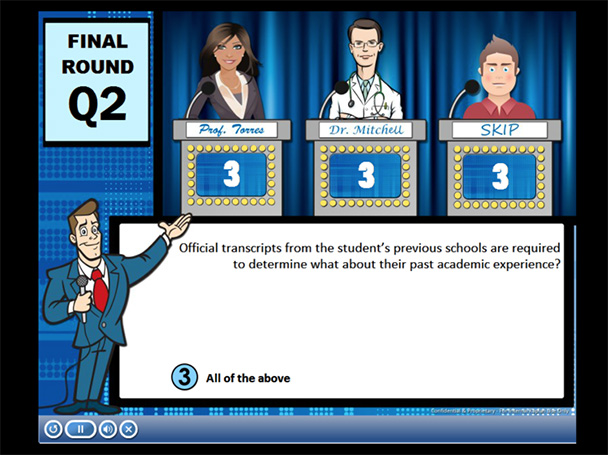
Figure 2: Users played the role of Skip, who was dramaticallyunqualified for this game show
Rather than deliver the same process update training toevery call center and campus employee, I positioned the eLearning as a gameshow (Figure 2). However, this design was actually hiding the branching setupwithin a pretty standard, Captivate-authored module. The player started with asimple question on the topic—in this case, students’ prior academictranscripts. If the player answered correctly, they earned points and moved onto a more difficult question. If they got it wrong, they were presented with a“commercial break” that included refresher information. They then returned toanswer a similar question and prove their renewed understanding. Unlike mosttraining modules, which are designed to ensure completion, this one includedthe risk of losing the game, which triggered greater user focus. Sure, I couldhave just given everyone a quiz on the topic and pushed a simple eLearning tothose who failed. The game elements added a layer of engagement while enablinga simple but personalized learning experience.
I eventually expanded my tactics from just content to includestructural game elements. I started byapplying gamification as part of a side project to tackle the organization’sshared knowledge problem. We found ourselves in a familiar position for a bigcompany: We had a lot of great information out there, but it just wasn’t well curatedin an easily accessible spot.
To create a simple, familiar, budget-friendly knowledge-sharingexperience, we introduced Confluence as our enterprise wiki. I then added aselection of game mechanics, including the oft-maligned points, badges, andleaderboards, to motivate users to share their knowledge. I didn’t realize justhow much of an impact these elements were having on our users until Iaccidentally turned them off one day. I heard about it—immediately! While some users didn’t care at all, there was a groupwho had associated the value of their work with this gamified recognition.
We ultimately refined our gamification strategy to leveragethese elements as a way to establish subject matter credibility and grantadvanced contribution permissions. Not only did we get more content, but inexperiencedemployees were able to more readily trust information shared by our recognizedcontributors, despite never having worked directly with them.
Takeaway: Value isunique to the individual. Therefore, a variety of game elements and tacticsmust be employed for maximum impact.
I continue to expand my use of game elements in my role withAxonifyas I help organizations achieve results through knowledge growth and behaviorchange. I have found that our research into the application of game elementswith our tens of thousands of users, across a variety of industries and usecases, echoes my earlier career takeaways. The right game elements not onlymotivate employees to engage in continuous learning, but also foster improvedconnections to the message being shared.
I’ll be sharing more information about our research, as wellas my practical experience with game elements, at FocusOn Learning 2017 Conference & Expo in San Diego this June. Join me for twosessions:
- From Research to Reality: Building a Holistic Gamification Strategy (Tuesday,June 20 at 1:00 PM)
- Deconstructing Games: Spaceteam (Wednesday, June 21 at 2:30 PM)
You can also check out my past Learning Solutions Magazine article on the “Top 10 Objection to Gamification (and the Best Way to Respond).”
Gameelements in workplace learning are no different than other organizationalstrategies. When applied the right way, and with a focus on value and context,they can meaningfully support knowledge growth, behavior change, andperformance outcomes. However, when executed poorly, game elements can come offas gimmicks and result in negative outcomes. L&D pros must do theirhomework and understand the potential for game elements within their ownlearning ecosystems. After all, we all want people to care as much aboutlearning as they do their Starbucks Rewards stars, right?