The eLearning Guild’s newest research report, Beyond ROI: The Value of Learning, explainsthat training ROI studies are flawed because they measure learning “events.” Butbecause we are continually learningat work we need to look for more holistic and contextual training impacts, suchas through Robert O. Brinkerhoff’s models (which are presented and explained inthe report, and in Brinkerhoff’s book—see “Reference” at the end of thisarticle).
Nic Laycock, the author of the report, asked C-level execs whatthey wanted to have measured and, just as we found in the Guild’s Getting Started in e-Learning: Measuring Success research report, theyare not nearly as interested in ROI as wethink they are. Instead, they are more interested in knowing that people have the skills needed to do their job andcontribute to the needed performance of the organization.
But … do people in our organizations have the skills they need?
The Organisation for Economic Co-operation and Development(OECD) has begun performing a survey of adult skills to assess key information-processing skills that adults aged 16 – 65need in order to participate in education, training, work, and social andcommunity life.
They interviewed people in their homes, asked people toanswer questions, and collected a broad range of data about understanding andusing information from written texts; using, applying, interpreting, andcommunicating mathematical information and ideas; and using technology to solveproblems and accomplish tasks.
Participants in Round 1 (2008 – 2012) came from thefollowing countries: Australia, Austria, Belgium (Flanders), Canada, CzechRepublic, Denmark, Estonia, Finland, France, Germany, Ireland, Italy, Japan,Korea, Netherlands, Norway, Poland, Russian Federation, Slovak Republic, Spain,Sweden, England, Northern Ireland, and the United States.
They recently published what they found from Round 1. Theresults highlight a number of concerns. Figure 1 shows some of the results forliteracy (understanding and using information from written texts).
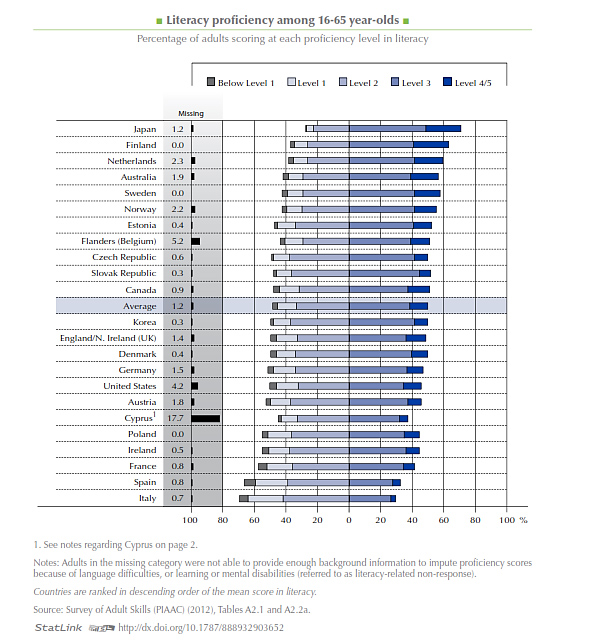
Figure 1: OECD Survey of adult skills literacy levels by country
(Source:https://skills.oecd.org/documents/OECD_Skills_Outlook_2013.pdf, pg. 29)
The skills in Figure 1 are learnable skills. The report makes a clear case that each countryshapes the level of skill in their population through learning opportunities(in home, education, and workplace).
We can see that some countries are struggling with basicskills and in others, a large percentage of the population have advancedskills. The study points out, for example, that in Italy and Spain only one in20 adults is proficient at the highest level of literacy. And the US is belowaverage for this group of countries. A closer look shows that in all but one ofthese countries, at least one tenth of adults are proficient only at or belowLevel 1 in literacy or numeracy.
In most countries, a significant portion of adults, “…havetrouble using digital technology, communication tools, and networks to acquireand evaluate information, communicate with others, and perform practical tasks… From 7% to 27% of adults lack the most elementary computer skills, such asthe ability to use a mouse.”
The demand for these types of skills continues to shifttowards higher and higher levels, even with lower-level jobs, because using andcommunicating with technology is pervading every aspect of our lives. At thispoint, lack of basic computer skills is beginning to limit adults’ access toservices, jobs, and even participation in training and education. My daughtertold me she recently went into a bank branch where customers communicated witha virtual teller via computer screen. There weren’t any people working in thebranch! I recently visited a dental specialty office where they computerized everything. There was literally nopaper in the office. I filled out “papers” via an iPad and they emailed myreceipt and other paperwork to me. How would those 7% to 27% fare in theseinstances?
There are certainly huge implications here for those of usin education and training. What is our role with those who do not have adequateliteracy, numeracy, and technical skills? Will those people even make it to us?Are you dealing with this in your workplace? What are your thoughts?
Reference
Brinkerhoff, Robert O. TellingTraining’s Story: Evaluation Made Simple, Credible, and Effective. 2006.