
If you askmost C-level executives in 2014 what keeps them awake at night you’ll likelyget a combination of the following: sales growth, competitive positioning, andproduct innovation. However, for the savviest executives today, a rapidly emergingconcern is heading to the top of the list: employee motivation and retention.
Data is the key
Today, learningdata is the Holy Grail. For years, executives have been searching for a way totruly measure learning outcomes in a cost effective and meaningful way that canenable strategic decisions in the enterprise. Figuring out whether an employeeactually “got” what was conveyed to them, and translating that intoperformance, has been thought of for years as virtually impossible. And lookingforward—wouldn’t it be amazing to be able to predict behavior ahead of timebased on historical learning data and then tie it to a forecast financialresult?
Learning, in2014 and beyond, is about bottom-line results and quantification. It is alsoabout meeting the deep needs of a mobile and fearless workforce to better equipthem with the learning they crave and demand.
Like manyother things at work, today’s employee isn’t just sitting back and waiting forprofessional development opportunities to be offered to them. They expect training and information—ondemand, in a way that they can digest it, specific to their knowledge gaps, andusing the latest in technology. Who would have thought five years ago thatsatisfying a demand for continuous education would become a critical element inthe attraction and retention of a top-drawer employee?
To date,measurable learning outcomes have tended to be more of the undesirable kind—anemployee’s lack of knowledge manifests through negative consequences—they don’tdo something they were supposed to, or actively do something they shouldn’thave, and a visible loss results.
Failure tooperationalize a procedure that results in a medical accident, for example, isa very visible way to learn that an employee didn’t understand the right way todo something. But many other types of loss that result from lack of learningtransfer aren’t so visible—like the employee who fails to follow propercustomer-service principles and ends up driving a loyal customer away, or thesales rep who can’t recall the latest product features and pricing in a complexsale and loses to the competition. This results in a negative feedback loopthat doesn’t work for the executive who lost the sale, or for the customer, orfor the employee who is increasingly looking for positive reinforcement andtraining.
So, how toinvert the learning conversation so that everyone wins?
Creating memory that lasts
The underlyingconcept is actually really simple—human beings do what they remember. When they don’t remember, they exercise judgment, based on their(sometimes limited or non-existent) experience, the advice of co-workers (whomay not remember), or on their best guess. Sometimes they get it right, andsometimes they get it wrong. So what’s the key to real learning? Creatinglasting memory!
Imagine being the chief revenue officer of a largemulti-national corporation. What if you had the data to show at any given pointin time what every single salesperson remembered about product features,pricing, positioning—and you could tie that to their individual sales results? Whatif you could correlate the success of a salesperson who consistently remembered90 percent of the information he needed to know against a rep who consistentlyremembered 35 percent? And what if you had a way to effectively address thesecond individual’s specificknowledge gaps to close them and improve his performance?
Or, imagine being the VP of operations of a major callcenter. What cost savings might result from a call center associate who cananswer a customer’s questions in half the time of another associate, justbecause she could instantly recall the appropriate service information?
And as the VP of safety at a manufacturing facility what ifyou knew that an employee who remembered the correct operational proceduresaround ladder safety was 80 percent less likely to have an OSHA-reportableincident?
Creating lasting memory isthe polar opposite of what yesterday’s training environments achieved. Theysimply didn’t deliver knowledge in a way that our brains can digest and retainit. The human brain is really good at processing four to five bits ofinformation at a time, and relating them to other concepts and contexts italready knows. Instead, historically, organizations delivered a gargantuanamount of content, all at once, not personalized to the learner and with noreinforcement, and expected employees to find the needles in the haystack and operationalizecritical nuggets of information from that point on. They got thrown onto thejob, and were expected to know. Exceptthey didn’t, and a lot of visible and invisible mistakes happened.
The most essential thing tofocus on is the creation of memory through retrieval practice. Tell, question, andanswer. In bite-sized chunks. Every day. That’s it! The act of going back intothe brain, and being forced to recall one to five short pieces of informationat a time, actually solidifies the neural pathways and creates memory. And asthe employee answers, the employer gets to measure knowledge retained at thesame time. And what if an employee gets a question wrong? Deliver them theright answer on the spot, and then ask the same question again a few days later.It’s amazing how, when you employ simple retrieval practice, knowledge liftwith each iteration of question grows significantly.
On first blush, one can dismiss retrieval practice ascreating an environment of rote memorization, which doesn’t necessarily addressfundamental understanding of concepts. However, memory needs to exist in thefirst place, so that when the employee actually encounters a situation wherethey need to apply the knowledge, they have correct recall of the information.It’s the first step to making sure they aren’t just guessing at what to do.Once they have the opportunity to actually apply the memory, it contributes tounderstanding and deepens the learning.
How about some examples?
Here’s some data to proveit. In each of the cases below, these Fortune 1,000 organizations use anadaptive learning platform to ask core questions of their employees up to fivetimes in 45 days. They personalize questions to the individual based on theirspecific job requirements, and adapt to the demonstrated knowledge levels ofeach person as they answer. In all cases, the information is critical to those employeesdoing their jobs well, and when an individual demonstrates mastery ofinformation the platform introduces new questions seamlessly and continuously. Eachtime an employee answers, it measures success and determines how and when toask the questions again.
Here were the overallresults in the first 45 days:
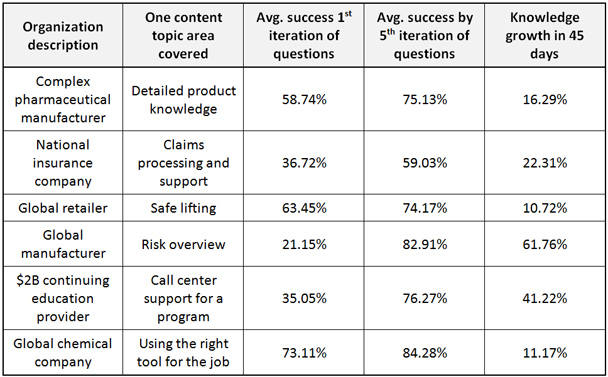
The experience lasts from oneto four minutes a day, depending on the number of questions, and is woven intothe workday whenever the employee has a few minutes available. Data being gatheredand correlated employee-by-employee includes number and frequency of questionsanswered by individual, by topic, by iteration (1 – 5), by location, by jobtitle, and by success (correct or incorrect).
Financial results
How are the organizationsabove tying growth in knowledge to a financial outcome for their organizations?Each of the topic areas has a direct correlation to a financial cost.
Let’s take the global retailerabove as an example. Like many large retail organizations, this retailer spendshundreds of millions of dollars a year in employee medical accidents andinjuries that often result from improperly following procedure. Each type ofinjury has a typical cost, with back injuries averaging $10,000 – $15,000 perincident. After introducing a daily retrieval-based questioning solution, thisretailer has seen a drop in overall incident rates of 20 – 50 percent overhistorical figures, which they can directly attribute to the type of contentand questions they ask every day. Not only are overall incidents now down, andresulting in tens of millions of dollars in savings, but for every incident thatoccurs the employer has an audit trail to determine how many questions theemployee answered in that topic area (if any) and his or her level of knowledgemastery as compared to employees who have no incidents.
Similarly, the complex pharmaceuticalmanufacturer above was having a very difficult time getting widely disbursedsales professionals to accurately digest and remember specifics aroundfrequently changing products. Simply asking questions and getting them torecall the correct answers ongoing has had a measurable impact on salesresults, person by person, which also correlates to their success in answering thosequestions.
Put simply, employers arediscovering that the employees who answer three to five short questions everyday, targeted to the core information they need to know for optimalperformance, are seeing significant and measurable knowledge growth thattranslates into improved and measurable performance.
Predictive analytics from learning data
In fact, employers areconstantly amazed at how many questions employees initially get wrong in topicareas that are considered to be simple when they start. And they’re relievedwhen knowledge growth is clearly evident and significant by the fifthiteration. Step by step, this is the way the results grow:
1. Create focused andrelevant questions targeted to core knowledge.
2. Question + answerrepeatedly = memory (measure how many questions answered, correct and incorrect,by person, by topic)
3. Memory = learning
4. Learning = performance
5. Performance = improvedfinancial results (reductions in incident rates or events, increase in sales—bothtied to specific people and how they did in #2. above)
While ongoing measurementand correlation of learning activities to outcomes by employee is now entirelypossible, let’s not stop there. This data is a powerful way for executives to alsopredict future financial outcomes. Let’s take a sales example again—what if youhad the data to show that employees who achieve a consistent, minimum success rateof 80 percent answering product and positioning questions achieved 30 percentmore sales? For a sales rep with a $1 million quota, that’s an extra $300,000in revenue. Executives who have that kind of data know how critically importantknowledge acquisition is to their overall financial success.
Not only can you look tothe financial future, you can flag top performers. When you provide them with relevantinformation, specific to their knowledge gaps, when they need it, in a waythat’s fast, approachable, and effective, and where they actively realize they’relearning something as they get questions right, it isn’t a stretch to imaginethat you can achieve attraction and retention of the best people. Whenemployees recognize they are mastering knowledge it makes them feel good, andthat good feeling translates into how they feel about the employer (Figure 1).
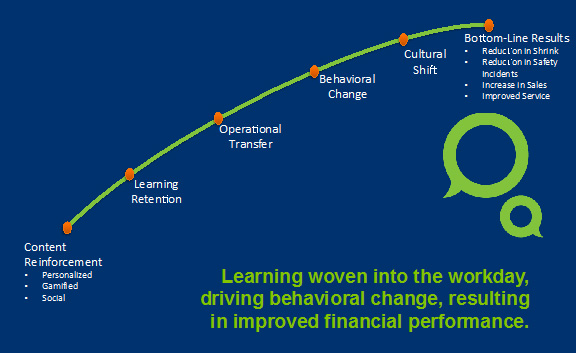 Figure 1: The outcome curve fromregular retrieval practice