



Anyone with a smartphone these days can shootvideo and post it to YouTube, but that doesn’t mean the video will be good.While jerky shots and inaudible audio may be fine for home movies, you wantsomething better for your eLearning production. The challenge is getting something better on a limited budget and undersevere constraints on equipment, locations, and talent available.
 If you aren’t an experienced videographer,those challenges may have kept you from using video. While you could find acourse online or at a local college, a good book and some examples wouldprobably give you what you need faster and at less cost. Jefferson Graham haswritten that book.
A complete guide—with video examples
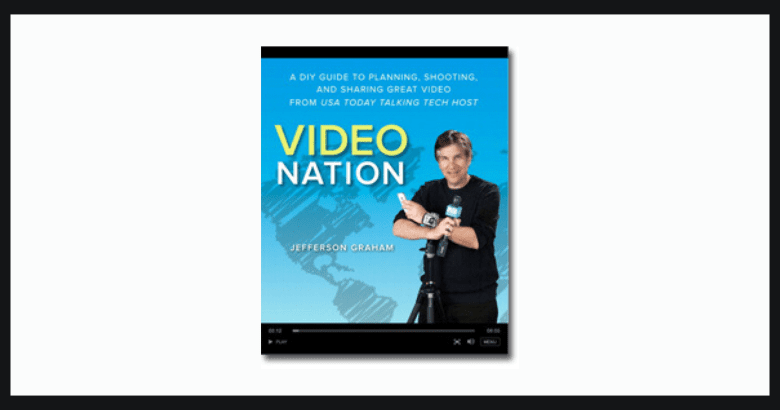
VideoNation: A DIY Guide to Planning, Shooting, and Sharing Great Video provides239 pages of text and 32 videos that cover:
- The basic elements of Web video production
- Styles of Web video (including product demos, vlogs, tutorials,and interviews)
- Selecting a camera (including iPhone and iPad), lightingequipment, audio gear, camera mounts, accessories, and video editing software
- Using your equipment
- Video apps for iPhone and iPad
- Pre-production planning
- Production day (from camera placement and audio checks to lightingand shooting)
- Shooting techniques
- Video editing
- Distribution of your video
Within those categories, the coverage overallis very complete, with a couple of areas where I found myself wishing for alittle more. Graham provides lots of practical advice, with particularattention paid to the needs of the “one-person shop” situation in which manyeLearning professionals find themselves.
Walking the talk
Jefferson Graham himself is a longtimetechnology columnist for USA TODAY,where he also produces, edits, and hosts the “Talking Tech” and “Talking YourTech” video programs.
He creates these programs on the same DIY (doit yourself) budgets that he describes in the book. In fact, he turns out three“Tech” videos each week from a studio that he set up in his garage (there’s apicture of it in the book), using off-the-shelf consumer tools that includeDSLRs (digital single lens reflex cameras), an iPhone, point-and-shoot cameras,a GoPro extreme wide-angle “helmet cam”—and very occasionally a traditionalvideo camcorder. On the more polished pieces he has help from a cameraoperator, but he also produces many segments single-handedly.
If it’s in the book Graham has done it andstill does it, and you can do it, too.
Who is this book for?
If you are an eLearning professional with noexperience in video production, or with very limited experience, Video Nation is for you. If you aresomewhat experienced or very experienced, you may benefit from some of thetips, but you will also find the book a little too basic.
Most of VideoNation deals with production and post-production matters, and that is wherethe text really shines.
Where the book falls a little short
In my opinion, the text should have coveredAndroid phones and their video apps. There’s really no reason not to includethem. However, you can adapt practically all of the advice for iPhones to Androids—it’sthe specific Android apps that you’ll not find addressed.
Some of the gear coverage is a little dated.There’s a (very) short section on point-and-shoot video cameras, including theFlip Video camera (now discontinued). You will want to talk to your friendlylocal camera nut about choosing a DSLR, mirrorless point-and-shoot stillcamera, or wearable camera (the GoPro), since the discussion of these in thebook is, in my opinion, a little light. Go to a camera store and spend sometime with the various models of DSLR to find the one you like best and can workwith most easily. Be sure to consider the selection of lenses as carefully asyou consider selection of the basic camera.
Summary
As a fast introduction to video creation,especially for the one-person shop, VideoNation is an excellent choice. There are many tips and techniques that youwill not have seen anywhere else, with detailed descriptions of how to workwith sound, lighting, and editing. I wished that the text went more in-depth onequipment selection and on Android phones, but these are not criticalshortcomings, and you can get the information easily online.
I recommend Video Nation for eLearning producers with limited experience andlimited budgets as a good “getting started” guide. I think more experiencedproducers may find the book interesting, but wanting a somewhat more advanced discussionof the hardware.
Bibliographic information
Graham,Jefferson. (2013) Video Nation: A DIYGuide to Planning, Shooting, and Sharing Great Video. Berkeley, California,Peachpit Press. 239 pages. ISBN 978-0-321-83287-0.
Publisher’s price: $23.99 (paperback); $19.19(eBook, in multiple formats, including EPUB, Kindle, and PDF)
Amazon price: $17.99 (paperback); $10.80(Kindle)
Barnes & Noble: $17.99 (paperback);$13.19 (Nook)


