



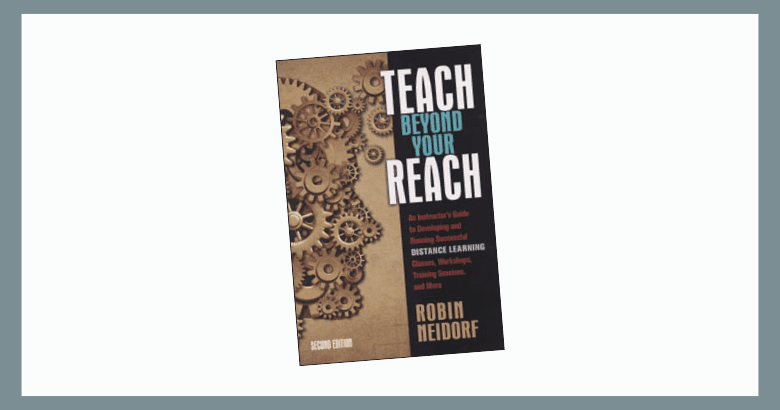
In her significantly updated and expandededition of Teach Beyond Your Reach,Robin Neidorf provides new and experienced distance educators with bestpractices and examples, an overview of tools and platforms, and strategies fordealing with key issues.
Whether you call it distance learning, virtual classrooms,or by some other term, the use of technology to deliver instruction to peoplewho are not physically present in a classroom continues to grow in popularitywith organizations and with individuals.

In nine chapters, Neidorf provides basics, philosophy,design principles, and development tips, and delivers key tips for supporting learners during and after your distance learning event. If you are among those who are movingfrom classroom instruction to online, this book gets high recommendation as a guide.
Strengths of the book
There are worksheets and checklists throughout the book thatwill be very helpful as guides to your development work. Distance learning doesrequire some additional considerations that you would not have to be concernedabout when designing a classroom course. These job aids alone are worth theprice of the book.
Here is a typical example of Neidorf’s insights and helpfulcomments throughout the book: She sketches “learner profiles” in the chapter on“Individual Learners.” I find such sketches very useful in designinginstruction. As she says, “If it seems to take an immense amount of time andeffort to focus on individuals and their needs, you are reading this chaptercorrectly. Because effective distance learning is learner-centered, aninstructor can have a solid idea of how to instruct only by having a detailedunderstanding of the learners.”
Some quibbles
Neidorf includes some content that has no support fromresearch: In other words, she presents as doctrine what many experts consider to be myths. In the chapter “Whatto Expect When You’re Expecting Students,” she uses up 10 pages to present“learning styles” and “generational differences.” The best research results suggest that these styles and generational characteristics do not exist.However, she is right to discuss audience analysis before she discussesinstructional design.
My other quibble is with the coverage of social media and mobilelearning—it is very sparse. I wouldn’t expect an in-depth treatment of thesetopics in a book like this one, but there definitely should have been discussion ofways to incorporate them into a blended design, and tips on how they cansupport collaborative learning, informal learning, and creating a community oflearners.
This book should be on your shelf
When you are further along, you will want to find out moreabout how to incorporate social media, informal learning, collaboration, andmobile technology, but what you get in TeachBeyond Your Reach is still a great resource.
Bibliographic information
Neidorf, Robin (2012). TeachBeyond Your Reach: An Instructor’s Guide to Developing and Running SuccessfulDistance Learning Classes, Workshops, Training Sessions, and More (SecondEdition). Medford, New Jersey:Information Today, Inc. 214 pages. ISBN 978-1-937290-01-6.
Paperback: $29.95 list, $18.46 at Amazon.comand Barnes & Noble. There are no eBook versions.


