



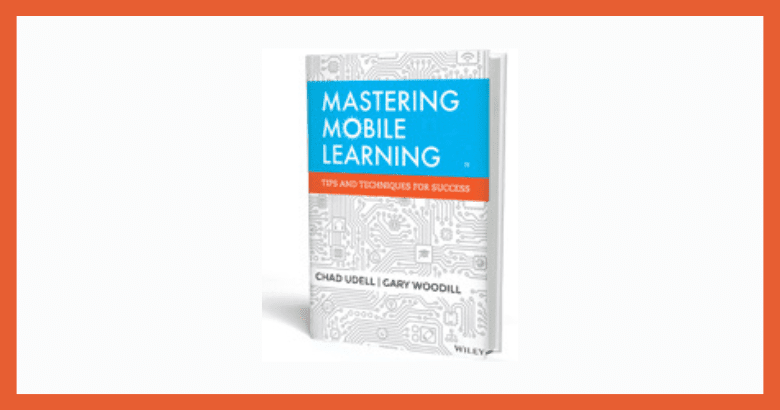
 At the intersection of disruptive technologies—robusthandheld computing and communications, sensor technology, and big data—mobilelearning has emerged as a game changer for a number of organizations. Mobilemeets learners at the moment of piqued interest and at the point of need, atonce forming a great opportunity and unveiling a responsibility.
Mobile learning is one of those topics that’s so obviouslyimportant that everyone involved in workforce development and education needsto understand its breadth and width and then explore the little spaces inbetween. It deserves your focused examination and consideration; you owe it toyourself and to your customers to truly master this category. A great place tostart (or continue) your journey is Chad Udell and Gary Woodill’s book, Mastering Mobile Learning.
Insights based on experience
Mastering MobileLearning emerges from experiences of key team members at Float Mobile Learning(a leading mobile learning and development company) and pulls together some ofthe best and most important thinking from this group, many of whom are regularspeakers and prolific writers. Chad and Gary have done an awesome job weaving atapestry of critical thinking around mobile to help newbies and experiencedprofessionals alike achieve a clearer picture of the overall mobile landscapeas well as gain deep insights related to mobile strategy, design, development,and deployment.
Organized into 50 short “chapters,” the book is easy to readand digest. Even though I picked it up at a rather busy time of the year, Ifound myself stealing away minutes wherever I could to absorb another chapter—readingit on mobile devices, of course. And while it may sound cliché, I fully expectto turn back to this work frequently as I pursue mobile endeavors in thefuture—especially for strategy work.
Stated goals of the book include helping to shift thinking:seeing mobile learning differently than other forms of learning and helpingreveal how large-scale mobile learning is doable. These goals, in my opinion,were addressed rather well throughout the work.
A roadmap for mobile learning implementation
According to the authors, the five parts of Mastering Mobile Learning are sequencedsimilarly to the roadmap Float uses to guide clients through the process ofimplementing mobile learning.
The first section, UnderstandingMobile Learning, starts at the proper beginning. By exposing the businessdrivers behind mobile, out of the gate the authors lay the foundation for themobile learning business case. This section discusses the benefits of mobilelearning, disruptive shifts that are happening in the way learning is carriedout in enterprises, and opportunities created by these disruptions.
The second section, Strategic Thinking about Mobile Learning, provides readers with fodder forcreating a compelling business case for mobile. It gives guidance for strategicconsiderations; ties to core business drivers; insights around developing amobile content strategy including quick and easy ways to create content; andsuggestions for using mobile to improve customer engagement. This section alsoexplores the implications of mobile device management strategies, includingBYOD (bring your own device) and BYOT (bring your own technology); securityconsiderations such as mobile device management and mobile applicationmanagement; and change management strategies for mobile learning.
The Varieties of Mobile Learning Experiences explores ways youcan use mobile for learning. The authors discuss categories of learning;affordances of mobile devices; using gestures and multi-touch; leveragingsensors; voice and messaging; alternative reality games; uses for salestraining and assessment; the impact of mobile learning on assessment andevaluation in a broader sense; autonomous learning (mobile research);performance support; the implied personalization of mobile devices and theirunique ability to presume intent; and the possibilities of mobile learningleveraging the uniquely personal and relevant information available throughmobile devices.
In addition, one chapter of this section focuses entirely onways you can use geolocation to make content more relevant. Another focuses onusing the mobile camera as a learning tool. And a third relates Gary’s insightsof working in “third spaces,” which is sure to resonate with more than a few ofyou.
Simply repurposing existing content in a mobile footprintwill get you no farther in mobile than that practice did for eLearning in theearly 2000’s—one result being “boring” eLearning, which damaged the category’sreputation. In fact, the authors clearly state their position that mobile ismostly not about formal learning. Design and Development Processes for MobileLearning, the fourth part, focuses on how you should approach design for mobile.While it does include a chapter that addresses the topic of converting eLearningto mLearning, Chad notes that you “can’t really just move things around to makethem smaller and expect that to work.” Fortunately though, the authors do sharestrategies that do work.
Additional topics in the fourth part of the book includecontent curation as an essential ingredient of your mobile strategy; tools formobile learning development; instructional design patterns; digitalpublications; multi-screen design considerations; context; social media forlearning; responsive design; learning management systems; geolocation-basedapplications; push notifications; web-based mobile apps (and performanceconsiderations); the Experience API; and Mobile Metrics.
In Part 5, Managingand Delivering Mobile Learning Projects, the authors cover mobile learningproject management, security, social media, budgeting, and strategies forkeeping up with the ever-changing landscape of mobile learning technology.
Closing observations
Mobile isn’t going away, and you need to understand itsimplications. As the authors state early on, “Full-scale adoption of mobilelearning will have a profound impact on the structure of enterprise learningand development departments in ways that we are just beginning to understand.”
If you drink in Mastering Mobile Learning, as I did, I’m confident you will have aneffective understanding of mobile learning and will have the foundation youneed, with application and opportunity, to truly master mobile learning.

