
By Elham Arabi, PhD
If you’ve ever felt like a course catalog manager, taking orders for training without question, designing solutions before understanding problems, or struggling to prove your value beyond attendance numbers, you’re not alone. Many learning professionals find themselves trapped in an order-taking role, responding to stakeholder requests with “Sure, we can build that training” before asking the most critical question: “Why?”
There’s a roadmap to break free from this reactive pattern. Here’s how you can do that:
1. Build business acumen skills
The foundation of strategic partnership is understanding the business deeply enough to challenge assumptions and propose alternatives. Business acumen isn’t about becoming a finance expert; it’s about building four key capabilities:
- Strategic alignment & impact: When you understand how learning initiatives connect to organizational goals, you can design solutions that move real business metrics, not just completion rates.
Start by understanding your business context. Study your company’s strategic goals and map how L&D can genuinely support them. Take time to understand different business functions: What does marketing do? What challenges does operations face? This knowledge transforms how you approach learning solutions.
Build financial literacy incrementally. You don’t need an MBA, but you should understand cost-benefit analysis, resource allocation, and how to demonstrate ROI through data. Learn to speak in terms of business value. - Stakeholder credibility & buy-in: Speaking the language of business builds trust and positions you as someone who understands the bigger picture, increasing your competitive advantage within the organization.
Increase your visibility by asking thoughtful questions rather than simply accepting requirements. Make recommendations backed by data and research. Demonstrate the value of your expertise to your stakeholders. - Performance-driven design decisions: When you make data-informed decisions grounded in business realities, your recommendations carry weight.
Think strategically by connecting every learning initiative to organizational performance goals. Before designing a solution, ask: Is this scalable? Is it sustainable? Does it address a real performance gap or just a perceived training need? - Develop market awareness: Follow industry trends through resources, such as McKinsey, Deloitte, the World Economic Forum, and Boston Consulting Group reports. Use tools like Lightcast or similar ones to analyze growing skills in your industry and the Bureau of Labor Statistics to anticipate future skills needs. When you can speak to where the market is headed, you become invaluable.
2. Master evaluation beyond smile sheets
Nothing combats order-taking faster than being able to prove, or disprove, that training is the right solution. Yet most organizations and L&D professionals stop at satisfaction surveys (smile sheets) and attendance tracking, the lowest levels of measurement. Some may even measure learning and change of behavior by asking learners in learner surveys.
These data do not generate actionable insights. Explore the research on “illusions of knowledge,” meaning learners assume they have learned and are competent, whereas if assessed rigorously, it would prove against this assumption. “Dunning-Kruger effect” is another phenomenon proving that learners are not the best sources to verify the effectiveness of training.
Learn by doing: Start small with pilot evaluations. Propose a single project where you’ll track actual on-the-job behavior change, not just completion rates. Show results through regular status updates at key intervals, then use an iterative cycle to gradually expand your evaluation practices. The key is demonstrating value through data, which shifts conversations from “Can you build this training?” to “Should we build training at all?”
Iterative Design & Evaluation Cycle
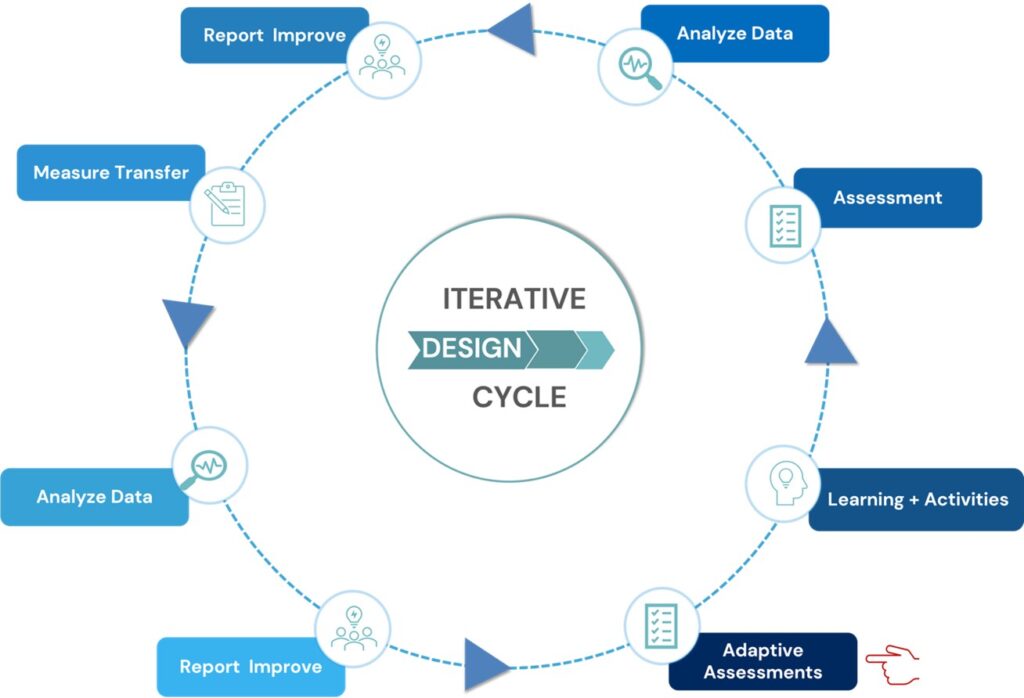
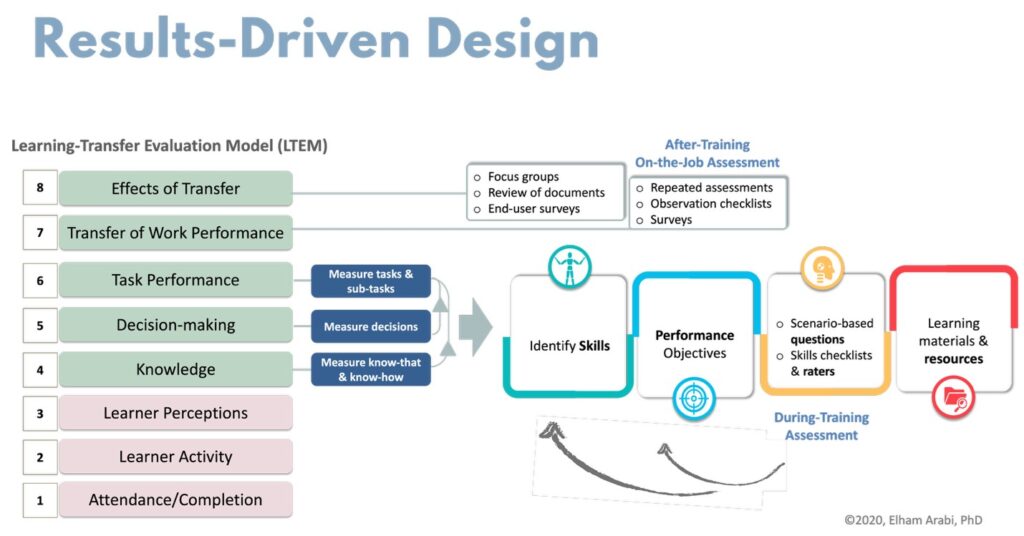
Choose an evaluation model based on evidence, not popularity: While there are many evaluation models, such as Katzell-Kirkpatrick, Phillips’ ROI, Holton’s HRD, Brinkerhoff’s Success Case Method, Stufflebeam’s CIPP (Context, Input, Process, Product), select one that research shows is effective for your context. I use Thalheimer’s LTEM (Learning-Transfer Evaluation Model) because it bridges the gap between learning and workplace performance by measuring knowledge, decision-making, and task performance during training, then measures transfer to work performance and effects of transfer after training on the job.
My key recommendation is developing criterion-referenced tests—assessments that measure whether learners can perform specific job tasks to a defined standard—rather than simple knowledge checks. Use scenario-based questions aligned with actual work context, then repeat these same tests 2-3 months after training in addition to using observation checklists on the job to measure actual transfer and determine whether skills stuck and are being used in the workplace, not just whether people could demonstrate them in a training environment.
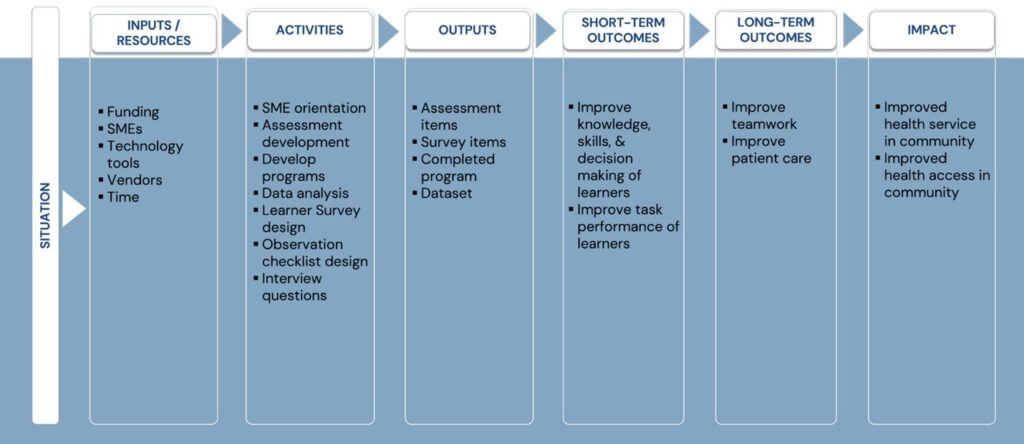
Plan the evaluation from the start, not as an afterthought: Use a logic model to map out what and how you’ll evaluate, and work backwards from impact to activities:
- Start with impact: What does success look like at the organizational or community level? This is your ultimate destination.
- Define long-term outcomes: What workplace performance changes (transfer) do you need to see to achieve that impact? These are your training goals.
- Identify short-term outcomes: What immediate changes in knowledge, skills, or confidence are necessary stepping stones?
- Map your activities and resources: What coaching and support (budget, tools, time, people) need to be in place to make this happen?
An example of a logic model
3. Use results-driven design to connect training to real-world performance
When training is the right solution, design it with the end in mind. Use a results-driven design approach:
- Identify the specific skills that drive performance outcomes
- Define performance objectives in measurable terms
- Create during-training assessments using scenario-based questions, skills checklists, and raters
- Develop learning materials and resources aligned to those specific objectives
- Conduct after-training, on-the-job assessment using observation checklists, repeated assessments, and surveys
- Measure actual task performance through focus groups, document reviews, and end-user feedback
This approach ensures every design decision traces back to workplace performance, not just knowledge acquisition.
4. Become an organizational consultant, not just a course builder
Most performance problems aren’t training problems. They’re caused by unclear expectations, missing tools, poor processes, lack of feedback, or misaligned incentives. Yet stakeholders often come to L&D with a training request because that’s the tool they know.
You should take a holistic approach and understand the root cause of performance gaps:
- Resist the urge to immediately discuss training solutions. This is the defining moment that separates order takers from strategic partners.
- Shift the conversation from solution mode to problem definition mode. Instead of asking “What kind of training do you want?” ask “Help me understand the performance challenge we’re trying to solve.”
- Guide stakeholders through the analysis process rather than doing it to them. Make them partners in diagnosing the real issue.
Sample consultation questions
- “What specific behaviors or outcomes aren’t happening that should be?”
- “Why isn’t the behavior change happening now?”
- “What would success look like in measurable terms?”
- “What other factors affect the target learners’ performance?”
- “What have you tried before, and what were the results?”
- “Does learning solve this problem, or do we need to think of other ways to address it?”
These questions position you as a consultant focused on performance improvement, not a vendor taking orders for courses.
5. Master stakeholder management
You can’t be a strategic partner if you’re isolated in the L&D department. Stakeholder management is about building the relationships and credibility that give you influence.
- Listen actively and demonstrate genuine understanding of stakeholders’ challenges. Don’t just hear their training request—understand the business pressure behind it.
- Partner collaboratively by establishing credibility through joint problem-solving. Schedule regular check-ins and have informal conversations that aren’t tied to specific project requests. This builds trust over time.
- Gain operational knowledge about who holds influence (high and low) and interest (high and low) in learning initiatives. Partner directly with front-line managers and staff who understand day-to-day performance challenges.
- Become a go-to resource by sharing relevant research, benchmark data, and trend analysis even when not asked. Position yourself as someone who brings value beyond course development.
6. Communicate like a partner, not a training expert
Finally, how you communicate determines whether you’re seen as strategic or tactical.
Eliminate jargon: Instead of talking about “learning objectives,” “instructional design models,” or technical training terms, translate what you do into simple language. Talk about performance improvement, behavior change, and measurable results—concepts that resonate with stakeholders and clearly connect your work to what they care about. I once got into a heated discussion with stakeholders when I used the term “learning outcomes” instead of “learning objectives”—they wanted to know the difference! Now, I use “performance objectives” to shift their mindset toward performance improvement, not just knowledge acquisition.
Use open-ended questions that invite dialogue: “What would success look like?” “What other factors affect performance?” These questions position you as a consultant, not a vendor.
Approach every conversation with confident humility: Be confident in your expertise while remaining genuinely curious about their challenges. Seek feedback continuously and apply research to practice, demonstrating mastery of learning sciences without being preachy about it.
Your action plan
Don’t try to transform overnight. Start with these small steps:
- This week: The next time someone requests training, pause and ask three diagnostic questions before discussing solutions.
- This month: Pilot one evaluation that measures on-the-job behavior change, not just satisfaction. Share the results with stakeholders.
- This quarter: Schedule informal coffee chats with three stakeholders to understand their challenges—without pitching any learning solutions.
- This year: Build one business acumen skill (financial literacy, market awareness, or strategic thinking) through deliberate study and application.
The shift from order taker to strategic advisor doesn’t require permission from your leadership. It starts with how you show up in the next stakeholder conversation. Will you accept the training request at face value, or will you ask “Why?” and guide them toward the real solution—whether that’s training or something else entirely?
Image credit:
- Top image: EtiAmmos
- Remaining graphics: Elham Arabi