
Brilliantideas sometimes take a while to bloom. Here are a couple of examples:smartphones and performance support. You might not think these topics arerelated, but in an odd, timeline kind of way, they are.
Timing is everything
Ifyou ask your friends and colleagues about their smartphone, chances are thatthe vast majority will proudly trumpet their preferred Android, BlackBerry, or iPhonedevice. But things weren’t always so rosy for the smartphone. It’s true thesmartphone market is now booming. According to International Data Corp (IDC), manufacturersshipped 495 million smartphones in 2011. Just one year later, in 2012, theyshipped 713 million smartphones. This astounding 44 percent year-over-year increasespeaks volumes to the growing popularity of these luxury items now turned into lifenecessities.
Butif you ask your friends and colleagues to name their very first smartphone, few if any will answer, “the IBM Simon.” In fact,only 50,000 customers can claim that they owned the world’s first smartphone, whichwas sold for six months in 1994. The Simon could send and receivecellular calls (analog, not 3-G or 4-G!), pages, and emails. It even boastedsuch radical conveniences as an address book, calendar, calculator, clock, andhandwritten notepad.
Intoday’s app-saturated world, it would be hard to imagine purchasing asmartphone that was limited to such humble features. However, to put things incontext, IBM introduced Simon at the same time that Intel brought the firstPentium processors to market and Microsoft was still developing Windows 95.
Inshort, the world’s first smartphone was a brilliant idea that was simply aheadof its time.
Performance support: Early struggles
Atabout the same time the Simon made its short debut and the Wintel powerhousewas in full swing, another brilliant idea was born. While working at Aetna andlater AT&T, Gloria Gery introduced the notion of providing employeeswith the information they needed to do their work on-the-job, rather than trainingthem beforehand. Gery argued that providing performancesupport (PS) instead of training could make employees proficient andproductive more quickly and efficiently.
Likethe Simon smartphone, performance support found some early adopters and supporters.Most pioneers struggled, however, with building homegrown performance support systemsusing the limited technology available in the early 1990s. Development costswere significant, time-to-market was slow, and adoption was limited at best.
Becauseof these limitations, the promise of performance support fizzled out for themainstream learning community. Performance support was a brilliant idea thatwas simply ahead of its time.
Fast forward 20 years
Inrecent years, several key events have rejuvenated the once young but forgottenfield of performance support:
- Technology:The World Wide Web became available to the general public in April 1993. Thefirst iteration of the web made it easier for subject-matter experts to publishtheir expertise and share that information anywhere in the world. In 2004, Web2.0 technologies simplified content publishing even further and quickly enabledeven average users to share their expertise.
- Best Practice: Drawingfrom research studies conducted by academia and best practices shared by thosein the field, in the last ten years we have become smarter about how to designand implement performance support.
- Great Recession of 2007 – 2009: TheUnited States alone lost 8.4 million jobs during our most recent financialcrisis. While many workers were forced to leave organizations, the work itself oftenremained. As a result, organizations had to find ways to make their remainingemployees more efficient and productive. This led to an increased investment inperformance support despite the difficult economic times.
Thisrenewed interest in performance support leads to the questions: How manyorganizations have adopted or are going to adopt PS? To what extent is performancesupport deployed across the enterprise? How mature are performance-support bestpractices across the industry?
Toaddress these questions, Sharon Jun and I recently conducted a study to measurethe adoption and maturity level of performance support. Eighty-nineparticipants from The eLearning Guild and the performance support communityresponded to a short survey examining various aspects of PS adoption.
Performance support adoption
Asshown in Table 1, 75 percent of those who responded have some performance supportdeployed in their respective organizations. Of those without any existingperformance support, we learned that more than half plan to implement PS in thenext 12 months.
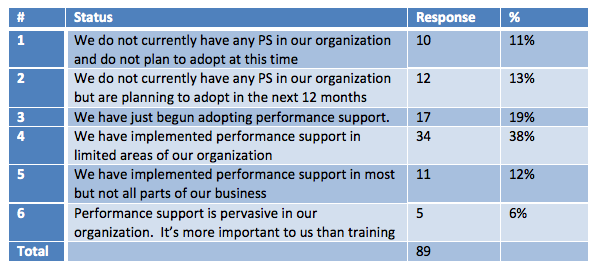
Table1: Survey responses: Performance support status (2013)
Performance support maturity
InAugust 2012, Learning Solutions Magazine published my article, “Performance Support Maturity (PSM): A Performance Support Rebirth.”The article described a model that can be the basis for measuring anorganization’s performance support maturity. As shown in Figure 1, the modelidentifies five key criteria: workplace integration, information technology,proliferation, content reuse, and learning experience design.
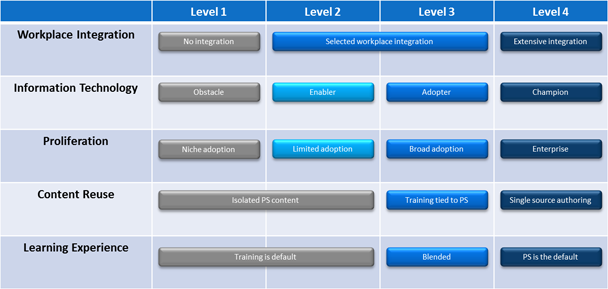 Figure 1: Performance support maturity grid
Thoughthe data from our more recent study indicates that performance support has tremendoussupport, interest, and growth potential, the results also indicate that feworganizations (six percent) are very mature in their PS practices. In fact, the majorityof organizations are still very early in their PS journey with 19 percent indicating thatthey are currently at Level 1 adoption while 38 percent have matured to Level 2.
What you will hear in Boston
Theimplications of this research will be explored more deeply at Performance Support Symposium 2013(September 9 – 10 in Boston). However, initial analysis of the survey results suggeststhat most organizations are quite adept at repurposing learning content foron-the-job-support purposes. In fact, 91 percent report reusing content some or all ofthe time.
Organizations,however, struggle in other key areas: 83 percent report issues with integrating PSinto the workplace, 77 percent do not feel that they have sufficient support from theirinformation technology partners, and 83 percent are attempting to reconcileperformance support into their broader strategy and learning-experience designprocesses.
For learning leaderswho want to know more how to overcome these obstacles, I invite you to join usat Performance Support Symposium 2013, where Allison Rossett and I will host akeynote panel: 25 Years Later: The Evolution and Transformation of PS.