



By Destery Hildenbrand
Technology in learning has always moved forward. Sometimes it strolls. Sometimes it sprints. Lately, it feels like it’s doing parkour.
We went from overhead projectors to CBTs, from CBTs to eLearning, and from eLearning to mobile, microlearning, VR, and now artificial intelligence. Each wave promised efficiency, scale, or transformation. Each wave delivered some of that, missed some of it, and left us with new tools, new questions, and usually a new acronym to explain to stakeholders.
What’s changed isn’t that technology keeps evolving. It’s the rate. The pace of change now makes it impossible to keep up with everything. Not difficult. Impossible.
We all have finite bandwidth. It’s already spoken for by meetings, deliverables, learners, stakeholders, and the occasional attempt to eat lunch without answering email. Expecting anyone to know all the things always is unrealistic. Expecting us to become unicorns and stay unicorns in perpetuity is even more so.
That’s a different article. Maybe when the days are longer and the temperature doesn’t send me into a full-body shiver.
Promising Tech & the Reality Check
There’s no shortage of promising technology on the horizon. But as any good Gartner report can tell you, not everything you plant grows the way you expect or ever quite leaves the trough of disillusionment the way you hope it will. Alas, poor blockchain in learning. I knew thee well.
Artificial Intelligence
Artificial intelligence (AI) is the topic du jour. It’s still hyped, still debated, still confusing, and still unavoidable. That’s exactly what you’d expect from a technology this broad and this powerful.
We’ve got ideas about how to use AI, but there are still meaningful unknowns, including:
- How reliable AI outputs will be over time without constant human calibration
- How data privacy and intellectual property concerns will shake out at scale
- How learners will respond when AI shifts from novelty to infrastructure
None of those are small questions. They should give us pause. They should also give us space to experiment responsibly.
XR Isn’t Going Anywhere
XR has always been near and dear to me. VR in particular remains an incredible modality for learning.
When a project hits the right benchmarks, VR’s hard to beat. Those benchmarks usually include:
- Safety or risk-sensitive environments
- Hands-on practice that’s difficult, dangerous, or expensive to replicate
- Situations were getting the learner there isn’t feasible
If those conditions are met, VR delivers presence, practice, and perspective in ways few other modalities can. That hasn’t changed.
What has changed is where the next evolution inside XR is taking us.
Grounded, Hands-Free & Useful
The evolution that’s got me genuinely excited keeps us grounded in the real world and gives us our hands back. That’s the winning combination.
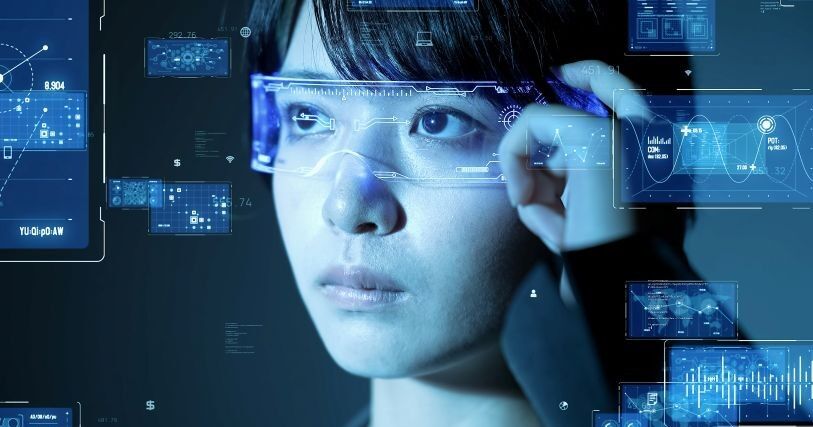
Wearable AR and MR-enabled glasses, paired with a measured dash of AI, open possibilities that feel less like science fiction and more like practical augmentation. These tools aren’t about escaping reality. They’re about enhancing it.
And no, I’m not doing a historical retrospective on smart glasses. If you think I should, then you truly are a glasshole. Get it. Glasshole. Do some research. It’s funny.
Play Along with Me for a Minute
Imagine wearing glasses that look and feel like everyday eyewear. Don’t wear glasses, have no idea what I’m talking about? Seriously, you need to play along here. Think really hard and I’m sure you’ll be able to visualize it.
You’re in a new place, or a place you’ve visited a thousand times. You’re looking at an object and wondering about its style, history, price, or translation.
You focus on it and say, “Hey glasses.”
You ask your question. You hold the item, turn it, inspect it. Your hands stay busy. Your voice guides the experience. Learning happens in the moment, not after the fact.
Now try this.
You’re at the happiest place on Earth. You want to know the wait time for your favorite ride. You also need to coordinate with friends, manage snack logistics, and make sure everyone gets there at the right time so no one misses out. Information shows up when you need it, where you need it, without pulling you out of the experience.
One more.
You’re a new cook. You trained. You practiced. You were a great apprentice. But now you’re running the grill and juggling five or six items at once. You know the theory, but the pressure’s real.
You say, “Hey glasses, show me the most optimal grill layout for the next five orders. Adjust in real time.”
Visual patterns guide placement. Timing adjusts as food hits the grill. You stay in the flow of work while the system supports decision-making.
Far-fetched? Not really. Optimistic? Sure. But progress requires a little optimism.
Watching the Signals
I’m not a fortune teller. I don’t know what the next dominant technology will be. What I do know is that watching how newer tools evolve gives us a chance to shape their use before they’re fully baked.
We can influence their effectiveness in the learning world. We can push for applications that respect learners, support performance, and solve real problems.
I’m not blind to the challenges. But from a technology standpoint, my glass is always half full.
It’s a great time to be in this space. It’s a great time to explore what’s new and what’s next. Artificial intelligence will absolutely be part of that future. The real question is how we incorporate it and adjust so it’s meaningful and purposeful for what learners face on a day-to-day basis.
And with that in mind, I present to you, hands-free wearable tech, my friends.
Hands-free wearable tech.
I can’t wait.
DevLearn 2026: Explore What’s New & What’s Next
The DevLearn 2026 Conference & Expo in Las Vegas, November 4–6, is the place to explore what’s new and what’s next in learning technology, design, development, leadership—and much more. See, try, and learn about new tools and technologies, meet peers, and leave equipped to advance learning at your organization. Register today!
Image credit: metamorworks


