
 Six years ago, Connie Malamed woke up the visual sense ofmany instructional designers with her book VisualLanguage for Designers: Principles for Creating Graphics that People Understand.I reviewed that book at the time, and it is still on my list of recommendedresources for eLearning design and development teams.
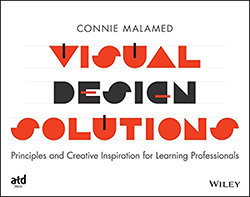
Connie has now authored a companion text, Visual Design Solutions: Principles and CreativeInspiration for Learning Professionals, to complement (without duplicatingmuch of it) her earlier book. “Expands” really isn’t the right word for therelationship of the new book to the first one. “Magnifies” comes closer todescribing what she has done.
The book
Visual DesignSolutions is a volume that could be used as a textbook in an upper-levelcourse for instructional systems designers. It can be used on its own forself-directed study. It will also be a reference, a source of ideas, and asteady inspiration to many in this field in their everyday work.
Physically, this is 361 pages of design goodness. It isavailable as paperback or as Kindle. I’m normally a Kindle fan, but not forthis book. You need easy access to the figures, of which there are many, andthe physical book is 7.4inches high by 9.4 inches wide, so the form factor is different from a Kindlescreen. If you have an old Kindle (no color!), you will be missing a lot of thebest part of the book.
The book is organized into four parts, with a total of 16chapters. There are an amazing 176 figures to illustrate the key points andprovide examples; there are also several tables that summarize importantdetails, such as the various graphic file formats and their uses.
The content
I am hard pressed to give an adequate summary of everythingthat is between the covers of Connie’s book. The best way to proceed may be tohit the high points, and then urge you to get the book. I am certain you willnot be disappointed. There is nothing in VisualDesign Solutions that is not excellent and that you will not find helpful.The price ($38.83 at Amazon) is a bargain.
Part 1: “The Big Ideas”
This three-chapter part helps you, in Connie’s words, “to embracethe role of the designer,” which might not be a role you feel very confidentabout embracing. She intends to change your mind about that.
Throughout the book, each chapter starts with the questionsit intends to answer, and ends with takeaways. This will help when you areskimming the book, or looking for specific help with a specific problem. Part 1starts with background (how can I use visuals to improve learning?), andcontinues to provide a design process (a process much like ADDIE should be). Itconcludes with practical suggestions to improve your work: building a graphicdesign “toolbox,” how to create and use a visual style guide and templates,where to get design ideas, and technical terminology.
Part 2: “Building Blocks of Design”
These three chapters introduce the reader to the concepts oforganizing graphic space, selecting and creating images, and working with type.These are more practical and hands-on than the word “concepts” might imply. Aspart of organizing graphic space, you learn about white space and how to useit, about using grids to gain competence in layout design, and usingperspective to add realism.
As an old “type dog” myself, I was happy to see the chapteron typography, an aspect of design that many designers (including someprofessionals) just don’t get. It’s not about “readability” alone. Typefacesadd their specific personality to a design. Don’t skip this chapter!
Part 3: “Power Principles” and Part 4: “Practicing Design”
These 10 chapters provide compelling principles that guidegood design decisions and make for great results. Taken together, and assumingyou paid attention to the first six chapters, these are the parts that pay forthe cost of the entire book. Applied, they will add the production values andpizazz to your eLearning product that will set it apart from all others. Youlearn how to achieve a balanced, unified, polished “look” and there are plentyof illustrations to inspire you.
The payoff begins with tips for using color with purpose,establishing a visual hierarchy, and unifying your design. You also learn howto use contrast and to group visuals for meaning, so that ideas, concepts, andfacts will be clear to learners (and by the way, all of this applies toperformance support and to infographics, too). You will find out the techniquesfor directing a learner’s attention, and making learning exciting, enhancingmeaning, and making numbers interesting. Most intriguing, you will learn how totell stories with your visuals. Graphic novel format, anyone? Well, maybe notfor every eLearning production, but in these two parts of the book you willfind the help you may need to make a compelling and engaging visual story!
Summary: Buy the book!
Maybe at this point you are ready for a summary. Here it is,in Connie’s words: “This book does not teach you how to produce graphics, nordoes it promote a particular software package. You can make great improvementsby applying the foundation principles of visual design, regardless of whatprogram you use.”
Connie gives you those foundation principles—organized,illustrated, and exemplified. Go out and make even greater eLearning!
Bibliographic information
Malamed, Connie. VisualDesign Solutions: Principles and Creative Inspiration for LearningProfessionals. Hoboken: John Wiley & Sons, 2015. Available in print andKindle formats.