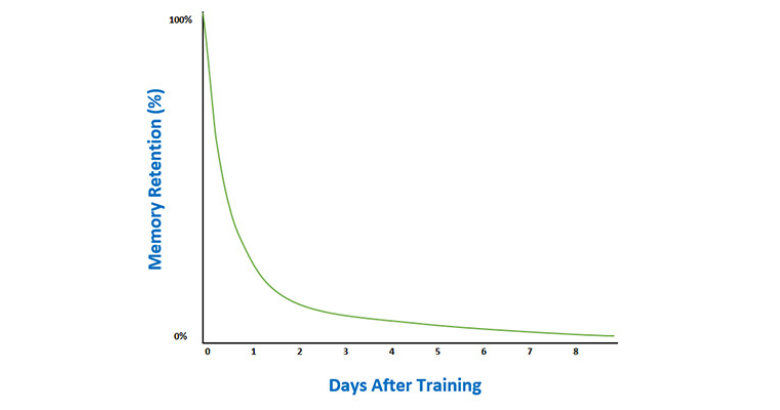
Well-designed serious games can bepowerful learning tools because they effectively combat the forgetting curve.The forgetting curve,discovered by 19th century German psychologist Hermann Ebbinghaus,explains some of the fundamental factors that can make learning and rememberingdifficult. The forgetting curve demonstrates that forgetting begins right afterlearning, with retention dropping steeply right away and then nearly levelingoff over time at nearly zero retention. The basic forgetting curve looks likethis:
By adding spacedrepetitions of learning (i.e., relearning repeatedly over time, withgaps between the sessions), the forgetting curve can instead look something likethis:
Unfortunately , little research has been done on the impact of seriousgames on the forgetting curve. However, when we examine the various principlesthat underlie the forgetting curve, we can clearly see that seriousgames are an ideal technology for maximizing learning retention. Let’stake a look at the seven primary forgetting curve principles and how they’re utilizedby serious games.
Principle 1: Information is easier to learn if it’smeaningful and relevant to real world situations.
Serious games create environmentsand situations that mimic the real world, reminding users that this learning isrelevant and meaningful. We’re not just learning facts and figures, we’reexperiencing and doing things, which engages our brains in a much deeper way.Also, we connect with characters and stories more than plain facts, so thatmakes it still more meaningful. Bonus points if the serious game is in VR,where the experience can feel very real, increasing relevance and meaning evenfurther.
Principle 2. More material to learn means an exponentialincrease in the time required to learn.
Well-designed games can hook playersinto playing for hours on end due to the fun factor, which means students canlearn more material in any given session. Further, designers can encouragelearners to want to go back and play repeatedly over a period of weeks ormonths, which means even students can cover even more material. For example, newlevels and player abilities can be unlocked after a set period of time, andplayers can earn points or other rewards for playing longer sessions or repeatsessions over several weeks or months. Better still, games with a socialelement, as in multiplayer games or competitions encourage players to play forlonger, talk to other people about the game and lessons during and after gameplay, and return to play together again later on.
Principle 3: Relearning is easier and faster with eachrepetition (i.e. the fourth time we learn something is easier than the first).
Relearning material is easier withserious games than many traditional learning methods because we don’t easilyforget how to play and win a game we’ve played many times, especially if itengages us at an emotional level. Games allow us to repeatedly “do” instead ofjust think, which helps entrench the learning at a deep level. For thosereaders who like to play video games, you know that if you stop playing a game andreturn to play again years later, you won’t instantly pick up where you leftoff, but many skills do remain. This is true of serious games as well; it doesn’ttake long to get back to the level where you left off before.
Principle 4: Each relearning increases the time it takes toforget.
Principle 5: Spaced repetitions of learning sessions are better than intensivelearning over a short period of time (i.e. seven one-hour learning sessions ina week are better than one seven-hour session).
Serious games encourage learners to returnto play often, especially if the games are fun, thus creating spacedrepetitions over many learning sessions. If there are many levels to complete,learners may have to return repeatedly over the course of days, weeks, ormonths in order to pass the final level and complete the game.
Principle6: Forgetting begins immediately after learning.
Principle7: The steepest period of forgetting is the period right after learning, andthe pace of forgetting slows over time.
Seriousgames can be designedso that we don’t just learn something once and move on. We learn it severaltimes in a row until we get it perfect. We can’t proceed to the next until we’vemastered the current level. Then, each successive level builds on the informationacquired in earlier levels, reinforcing the learning attained in those priorlessons. This immediate repetition, combined with longer duration learningsessions and spaced repetition game play as described above, can create a forgettingcurve that demonstrates accelerated learning and looks more this:
The takeaway
Serious games work with the principlesabove to help learners overcome and redraw the forgetting curve. This ultimatelyhelps game players learn faster and retain more. If you aren’t using seriousgames in your L&D curriculum, whether in a work, school, or other trainingenvironment, try putting the forgetting curve principles to work by creating aserious game. This will likely increase learning retention and slow theforgetting curve in your learners and students.
Additional resources
Brown, Peter C.,Henry L. Roediger III, and Mark McDaniel. Make It Stick: The Scienceof Successful Learning. Belknap Press, 2014.