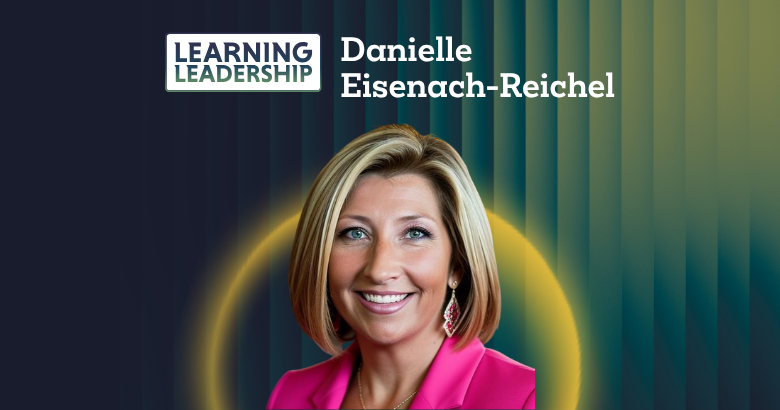
As part of our Learning Expert Spotlight series, we spoke with Danielle Eisenach-Reichel, Global Director of Facilitation at Fresenius Medical Care, ahead of her discussion at Learning Leadership 2026. In a rapidly evolving workplace, the role of learning leaders has expanded far beyond delivering training programs—they’re now responsible for building leadership capability, navigating complexity and driving meaningful behavior change. Danielle is at the forefront of that transformation.
In this interview, she shares why values-driven leadership is more important than ever, how organizations can move beyond content to create lasting impact, and what attendees can expect from her Learning Leadership breakout discussion on turning values into everyday leadership behaviors.
Q: How did you get your start in learning and development?
A: I’ve been a part of learning and development since my very first job. I was a swim instructor, and what I loved most about that job that still holds true today is the ability to help people create an experience where people feel comfortable, where they build confidence and competence, and whether that’s in a pool or in a work environment, it’s not really that big of a difference. So, I’ve always been really interested in bridging that gap between what people want to do, where they want to be, what that desired state is, and where they’re at today, and helping them see it’s really not that far, and that people really will learn best when it’s practical, when we can meet them where they are and when we can show them that it’s attainable.
Q: What does your current role look like?
A: I am the Global Director of Facilitation within Talent, Learning, and Organizational Development at Fresenius Medical Care. And our work right now is focused on leadership and professional development. So I lead a global team of expert facilitators who are certified and trained and really just amazing humans who help our leaders to be their very best so that we can provide the best possible care for our patients, the best quality of life for our patients. And so my focus is on empowering and supporting those facilitators, partnering with our talent team to create experiences where leaders can support their teams around the world, whether that’s clinical, whether that’s within the business, or even on our manufacturing and distribution side. So, supporting really what that looks like on a global level, making it relevant to their work is really what my job is about.
Q: What is your favorite part of the work you do right now?
A: Connecting with leaders and really seeing them grow in their leadership, confidence and capabilities, really making those experiences and those conversations in the time that matters most. And when leaders come back and they’re like, you know, I did this thing that you and I were talking about and here’s what happened, and it wasn’t as hard as I thought it would be. And so just having those meaningful conversations, which is what drew me to this conference, is because it’s about having those conversations. You know, a lot of people know more than they’re giving themselves credit for. A lot of times it’s just fine-tuning or enhancing or helping them apply a concept that they know in that situation. So, helping them really make it practical. And so, it’s helping people. That’s my favorite part.
Q: What has changed the most about being a learning leader in recent years?
A: What hasn’t changed in recent years? It’s a lot more strategic than I think it used to be. We’re not just delivering programs anymore. We really help the organization build capacity. And so the pace, as I’m sure you can appreciate, has substantially and exponentially accelerated. People are expected to do more faster, typically with fewer resources. And so really connecting what we’re doing to help our leaders upskill, tying that to strategy, tying it to performance, making sure it’s aligned to culture really helping the organization to transform and remembering that this is all about people. It’s not about the content anymore. Content is important, but it’s how it connects to the people. It’s how we help them navigate complexity and uncertainty and being hybrid or being face-to-face or being completely virtual and then let’s layer in technology, which is changing faster than we can keep up with. And so then it’s helping people to have the mindset and the discipline to be agile, to be open, to be curious. So really it’s moved from program delivery to capability acceleration. And so again, tying that strategy to the human.
Q: What are the biggest challenges learning leaders are currently facing?
A: Speed and complexity. Thank you, TikTok. Our attention spans have really dwindled, right? So, where something might have been 3 three-hour sessions or a two-hour session, now you need microlearning. And by micro, I mean, I’m having this problem right now in this very moment. I want an answer. How can I get that support I need now? Not, I’m going to go register for a course. It’s going to be 6 or 8 weeks from now and I’ll take care of it then. People need what they need and they want the answer now. And so, speed and complexity for certain, especially in a global organization, we’ve got multiple contexts, multiple languages, multiple disciplines making sure it’s localized, making sure it’s relevant, so it’s connected to where they are today, while also taking into consideration that as adults, we have experience, we have knowledge that we come into this workplace with. So, I think that’s a huge challenge capacity. Thinking about how busy and stretched we are. When we think about leadership, we often hear terms like frenzied, fragmented, and fearful. So, how do we help leaders calm that storm and be willing to adapt their mindset, their behaviors, and integrate a little bit of technology. And then we have to sustain that in a global organization. We can’t just have that excellence in one pocket, in one language, in one line of business. We have to amplify that around the world. So, the challenge isn’t just creating more learning like it used to be. It’s really making sure that we’re relevant, that we’re trusted as partners and support, and that what we’re providing is applicable and sustainable.
Q: Can you give us a sneak peek into the discussion you’ll be leading at Learning Leadership?
A: The discussion is really going to be focused on leading with intention and how we scale values-driven leadership. Again, humans at the center of all we do. Exploring how organizations are going from values that are words on the wall to really embedding our values and our leadership in our day-to-day behaviors and how we guide an organization towards those results. So, touching on decision-making, alignment, strategy, growth, development, and thoughtful integration of AI. And again, the format of this particular conference really interests me because having the discussion about what people are experiencing, what successes they’ve had, what challenges they’re facing, how we can work better together, because none of us are experts in this space yet. The key themes around leadership remain consistent. The application is what’s continuing to evolve, and that’s exciting. So, the conversation that I’ll focus on will really be moving those values from just the words on the page to really being strategic drivers for leadership behaviors, building trust, psychological safety, and driving results.
Q: What do you hope attendees take away from that discussion?
A: Hope. I hope they have hope. I hope that they leave with practical ways to make values-driven leadership actionable. I hope that they understand and see the alignment between their personal values and the work that their organization is doing, and that they can translate that into day-to-day behaviors that drive results and support the people in the organization. I really hope that they have ideas they can implement immediately and that they feel encouraged and connected. As leaders, we’re carrying a lot right now. And I think the idea here is that this is going to be progress, not perfection. Giving people permission to do it messy, to show the work, to have the discussion, because if we don’t talk about it, we get stuck in our own set of expectations. I hope that they leave with hope and that they leave with those practical ways to turn the conversation into action.
Q: What are you most looking forward to at Learning Leadership?
A: The relationships and peer-to-peer interaction. Learning Leadership is about connecting people who are the drivers in their organizations, talking about how we innovate, how we strategize, how we support the people who are making things happen, exchanging those ideas, understanding different perspectives, and contexts, and being able to bring that back and say, “here’s what I heard others are doing. What could that look like or mean in our organization?” and sharing what we’re doing and helping others see what that could look like for them. So, really the connections are what I’m most looking forward to.
Q: What is one trend learning leaders should pay more attention to?
A: I think it’s no longer about the content. It’s about the behaviors. It’s about leveraging technology, again, with the human at the center, and how can we design experiences so that our learners can get what they need, when they need it, how they need it, and apply it. It’s about supporting the mindsets and the behaviors. It’s not about pushing content out any longer. So, especially in leadership development, it’s not, “did people attend check the box?” It’s, “what has changed in their leadership? What has changed in their mindset, in their approach? How is their team different? Are they achieving what they desired?” It really isn’t about the content anymore, it’s about the behavior change.