



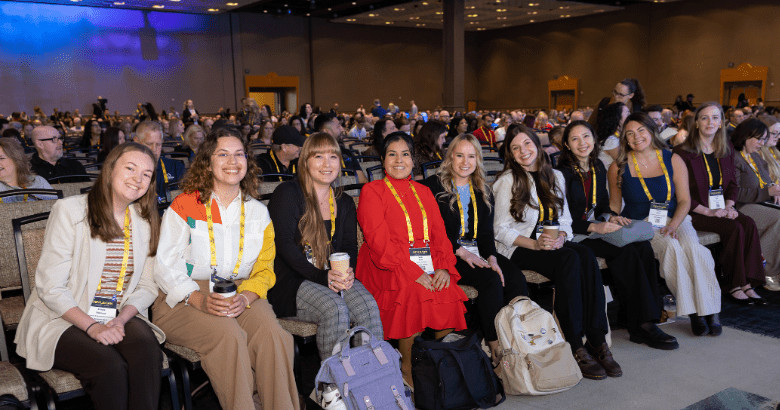
From AI and emerging technologies to accessibility, measurement, and peer learning, 18 DevLearn ambassadors share what they came looking to understand, solve, and bring back to their work.
At DevLearn, professionals arrive with different roles, responsibilities, and challenges. But when we asked our 2026 ambassadors what challenge or opportunity in their work brought them to DevLearn this year, their answers revealed a common thread.
They came to understand what is changing, learn how others are responding, and bring practical ideas back to work.
Seeing beyond the silo
Several ambassadors came to DevLearn to understand how their work compares with what is happening across the industry.
Melissa Milloway, Learning Strategist at Microsoft, wanted to learn what other companies are doing in product development and how organizations in the technology sector are working with different types of learners. Cassie Nii, Senior Program Manager of Talent Development at SanMar, described a similar need, explaining that when you work in your own silo, it can be difficult to know how your organization compares with others.
For Sandie Dela Cruz, Senior Manager Digital Solutions at Edwards Lifesciences, DevLearn provides the kind of support that can be difficult to find within a single organization.
“When I started at my company, I was a team of one,” she said. “Now, having a group of people at DevLearn feels like having a big team made up of people from different companies.”
Isabella Barker, Senior Trainer and Content Developer at TAC4 Solutions, who is newer to technical training, came to connect with people who have been doing this work for years. Debbie, CIO at Creative Interactive Ideas, was also interested in hearing from newer professionals, whose fresh perspectives can challenge and shape the way more experienced practitioners think about their work.
Moving from AI adoption to practical value
AI was another major reason ambassadors came to DevLearn, but they were looking for more than introductory conversations about the technology.
“We’ve moved on from, ‘Let’s adopt AI,’ to, ‘How does AI create value? How do we use it? How does it change what we do today?’” Zsolt Olah, Senior HR Data Measurement Analyst at Intel, said.
He wanted to hear from people who had already tried AI, including what worked, what did not, and what could be brought back to his own organization.
Jeff Batt, Founder of Learning Dojo, was interested in a similar exchange of practical ideas. He wanted to see how others were using AI to create customized interactions and compare the different approaches people were taking.
“Everyone is doing it in different ways,” he said. “It’s good to see if you’re doing it the right way, if you could do it better, or if there’s an entirely new way to do it.”
Christy Tucker, LXD Consultant at Syniad Learning, came to explore what may be next, including the shift from chatbots to agents and vibe coding. Sarah was thinking about the broader skills professionals will need to work effectively with AI and other tools. For Ivonne Martin, Senior Instructional Designer and Owner of eLearning Bestie, AI was connected to a specific organizational challenge: creating accessibility processes.
Finding practical solutions together
Other ambassadors arrived with specific workplace challenges they wanted to address.
Kevin Yates of the L&D Detectiv e® was focused on helping the learning community better measure how training and talent development contribute to workplace and human performance. At DevLearn, he shared his L&D Detective method and an AI assistant tool designed to support that work.
Tristia Hennessey, Senior Instructional Technology Strategist at Evolve Solutions Group, came looking for solutions and new ways of thinking, while Pooja Jaisingh, Founder and CEO of Digital Learning Nook, wanted to learn what people were experimenting with and bring those ideas back to her own work and the broader community.
The exchange went both ways. David Chestnut, Principal Director of Human & AI Talent Strategy at Accenture, returned as a speaker and ambassador after attending DevLearn the previous year, ready to share his story and help others think through their own challenges. Kassy LaBorie, Karl Kapp, and Megan Torrance also highlighted the value of being surrounded by people who are exploring, building, teaching, and sharing new approaches to learning technology.
Across the ambassadors’ responses, DevLearn emerged as more than a place to collect information. It is a place to compare notes, test assumptions, hear what is working in other organizations, and explore what comes next.
In a field changing as quickly as learning and technology, professionals do not have to navigate those changes alone. They can connect with peers, find practical ideas, and leave with greater clarity about how to move forward.
Registration is now open for DevLearn 2027, taking place October 6–8 in Las Vegas. Register early to take advantage of our conference discounts because the sooner you make your plans, the more you can save.


