Serious games are being used by more and more organizations as part ofworkplace training, but despite their growing popularity they are still arelatively new phenomenon for some sectors. According to the 2014-15 Towards Maturity Benchmark Report,just 24 percent of learning and development (L&D) leaders use games orsimulations in their training. What’sholding them back?
It may be the view that serious games are still a bit of a novelty, orthat the world of work and gaming simply don’t mix. But perhaps it is morelikely to be concern over issues such as complexity, cost, production time, andthe practical application of serious games.
To shed light on the subject, here is a rough guide to the use ofserious games as a workplace training tool.
Quick definition
Very simply, serious games are learning games. Their primary purpose isto allow a person to learn something through game play while having fun. Theyare designed with the specific intention of achieving a particular learningoutcome linked to a training need. Serious games focus on real life issues orproblems that the player will recognize within their working life. They use thesame techniques and devices as a video game designed purely for pleasure.
Key differences
To understand more about serious games and the role they can play inworkplace training, it is helpful to consider how they contrast with standard eLearning.In Table 1, I’ve compared aspects that are typical of eLearning with aspects ofserious games. Some key differences start to emerge.
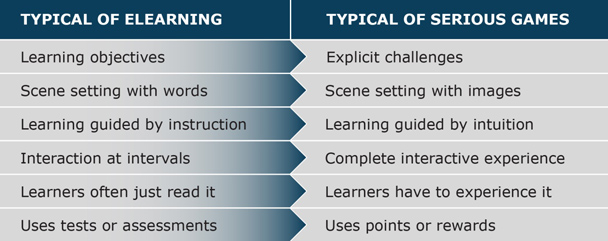
Table1: Contrasts between eLearningand serious games
Gamification expert Karl Kapp believes the acceptance of failureand “replayability” is also key in setting serious games apart from traditionalinstruction. He points out that in most instructional settings failure isportrayed as negative and the emphasis is on learners getting the right answer.“In most modern work environments, there are many ways of solving problems,dealing with obstacles, and creatively finding solutions,” writes Kapp. “Gamesencourage failure and exploration, two keys to modern workplace success.” He saysthat it is this exploratory quality of serious games that encourages people toplay them over and over, and in doing so, review the information and reinforcetheir knowledge.
Workplace applications
A group of more than a hundred L&D professionals were asked to comeup with a business challenge they thought would be suitable for a serious game.Compliance and health and safety were the most popular suggestions, but what reallystood out was the breadth of topics. From conflict resolution to prescribingmedicines, there are a wide range of possibilities. Figure 1 is a word cloud that summarizes their suggestions.
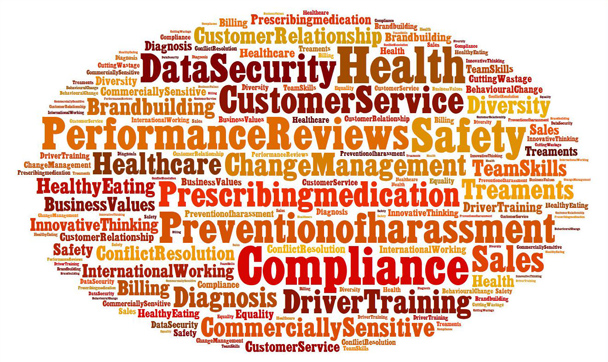
Figure1: This word cloud summarizesthe thoughts of over 100 L&D professionals on business challenges mostsuitable for a serious game
There are no hard and fast rules, but serious games tend to be mosteffective when they deal with real risksand real consequences in topic areas that impact on an employee’s safety,job, life, or money. For example, health and safety training is a good candidatefor a serious game because it has real workplace relevance and could ultimatelyimpact on an employee’s safety or the safety of the public. Likewise, ahealthcare game about injectable medicines could explore the real-life risks topatients. A serious game that helps an employee to learn about protecting tradesecrets would be compelling because getting it wrong could cost them their job.
Real-worldexamples
So how are organizations using serious games right now? Here are somereal-world, albeit anonymous, corporate examples:
- Social-mediacompliance: A serious game has been developed to help employees of a major organizationtest their knowledge and ability to successfully apply the company’s social-mediacode. As part of the challenge, staff must work against the clock to decidewhich Tweet to make in response to a particular scenario.
- Information securityawareness: A global company has experimented with teaching information securitytips through an animated interactive game where employees have to complete aset of six game challenges on protecting their personal and company data.
- Fire safety: Learners ata major organization are being taught how to spot fire hazards in a seriousgame. They must play against the clock to identify potential risks in aninteractive, animated challenge.
Jargon-buster
As serious games increase in popularity, you may find yourself facedwith a raft of new terms and phrases that can be mystifying to the uninitiated.These terms come from the world of video-game design and are starting to crossover into sectors such as eLearning, where serious games or game elements arebeing used.
Here’s a short jargon-buster to help anyone new to the world of seriousgames:
- Casual Game: This is theterm used to describe a game with simple rules that requires no special skillson behalf of the player. This is in contrast to commercially produced videogames where player skill and commitment is a key factor.
- Cut Scene: Also knownas an event scene. This is a non-interactive scene that breaks up the gameplay. It could be video or animation and is useful for moving a narrativeforward.
- ExperiencePoint (XP): This refers to a unitof measurement that quantifies a player’s progression through the game. Theseare generally awarded for completing tasks, overcoming obstacles, or meeting challenges.
- Juice: This termrefers to the extra touches that bring a game to life. Developer Martin Jonasson sums it up as things that “wobble, squirt, bouncearound, and make little cute noises; it’s sort of a catch-all phrase for thingsthat make a game more satisfying to interact with.”
- Permadeath: Sometimescalled PD. Both terms are short for permanent death which refers to a situationwhere a character who “dies” in the game cannot regenerate and continue withoutrestarting the game.
- Power Ups: This meansany object or icon in a game that instantly adds an extra benefit or “power.”This added boost will normally only work for a limited time.
Your move!
I hope this brief introduction to the usage andjargon of serious games will help you in your exploration of effective ways tofacilitate and support learning in your organization.