
We are living in a time of immensechange, but we are often not very aware of what is happening around us. Oursituation is like that in a famous quote, “We don’t know who discovered water,but we know it wasn’t a fish.” Even though cell phones wereinvented less than 50 years ago, and the iPhone less than 10 years ago, they havealready become part of our taken-for-granted world. In business, we are nowstarting to see the rise of the term “enterprisemobility” to describe the trend of working outside an office environment whileusing mobile devices and cloud services to carry out business tasks. This trendis accelerating and will overtake most large enterprises in the next fiveyears. Will you be ready for the impact of this change?
The answer to this question dependson your understanding of the medium in which you are swimming. We contend thatit is made up of three components—technologies, affordances, and organizationalchange—the TAO of enterprise mobility. In this article, we look at each of thecomponents, and how understanding each of them in the context of enterprisemobility adoption can help to prepare us for the near future of changingbusiness practices. We also examine the processes of innovation and ideadiffusion, and why constant innovation is necessary to simply keep up in thisrapidly changing field. Having viable innovation practices in place will be thesecret of success for those companies that master this new digital and mobileworld.
Technologies
While traces of a vision of being untethered from desksand landline phones while working for a business have existed for the past 50years, we are only now arriving at the “tipping point” (Gladwell, 2000) of innovation where werecognize that this change is happening very fast. Since the introduction ofthe iPhone in 2007, the use of mobile phones has grown such that there are nowsignificantly more mobile phone users than desktop computer users (1.9 billionvs. 1.7 billion worldwide in 2015). While usage of mobile devices varies byindustry, the use of mobile phones and tablets has become ubiquitous in mostbusiness settings.
Technologies are usually not adopted as single innovations,but come in clusters, often packaged together. Mobile phones are not justphones—they are Trojanhorses for over 30 discrete technologies, many invented more than 100 yearsago. Enterprise mobility would not be possible without the invention anddevelopment of electric batteries (1800), the telegraph (1837), fax machines(1843), telephones (1876), radio (1894), wireless telegraph (1895), television(1909), digital computers (1936), transistors (1947), solid state integratedcircuits (1949), silicon chips (1954), satellites (1957), computer networks(1960), pocket computers (1962), databases (1962), computer graphics (1963),touch screens (1965), memory cells (1969), graphical user interfaces (1973),the Global Positioning System (1973), cell phones (1973), digital cameras(1975), cellular networks (1979), and up to a dozen different sensors. (The date aftereach technology is approximately the year when a working model of thetechnology became available.) Eachtechnology in this incredible mélange has its ownhistory, and together, along with the myriad of applications that we use, they areprecursors to the functionality that we enjoy today from our mobile devices.
Obviously, the development of the technologies in ourmobile phones, tablets, and wearables hasn’t happened overnight; but, for manyexecutives, the major technologies now used in business have changed onlyrecently (if at all), becoming much more mobile and miniaturized and usingcomponents operating at much higher speeds, while using levels of machineintelligence, big data, and the cloud that didn’t even exist in the early 1990s,when Gloria Gery conceived the notion of improved efficiencies with instantinformation from electronic performance support systems (Gery, 1991). Such conceptswere science fiction at the time, something out of a then-contemporary WilliamGibson novel. However, with the ubiquitous pocket computing experience offeredby the smartphone, tablet, and now wearable devices, it’s clear that thescience-fiction books and films of the early days of the Internet were far moreaccurate than we could have imagined. Certainly, we don’t live in a computersimulation as the Matrix filmsfictionalized (though there are some very interesting physicists who have puttogether compelling arguments that we may be in that state of being), but wecan take advantage of many of the tropes that we’ve come to know and love fromthese cyber thrillers.
Affordances
In the diffusion of any innovation,the necessary technologies usually come first, followed by a set ofapplications that make the hardware useful for carrying out specific tasks.Sometimes the potential uses of a new technology are not obvious, even to thedevelopers and designers who produced a specific device. Sometimes, the users “reinvent”the possibilities by seeing new uses that the original inventors hadn’tanticipated.
As technology developers andanalysts, we refer to what we can do with a particular technology as its “affordances”(Gibson, 1979) or design “actionpossibilities” (Norman, 1988). Essentially, an affordance is a quality orfeature of an object, or of an environment, that allows an individual toperform an action. For example, the handle on a teacup allows it to be liftedwithout the holder getting burned. A teacup also has a number of other featuresthat make it a great and useful tool.
As technologies change, thepossibilities of what can be done also change. All technologies have a set ofaffordances that makes some actions possible while limiting others. Forexample, if we look at three different educational or training technologies—aphysical classroom, self-paced eLearning, and mobile learning—we canimmediately see that the actions of both teachers and users are enabled,shaped, and also limited by the features of each of these technologies. Table 1shows some of the differences (and similarities) among these three learningtechnologies.
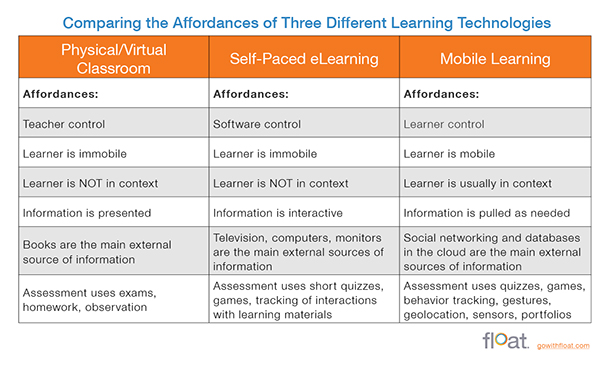
Table 1: How do learning technologies compare?
Organizationalchange
Every innovation that an individualor an organization adopts has consequences, many of them unforeseen. It isprobably obvious that your workplace has changed because of the use of mobiletechnologies. Reading the press, though, it’s just as obvious that all ofbusiness has changed—it is now global, connected, decentralized,hypercompetitive, and precarious.
How will you keep up? People,process, and tools are the only things you can affect. It’s clear that you needto attract, hire, and retain savvy people to collaborate and complete theirwork using the latest in technology. Let’s explore what that means for yourbusiness. What can you change, enable, and grow for your business? In the wordsof author Jack Womack, from the afterword of William Gibson’s cyberpunkclassic, Neuromancer, “What if the actof writing it down, in fact, brought it about?” Envision what could be possible,and you can make it so.
Certainly, in most industries, there isa steady demand for improved performance and increased productivity. “Domore with less” is a constant refrain. The numbers don’t lie. The recovery inthe US that has occurred since the market crash in 2008 was largely a joblessone until very recently. Most hiring in office and knowledge-worker roles hasoccurred to fill jobs vacated in the downturn, and we are just now hitting thepre-recession employment numbers. At the same time, there has been an increase in both theproductivity of the average office worker and in the GDP (gross domesticproduct). We are actually doing more with less. Perhaps this is theresult of the swing to enterprise mobility and all its benefits.
Businesses that have significantmarket share and a history of growth in their industry are embracing change, aswell as extensively employing mobile technology. A 2013 study by research firmi4cp found that “high-performance organizations” areover four times better at managing organizational change compared with low-performanceorganizations (i4cp, 2013). And business leaders “areincreasingly adopting an extensible Mobile Application Platform (MAP) approach”as the infrastructure underpinning such organizational change (Cloud StandardsCustomer Council, 2013). Accenture (2016) found that 54 percent of exemplarycompanies “deployed a mobile-enterprise app store (versus only 22percent of other organizations), providing enterprise-grade functionality totheir mobile users,” while a recent Salesforce research study showed that “high-performingorganizations are 3.5 times more likely than underperformers to extensively usemobile reporting tools” (Salesforce Research, 2015). The importance of anenterprise mobility strategy was also highlighted in 2013 research by theBrandon Hall Group (Freifeld, 2013) showing that high-performance organizationshad:
- A formal mobile learning strategy
- An integrated learning plan that incorporates mobileweb and apps into their LMS
- Content that is accessible through mobile devices
- Engaging and effective mobile content
- A well-thought-out and mature mobile learning model
The time of hesitation is over.Enterprise mobility is not a phase or a fad. These devices, and all theirwonderful affordances, are here to stay.
A key recommendation would be tostart examining some of your stickiest problems and begin with a clean slate.What nagging issues have you been unable to solve with learning, training,workshops, and the usual approaches to information access and sharing you’vetypically tried? It’s entirely possible that the solution is already insomeone’s hand in your company. It’s time to engage with your workers, begin ahuman-centered design process, and find out what clever pieces of technologycould be combined to make the problems go away.
References
Cloud Standards Customer Council. Convergence of Social, Mobile and Cloud: 7Steps to Ensure Success. 2013.
https://www.cloud-council.org/deliverables/CSCC-Convergence-of-Social-Mobile-and-Cloud-7-Steps-to-Ensure-Success.pdf
Daugherty, Paul. Masters of the digital universe.Accenture, 2013.
https://www.accenture.com/ca-en/insight-outlook-masters-of-the-digital-universe-information-technology.aspx#
Freifeld,Lorri. “Mobile Learning is Gaining Momentum.” Training. 29 November 2013. https://trainingmag.com/content/mobile-learning-gaining-momentum
Gery, Gloria. ElectronicPerformance Support Systems. GeryAssociates, 1991.
Gibson, James J. The EcologicalApproach to Visual Perception. Boston: Houghton Mifflin, 1979.
Gladwell, Malcolm. The TippingPoint: How Little Things Can Make a Big Difference. New York: Little, Brownand Co, 2000.
i4cp. Building a Change-Ready Organization: Critical Human Capital Issues2013. Institute for Corporate Productivity, 2013.
https://go.i4cp.com/critical-issues-2013-report
Norman, Donald A. The Design ofEveryday Things. New York: Doubleday, 1988.
Salesforce Research. State of Analytics. Salesforce, 2015. https://www.salesforce.com/form/conf/2015-state-of-analytics.jsp