
As David Kelly, executive vice president and executivedirector of The eLearning Guild, recently wrote about the potential and risks that enhanced realities hold forlearning: “Virtual, augmented, and mixed reality applications are poised toexplode into the consumer market. That explosion will bring with it themainstreaming of this technology that transforms how we look at content,opening new opportunities not only for how we entertain ourselves but also forhow we connect, share, and learn.”
Our newest white paper contains a “knowledge check” on enhancedrealities, with 20 multiple-choicequestions to test your knowledge of basic terminology, best-practiceapproaches, and the current state of enhanced realities for learning. This resourcecan help you begin building your knowledge of enhanced reality tools andtechnologies for learning and development, and can also serve as a first stepalong the pathway to success in this increasingly important area in learningand development.
In this whitepaper, you will gain essential knowledge for achieving success in (what Kellycalls) the coming “explosion” of enhanced realities. You will learn:
- Howwell you know the basic terminology of enhanced realities
- Whichuses of enhanced realities for L&D you need to work on for your current jobrole
- Whichenhanced reality devices, technologies, advantages, and disadvantages you needto understand and leverage for learning design and delivery
- Whichareas of broader enhanced reality learning you need to master in order toachieve your future job goals
- Whatpractical steps you need to take in order to incorporate enhanced realityknowledge and expertise into your skill set
Gazing at the fuzzy future
At themoment, the future of virtual reality and augmented reality seems intriguing,controversial, disruptive, and, at the same time, just plain fuzzy—as Amy Nordrum has observed. One thingis crystal clear, however: The technologies driving VR and AR have enormouscommercial value, they are growing exponentially, and they are here to stay. (See the white paper for numerous referencesand resources regarding the wider subject of enhanced realities.)
In fact, a 2016Citigroup report by Kota Ezawa and co-authors predictsthe “VR/AR market could grow to$2.16 trillion by 2035 [Figure 1] as different industries and applicationsadopt and make use of the technology. … AR commerce is expected to represent 25percent of online retailing by 2035.”
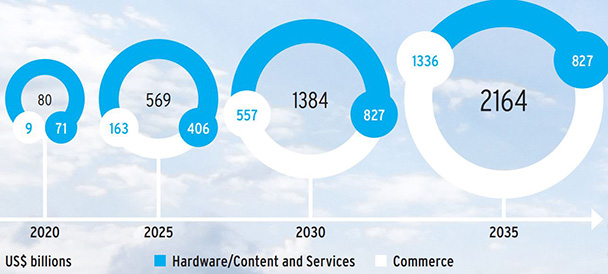
Source: Ezawa, et al, 2016
Figure 1: Citigroup’s forecast of VR/AR market growth
Althoughthe hardware and technologies for virtual and augmented reality have existedmainly at the periphery of business, commerce, entertainment, and learningwithout achieving mainstream acceptance and use, things are now changingrapidly. The L&D field—including learners, instructors, and instructionaldesigners—is on the forefront of these changes.
As Elizabeth Reede andLarissa Bailiff observe in TechCrunch, within the field of education inparticular, much of the rapid growth in VR-based learning “has centered on thehard sciences—biology, anatomy, geology, and astronomy. … In other areas ofeducation, many classes have used VR tools to collaboratively constructarchitectural models, re-creations of historic or natural sites, and otherspatial renderings.”
The time-to-adoption horizon
In spite of thevast commercial and pedagogical potential, many industry analysts and learningleaders during the past year—such as Carl Straumsheim, who wrote about VR inJuly 2016 for Inside Higher Ed—have still described the time-to-adoption horizon for VR/AR asbeing two to three years ahead.
Theterm time-to-adoption horizon is usedin the New Media Consortium’s Horizon Report on higher educationto characterize trendsthat (in the consortium’s view) are accelerating technology adoption andapproaching mainstream use. As Bryan Alexander has noted, these are divided into three categories: long-term trends(expected to achieve mainstream use in five or more years), mid-term trends(three to five years), and short-term trends (one to two years).
In other words,this means trend analysis envisions that enhanced realities will impactlearning environments in the long term far more than in the short term.
Interestingly, Gartner Research’s 2016 Hype Cycle for Emerging Technologies (Figure 2) separatesVR and AR and shows augmented reality mired in the “Trough of Disillusionment”;however, Gartner says virtual reality has already emerged from this trough andentered the “Slope of Enlightenment,” although it predicts mainstream adoptionis still five to 10 years away for both AR and VR. According to Gartner, neithertechnology has reached the “Plateau of Productivity” where it is widely used inall relevant markets.

Source: Gartner, 2016
Figure 2: Gartner’s 2016 Hype Cycle for EmergingTechnologies
As Gartner Research explains,the Gartner Hype Cycle is “a graphicrepresentation of the maturity and adoption of technologies and applications.”Gartner clients use Hype Cycle diagrams “to get educated about thepromise of an emerging technology within the context of their industry andindividual appetite for risk.”
If these widelyaccepted time-to-adoption horizons are even close to being accurate, thentoday’s learning leaders and instructional design practitioners, among others,are facing substantial challenges and opportunities for innovation in the nearfuture.
Furthermore,this means that we, as learning practitioners, must become knowledgeable andperhaps even proficient at using enhanced realities for learning. Moreimportantly, we must begin now if weexpect to be fully ready for enhanced realities as the adoption horizon rapidlyapproaches.
Are you ready to use enhanced realities forlearning?
Let’s stipulatethat readiness is defined as “a state of preparedness to meet asituation and carry out a planned sequence of actions; it is based onthoroughness of planning, adequacy and training of personnel, and supply ofsupporting services or systems.”
Here is thefundamental question: Is your currentunderstanding of how to use enhanced realities for learning—together with thetechnology platforms and devices required—sufficient for you to successfullyexplain, plan, design, deploy, and evaluate enhanced reality learning anddevelopment initiatives?
If you answered “no,” “maybe,” or “I’m notsure,” then you have arrived at the right place to take advantage of theinformation presented in this white paper.
But let’s first determine your current levelof knowledge regarding enhancedrealities for learning, and then start walking down the pathway tounderstanding, expertise, and ultimately, leadership.
The “knowledge check”presented in this white paper uses20 multiple-choice questions to test your knowledge of basic terminology,best-practice approaches, and the current state of enhanced realities forlearning. Also provided is an in-depth discussion of each correct answer and aglossary of enhanced-reality terminology, together with an extensive list ofresources for further reading.
This pathway tounderstanding and using enhanced realities for learning will be challenging,but well worth the journey.