



“The future is already here—it’s just not evenly distributed.”
—William Gibson
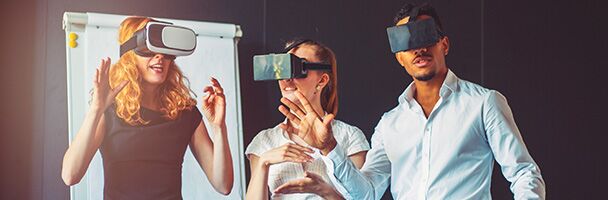
Welcome to the newest monthly column at Learning Solutions Magazine: a column dedicated to virtual reality(VR), augmented reality (AR), mixed/modified/merged reality (MR), games, andgamification as they relate to eLearning, corporate training, education, andinstructional design. In this first column, I’ll provide an overview of VR andMR within the eLearning industry. Future articles will address AR, gaming, andother related topics.
The future is now
In the popular sci-fi book Ready Player One by ErnestCline, the year is 2044, and nearly all education, business, and socialinteraction takes place in a virtual world, accessible anywhere on earth byanyone with a VR headset and a haptic suit. With amazingnew VR products and software now hitting the market seemingly every week, we’lllikely see Cline’s envisioned reality much sooner than 2044. (Editor’s note: It’s already arriving. See Pam Hogle’s November 8article on Cydalion, and anyof the many articles on The Void, whichmakes full-body use of haptic feedback.)
What are VR and MR?
Definitions of virtual and mixed reality vary depending onwhom you ask. Most commonly—and how I’ll use the terms in this column—VR denotes a fullyimmersive world experienced through headsets and earphones that block out thereal external environment (The Lawnmower Man, Avatar, The Matrix). MR, experienced through specialglasses, overlays holographic images onto the real world around us (Google Glass, Minority Report, Iron Man). MR is sometimes referredto as AR, but AR can also refer to an entirely different subset of devices,software, and apps. To confuse the matter further, some people use the termsVR, AR, MR, and even XR to refer to all of these related technologies together asa group. Regardless of what comes before the R, each technology offersdifferent benefits to instructional designers, trainers, and educators.
Because of the ability to fully immerse viewers into a newperspective, VR has often been described as an empathy machine. I’ll add thatMR is a productivity machine, due to how information, communications, graphics,animations, etc., seemingly exist within, interact with, and provide contextfor the physical world as we go through our day. Due to this heightened empathyand productivity, VR and MR are powerful learning tools, though we’ve only justbegun to see how either technology will be used in instruction and education.
Device capabilities
The Samsung Gear VR, PlayStation VR, Vive, and Oculus Rift VR headsets are currentlyavailable to consumers, with still more devices slated to hit the market in thecoming months. Developers have produced many VR games, videos, and otherentertainment content. A growing number of businesses, factories, scientists, andeducators use VR devices, too. Although far less capable, the Google Cardboard VR viewers andplatform are of particular interest to educators because of their low price andwidespread accessibility. A smartphone inside a free cardboard viewer creates apowerful learning experience, accessible by anyone, anytime, anywhere in theworld.
Although VR has been around for decades, the technology improvedexponentially over the past couple of years, contributing to the recent crazeand rapid rate of adoption. VR devices can now read faces, track eyes, andtranslate hand and body movements into the virtual world. The headsets arelight and comfortable, the experiences immersive and fun. Sounds feel real. Hapticdevices add physical sensations, and startups launch new devices every month.You can physically walk around in virtual worlds and 360-degree videos, justlike in Star Trek’s “holodeck.” VRexperiences can create intense empathy for the characters and people depicted. Studentscan repeat training and educational experiences cheaply, quickly, andindefinitely until lessons sink in.
As for MR, devices include the Microsoft HoloLens, Magic Leap, Meta, and Lumenora. Google Glass, brieflyavailable in 2013 and 2014, was discontinued in early 2015 with promises tocontinue developing the project. However, this market is still extremelynascent: Many of the devices are clunky, they’re only available in commercialmarkets, and little content and software has been created yet.
MR devices use the same basic technology as VR. The screenson MR headsets are transparent like eyeglasses, however, and the devices also containtiny room-scanning cameras. This allows holographic images and information—shownin the glasses’ field of view—to respond to and appear to interact with the real-worldpeople, objects, and environments surrounding the wearer. Some fascinating MRprojects also incorporate AI to empower users with relevant information andanalysis on the fly, without users having to stop what they’re doing to look upinformation or physically turn away from the task at hand. These benefits alreadyprovide profound value to many professionals; trainers and educators will soonfind them indispensable as well.
Use cases
Although VR is not for everyone (yet), many professionals doalready use VR for the following training, teaching, and general use cases:
- Training—flight,combat, police, skilled trades, athletics, emergencies (e.g., fires or oilspills)
- Psychology—eliminatingphobias such as fear of public speaking
- Classrooms—exploringnew places and times, safely playing with combustible materials, students indifferent geographies
- Space—NASAastronaut training, support for completing technical tasks on board the InternationalSpace Station (ISS)
- Medicine—surgeryrehearsal, diagnosis, studying human anatomy
- Design—architecture,automotive, aerospace, aviation
A few industries also use MR for similar training, teaching,and other use cases, including:
- Space—NASAastronaut training, support for completing technical tasks on board the ISS
- Medicine—surgerytraining and rehearsal, diagnosis, studying human anatomy
- Design—architecture,automotive, aerospace, aviation
- Industry—factorysupervision, inventory management
Summary
This is truly an exciting time, as the VR/AR/MR industry hasonly just begun to explore the profound implications for learningprofessionals. VR is already changing how we learn: improving it, democratizingit, making it more fun. MR will build on what VR can do and take us light-yearsbeyond what we currently imagine. Ernest Cline’s future as described in ReadyPlayer One—of education, work, and social interaction experienced almostentirely in VR—is already well on its way.
How have you used VR, AR, or MR as a teaching or trainingtool? Let us know in the comments below.
Additional reading and videos
See Mark Zuckerberg demonstratingVR’s awesome capabilities, or watch a HoloLens engineer training demo.
Other VR/AR solutions for training include zSpace and Compedia.
More articles about VR in corporate training:
- William Hall, Training Industry, “Look Before You Leap into Virtual Reality for Corporate Training”
- Erin Carson, TechRepublic,“9 industries using virtual reality”
- Cindy McCabe, SweetRush, “Is Virtual Reality Training in Your Future?”
- K.R. Sanjiv, VentureBeat,“How VR and AR will be training tomorrow’s workforce”
- Indusgeeks, “The potential of using Virtual Reality in corporate training”


