Learning executives can invest thousands of dollars in gamificationinitiatives with little reassurance that the investments will pay off.California-based gamification expert Yu-kai Chou has developeda free formula that can help them better understand the behavioral sciencebehind certain games. By applying the principles of his Octalysis Framework totheir enterprises’ gamification initiatives, chief learning officers can realizebetter returns on their investments, according to Chou.
Who is Yu-kai Chou?
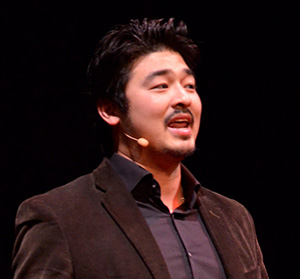
Yu-kai Chou
Chou has been working in the field of gamification since2003. An in-demand public speaker, he has lectured on the topic at Google,Stanford University, TEDx, and South by Southwest (SXSW), and he has consultedwith many Fortune 500 companies, including LEGO, Accenture, Fidelity, AIGJapan, Cisco, UPS, and Verizon. He was named “Gamification Guru of the Year” bythe European-based World Gamification Congress in 2014 and 2015, and his 2015book, Actionable Gamification: Beyond Points, Badges, and Leaderboards, is a best-seller in its category onAmazon.com.
The Octalysis Framework
Although gamification is a growing workplace trend, Chou sayscompanies could be more successful at implementing it. “Creating a richgamified experience is much more than simply slapping various game mechanics ontoexisting products,” he says. “It’s a craft that requires a lot of analysis,thinking, testing, and adjusting.”
Chou has spent considerable time analyzing why individualsare attracted to particular games, synthesizing his hypotheses into what he haschristened the Octalysis Framework (Figure 1). The theory identifies eight “Core Drives” that he maintainsmotivate behavior:
- Epic meaning and calling
- Development and accomplishment
- Empowerment of creativity and feedback
- Ownership and possession
- Social influence and relatedness
- Scarcity and impatience
- Unpredictability and curiosity
- Loss and avoidance
“With many years of trials and adjustments, I believe thateverything we do is based on one or more of these eight Core Drives. If none ofthose drives is there, there is zero motivation and no behavior happens,” Chousays.
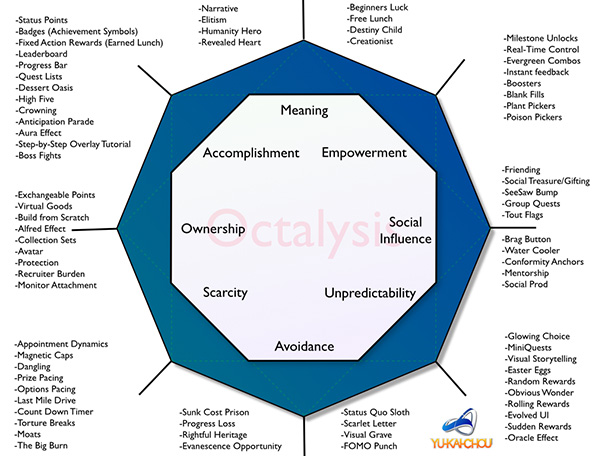
Figure 1: The OctalysisFramework
The theory is more nuanced, as users can further separatebehavior into categories such as extrinsic or intrinsic; white hat or blackhat; and long term or short term. But Chou stresses that even at the most basiclevel, learning executives can employ the Octalysis Framework tool to analyze and score their own gamification initiatives. They can then harness this information to drive higher usermetrics and alter workplace behavior.
“The tool allows people to not only understand behavior, butcreate the right type of behavior,” Chou says.
Although there are five levels in his Octalysis Framework, Chounotes that level one is usually sufficient for the vast majority of companiestrying to create a better-designed gamified product and experience. “Higher-levelOctalysis processes are really there for organizations that are truly committedto making sure that they push their metrics in the right direction whileimproving longevity of a gamified system,” he says.
Background
Chou, who has launched several Silicon Valley technology firms,was once an obsessive gamer. After retiring his controller, he began ponderingwhy certain games are so addictive. “There are a lot of studies as to why gamesappeal to our brains so much, when we know there are other things we should bedoing,” he says. “Games such as AngryBirds have no real purpose and don’t really accomplish anything, yet we canspend five or seven hours a day playing them.”
Four years ago, he stepped down as CEO of his last startupand began writing about gamification. He introduced the Octalysis Framework on hisblog, which went viral on Twitter. His theory was translated into more than adozen languages, and Chou began receiving invitations to present workshops aroundthe world. Fans urged him to compile a book.
ActionableGamification is an authoritative source that fully explains the OctalysisFramework, providing examples of how universities are using it to increasealumni donations and how companies are relying on it to get consumers topurchase more products, consume less energy, or exercise more consistently.
“Every week, I get emails from companies saying they readthe book and it tangibly helped them increase their business metrics,” Chousays.
Educators and trainers are applying the Octalysis Frameworkto learning. “One of my clients uses the Octalysis Framework to make compliancetraining more fun, while another, the University of Norway, wants to gamify itsmaster’s program to make it more interesting,” he says.
He notes that publishers in South Korea, China, Taiwan, andUkraine are in the process of translating and reprinting the book.
Cost and benefits
The Octalysis Framework is a free methodology; those who canmaster its intricacies from reading Chou’s book or blog posts can reap thebenefits at no cost. For those who prefer more personalized guidance orinstruction, Chou offers workshops, online courses, and private consultations.
Chou, who has worked with many chief learning officers,believes the Octalysis Framework can aid them in numerous ways. It can help seniorlearning professionals understand how the mind works and how to drive long-termmotivation. It can also provide insight into why a particular training program mighthave failed at an enterprise.
“A lot of clients come to me and say, ‘We added acompetition leaderboard design to our training program. It drove a short-termobsession, but after six months people burned out or stopped trying, especiallyamong the mid- to bottom tier,’” Chou says. “Through Octalysis they can betterunderstand exactly why that happened, and could have saved six months of wastedtime.”