
Dixon Hughes Goodman, a large CPA firm, counted on gamification to improve theproject management skills of its auditors. The Charlotte, North Carolina–basedcompany has 34 offices, primarily in the Southeast, with revenue in excess of$330 million. The firm employs more than 1,200 professionals, approximately 500of whom are in the firm’s audit services practice.
Business challenge
Inefficient service delivery isa common problem in the accounting industry. Dixon Hughes Goodman determinedthat a main culprit at the firm was its auditors’ poor project managementskills. The firm turned to consultants Jerry Gschwind, Michael Ramos, and The Training Associates todeliver a solution that would sharpen the project management skills of itsauditors and improve the overall profitability of the organization.
Solution design
The client initially requested atraining class, but then wondered whether a classroom learning experience alonewas really going to drive behavior and make a difference. “They realized theycould do more. That’s how we got started with the gamification piece,” Ramossaid.
Ramos and his team created TheChallenge (Figure 1), which applied game-like elements to engagement management.Auditors could accumulate points by successfully completing best-practiceactions.
“They [auditors] did their work,applying the engagement-management practices like they were supposed to do,”Gschwind said. “Throughout the process, they were encouraged to submit onlineforms describing the actions they took. Managers reviewed the forms, approving demonstratedbest practices. Each best practice was worth a different number of points, dependingon the difficulty. The points could later be exchanged for prizes.”

Figure 1: The Challengeencourages auditors to employ best practices of engagement management
The company launched itscampaign in December 2015, beginning with a mandate for employees toparticipate in a series of webcasts detailing best practices of engagementmanagement. More than 90 percent of the auditors complied. Participation in TheChallenge, which ran for six weeks, was voluntary. At its conclusion, theconsultants measured and compared active players to the control group ofauditors who chose not to participate. They examined key metrics such asawareness of engagement-management skills, frequency of application, andengagement efficiency.
Results
A survey conducted immediatelyafterward showed that participation exceeded expectations in all categories,and that key corporate objectives were met (Figure 2). The Challenge droveawareness and application of project management best practices, and providedleadership with insight into how staff members manage audit engagements.
An engagement is defined as aproject, and auditors typically work on several engagements concurrently. Thecompany had hoped for 75 – 100 engagements during the six-week period; itactually tracked more than 200. The firm expected 30 – 40 employees to activelyparticipate in The Challenge; 112 registered as active players, making at leastone best-practice submission. And while the company was anticipating 400 – 600best-practice submissions, it actually received 2,464—four times what itexpected.
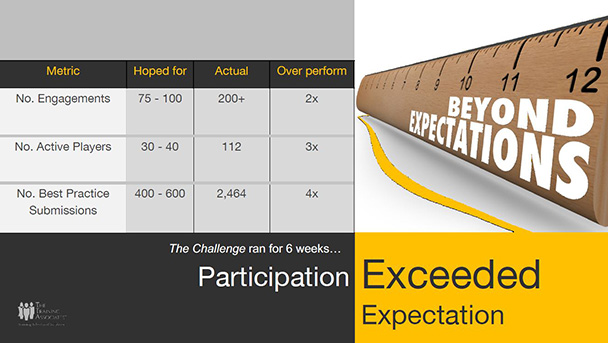
Figure 2: The Challenge exceededexpectations in all categories
Survey results found that Challengeplayers were 17 percent more likely than nonplayers to increase the frequencyof engagement-management best practices, and 45 percent of managers whose teamsparticipated observed the application of engagement-management best practices. Challengeplayers were 18 percent more likely to report an improvement in engagementefficiency, while 42 percent of managers whose teams participated reported animprovement in efficiency.
Participation
When submitting a best practice,employees were encouraged to share their actions with co-workers. If an auditorestablished a budget for an engagement (a company best practice), he or shecould upload the document to serve as an example to others. Blog posts in thecompany newsletter celebrated Challenge activity.
Individual employees, teams, andoffices competed against one another for points. Although the Asheville, NorthCarolina office is one of the smaller Dixon Hughes Goodman branches, it boasteda large number of participants and won the team challenge.
While Ramos and his team did notanalyze results based on auditor demographics such as age or gender, data wasseparated by job title and position within the company. Categories includedstaff associate, senior associate, manager, and partner/director (Figure 3).All segments enthusiastically participated in The Challenge.
“What we discovered is thatpeople across the board played, and that everyone who played benefited,”Gschwind said. “We got surprisingly good participation from the partners.”
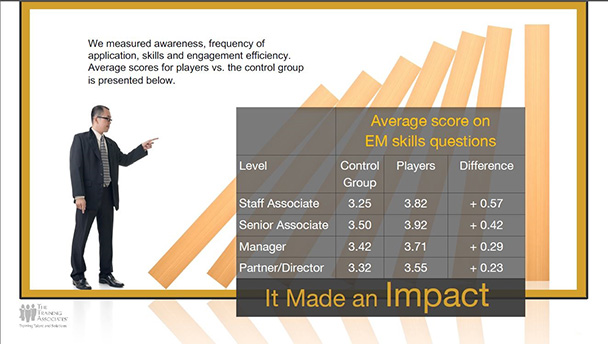
Figure3: Employees at every level in the company played andbenefited
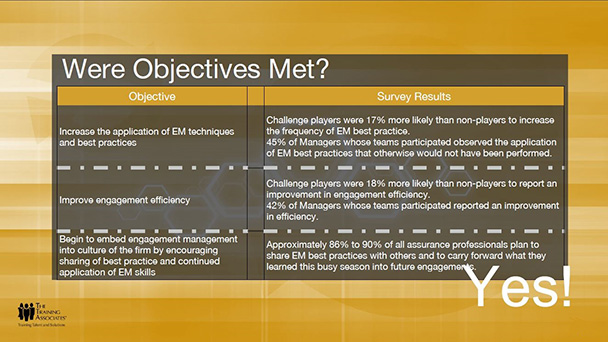
Figure4: Company objectives were met
Key takeaways
In addition to meeting keyobjectives, operational insights gained by Dixon Hughes Goodman included thefollowing:
- Most project management risks are related to clientmanagement issues
- Although staff understands the importance ofproject management skills, application of them is inconsistent across the firm
- There could be further improvement in theapplication of technology-enabled best practices
- The staff could benefit from additional trainingto help differentiate between technical audit risks and engagement-managementrisks
Want more?
Join us at FocusOn Learning 2017 Conference & Expo, June 20 – 22 in San Diego, California,for sessions with strategic and executive focus, such as How Gamification, Video, and Mobile Can Help Organizational Change: A Case Study.