 In the mid-1990s, I was hired as an instructional designerat an educational software start-up. The company’s vision was to blend story,character, and game interactivity with educational objectives. Essentially, a “Hollywoodmeets education” approach.
We wanted to engage kids, and motivate them to extend theirin-school learning day with use of the engaging software on a school-providedSony PlayStation at home. Our target audience was primarily low-income, non-native-English-speakingchildren. The students engaged with the characters and played games thatreinforced their learning at school. They were motivated to learn.
And then something interesting happened. Drawn in by the charactersand stories created by Hollywood professionals, parents of these children beganto use the lower elementary level software to improve their own literacyabilities. (The start-up company, Lightspan, merged with PLATO in 2003.)
The power of stories
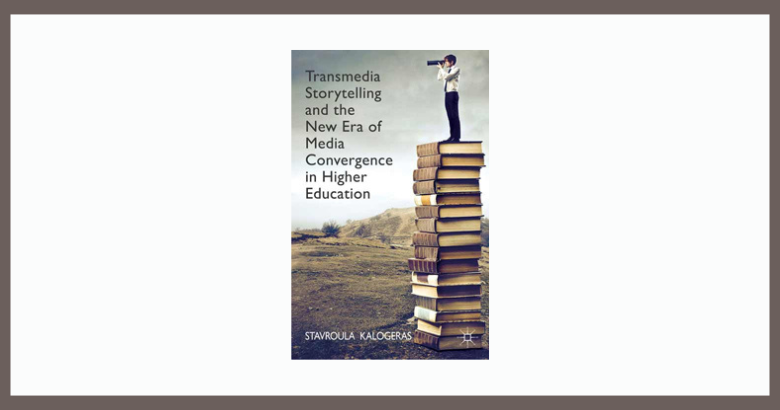
I was frequently reminded of the power of story andcharacter while reading Stavroula Kalogeras’s book, Transmedia Storytelling and the New Era of Media Convergence in HigherEducation. This self-described “scholarly exploration that combine[s]theory and practice” centers on the time-honored use of storytelling as a formof instruction, specifically in the higher education realm.
The book recounts the author’s journey to “discover a styleof teaching and learning that would be appropriate to the digital age.” Thatjourney is facilitated by significant amounts of literature review and theauthor’s own qualitative research, to ultimately define and describe the use oftransmedia storytelling edutainment (TmSE) in higher education. That is, theuse of multiple media platforms to engage learners in rich stories for thepurpose of learning.
Drives toward transmedia: the familiar and the controversial
The book begins with a significant amount of background. Diversechapters present impressive amounts of literature review to frame the author’sideas around topics that include media convergence, transmedia storytelling, andthe use of fiction as an instructional device. I benefitted by developing adeeper understanding of forces outside of education that are pushing educationtoward transmedia, and the likely use of storytelling as well.
Learning designers who read this book will encounter the familiarand, on occasion, the controversial. Not surprisingly, Kalogeras draws heavilyon cognitivism and constructivist theories as she makes connections between thenarrative structure of stories and the tenets of cognition. Her emphasis ongaining and sustaining the learner’s interest, and establishing relevance, willalso resonate with those familiar with John Keller’s ARCS model of motivationaldesign. The book succeeds in making connections between familiar theories,ideas, and models, and the use of storytelling as an instructional device fortechnology-delivered instruction.
Kalogeras suggests that the foundation for her work islearning styles. In Chapter 1, she describes how the education systemchallenged her. “I had suffered under the traditional model of educationbecause my learning style, which was visual, and then kinesthetic and auditory,was not accounted for.”
Much later in the book, she briefly acknowledges the currentarguments against learning styles, and the lack of empirical evidence. Yet,after terming these arguments “disturbing,” she offers little to defend herreliance upon learning style as the impetus for this work. While embracing manyeducation-related theories—and many others residing in the communication andmedia disciplines, the author eschews Sweller’s cognitive load theory. Sheasserts that extraneous cognitive load in the form of the “seductive details”is what engages learners.
These elements of Kalogeras’s work certainly activated mythinking. But they also left me longing for more discussion, research-basedevidence, or findings from the author’s own study described in the book, toreinforce the assertions.
Guidance for incorporating transmedia
The final chapters of the book turn toward application. Itis here where learning practitioners seeking guidance for incorporating a transmedia,story-based approach to eLearning will find some helpful examples and limitedguidance. This includes the author’s transmedia storytelling framework andguiding questions for developing or reviewing existing story-based assets forinclusion in training courses.
The first appendix provides a three-unit outline of theauthor’s eLearning course, DigitalHIStorytelling: Exploring the Trojan War. This eModule provides a living exampleto instantiate the theory and concepts discussed throughout the book. Inaddition, the author has thoughtfully provided online access to her screentext The Goddess Within. I recommendreviewing the online screentext first to establish some prior knowledge, andthus facilitate your reading of the book.
A scholarly work to ignite thinking
As the title implies and the author asserts, this is firstand foremost a scholarly work that targets the use of transmedia storytelling inhigher education. The book delivers on that commitment, and provides much inthe way of theory and concept to ignite the reader’s thinking around the topic.The author provides a compelling argument that addresses the “why to” oftransmedia storytelling in higher education, and a limited amount of guidanceregarding the “how to.”